Friday, October 17, 2025

Where War Destroys, Hope Still Builds

Where War Destroys, Hope Still Builds

Ukraine Salesian Superior Tells of His Province after 3 Years of War


(ANS – Turin – October 17, 2025) 
- Tormented Ukraine has the entire Salesian community among its good Samaritans. They take care of those who suffer most and reach even where flags cannot fly, where loneliness and abandonment create a dramatic silence. Recounting the circumstances of the Salesians and the Ukrainian population some 3½ years after the start of the Russian invasion is Fr. Mykhaylo Chaban, superior of the Salesian Vice Province of the Greek-Catholic Rite in Ukraine, who has recently been in Turin to participate in the first profession of a Ukrainian novice formed there in recent years.

Fr. Chaban told operators of Missioni Don Bosco of a daily life made up of hardship and fear, certainly, but above all of commitment, dedication, tenacity, resilience, dignity, and hope. That hope that was further renewed by the profession of the Ukrainian novice.

“It was a great celebration because the young novice became a Salesian. He is one of the young men who came to know the charism thru his involvement in the various youth activities we propose: courses for leaders, oratory, summer meetings. This event also gives hope that this commitment will continue, that it will be successful. Right now, we Salesians are trying to do all we can for education in schools, vocational and academic. We have after-school centers, a children’s home, sports activities for children and for people who have suffered amputations due to the ongoing war.

“We want to do as much as we can to give these young people moments of joy and happiness, even though the war limits us a lot, but we try to ensure safety for all our guests first and foremost. Russian attacks happen mostly at night, but they also happen during the day: the protection of the spaces where we welcome young people, therefore, is an important element of the service we render to them.”

Families from the eastern regions of Ukraine continue to arrive in Lviv, in the west of the country. Towns and countryside are being attacked by Russian forces and refugees are arriving and looking for safer places, says the Salesian superior.

“We also see everything through the eyes of our Fr. Andry Bodnar, who continues to stay with those families in the small center made up of modular houses that we have called Mariapolis: about 250 children, many elderly people, and many disabled people live there. And the number of guests never goes down, because for everyone who leaves, someone else arrives.”

The Salesians try to offer various activities, continually improving and expanding the service according to need: this year they have managed to give moments of joy to the elderly as well, and along with the children and minors who are usually taken for a few days’ holiday in the mountains, they have also brought the elderly, distancing them at least for a while from the daily anguish of war.

The Salesians continue to provide food for 350 people, the most vulnerable: the elderly, the sick, the disabled, and the poorest families with children. “If we end this assistance, it will be very, very difficult for them to go without even one hot meal a day. Since they cannot work, they cannot live solely on the small state economic support.”

The people want to return to normal life. They continue to work even in areas where the land may be mined, so the land is cleared and production is resumed. The Salesians, thanks to missionaries Fr. Oleh Ladnyuk and Fr. Gregory Shved, continue to bring foodstuffs every month to the border areas where families live who have lost their jobs, have nothing, and can barely survive.

In conclusion, Fr. Chaban mentions a not minor detail: in a significant effort of mutual solidarity among the needy, among the volunteers who prepare those parcels there are also the children who are guests of the Salesian family home in Lviv.

For more information, please visit: www.missionidonbosco.org 

Salesian Missions Helps Ship Medical Supplies for African Clinic

Salesian Missions Helps Ship Medical Supplies for African Clinic


(ANS – Bangui, Central African Republic – October 16, 2025)
 – Salesian missionaries in Bangui had the supplies needed for a medical clinic thanks to a shipment of goods funded in part by Salesian Missions of New Rochelle. The shipment was sent by Collaboration Santé Internationale (International Health Collaboration), a Canadian organization focused on responding to the needs of health centers in developing countries. 

Funding for the shipment was provided by both Salesian Missions and Don Bosco Foundation Paris. The shipment contained electric hospital beds, neonatal incubators, exam tables, filing cabinets, lab coats, amoxicillin, quinine, first aid supplies, and vitamins. 

The medical clinic was completed with funding from the French government through Don Bosco Foundation Paris. Don Bosco Foundation Paris requested assistance from Salesian Missions with funding for the shipment and also because it has extensive experience in shipping humanitarian aid around the globe. 

“Partnerships help ensure that medical supplies and other critical humanitarian aid reaches those most in need,” said Fr. Michael Conway, director of Salesian Missions. “While education is the priority for Salesians around the globe, they also focus on ensuring that those in poverty have their basic needs met including essential medical care.”

Since 1996, Collaboration Santé Internationale has been the only nonprofit and international cooperation organization accredited by the Quebec Ministry of Health and Social Services to recover and give a second life to surplus health care supplies for humanitarian aid purposes. Since its founding, the organization has sent the equivalent of $250 million in medical equipment, supplies, and medicines to support several hundred health centers in more than 90 countries.

The Central African Republic is one of the poorest countries on the African continent — despite being very rich in resources such as uranium, gold, and diamonds. It is also very unstable politically due to the regime changes and civil wars that have occurred over the last 20 years. According to the World Bank, in 2024, approximately 71% of people lived below the international poverty line, with 65.7% living on less than $2.15 per day. The infant mortality rate is among the highest in the world, and the most common causes are diseases such as malaria, diarrhea, respiratory infections, and acute malnutrition. 

Thursday, October 16, 2025

Homily for Thursday, 28th Week of Ordinary Time

Homily for Thursday
28th Week of Ordinary Time

Oct. 16, 2025
Rom 3: 21-30
Christian Brothers, St. Joseph Residence, N.R.

Moses with the 10 Commandments
(Philippe de Champaigne)

“The righteousness of God has been manifested apart from the law” (Rom 3: 21).

Paul addresses humanity’s ultimate question:  how do we establish and maintain a right relationship with God?  How are we justified, i.e., made just or made holy?

The 1st way I posed that question is false.  The 2d is true.  We can’t establish a right relationship with God, i.e., it’s beyond our power.  No one can keep the law perfectly.  No one is just; everyone’s a sinner.  We’re all on the outs with God and deserve condemnation.

Instead, God has “freely justified [human beings] by his grace thru redemption in Christ Jesus” (3:24).  God has issued an executive pardon, sealed by the blood of Christ (3:25).  He forgives; not only forgives, but even makes people holy.  God’s righteousness is so great in itself that it “justifies the one who has faith in Jesus” (3:26).  God shares his own holiness with us thru our relationship with Christ.  What matters, we could say, almost flippantly, isn’t what we know—the law—but whom we know:  Jesus.  The forgiveness of sins is an act of grace or of mercy, not something we’ve earned.

Something St. Augustine preached is apropos:  “It’s not as if a good life of some sort came first, and that thereupon God showed his love and esteem for it from on high, saying: ‘Let’s come to the aid of these people and assist them quickly because they’re living a good life.’  No, our life was displeasing to him; whatever we did by ourselves was displeasing to him; but what he did in us was not displeasing to him.  He will, therefore, condemn what we’ve done, but he’ll save what he himself has done in us.”[1]

In our Eucharist, then, we thank God for what he’s done and continues to do in us thru his Son, our Lord Jesus Christ.


[1] Sermon 23A, in LOH 4:188.

Wednesday, October 15, 2025

Homily for Memorial of St. Teresa of Avila

Homily for the Memorial of
St. Teresa of Avila

Wednesday, Week 28 of O.T.
Oct. 15, 2025
Rom 2: 1-11
Salesian Missions, New Rochelle, N.Y.

The Ecstasy of St. Teresa
(Bernini)

“The kindness of God would lead you to repentance” (Rom 2: 4).        

Both Scripture readings today challenge us to be aware of our sins.  St. Paul cautions against judging others when we are sinners ourselves, and he warns us that “God will repay everyone according to his works” (2:6)—with either eternal life, glory, and honor, or with divine wrath, affliction, and distress (2:7-9).  Jesus faults the scribes and Pharisees for loving themselves more than they love God and their neighbor.

St. Teresa of Avila entered a Carmelite convent as a young woman and for 18 years lived as a very ordinary nun, not evil but more interested in conversation than in conversion of life.  Then she did experience conversion and realized that she must be fired with love for our Lord Jesus rather than for herself or even for others.  She repented of her mediocre life and made Jesus her center, her focus.  “The name of Jesus was fixed and embedded” in her heart.[1]  She tells us in her autobiography that she recognized 2 fundamentals:  “All things of this world will pass away,” and God alone is forever.  She retained her lively personality and continued to enjoy human company; but she took Jesus as her closest friend.

It’s Jesus’ desire that every one of his followers should be a dear friend.  He loves us with a love that sacrificed himself to wash away our sins and lead us to eternal life, glory, and honor at his side.  “Love calls for love in return,” Teresa wrote.[2]  So we speak to him in prayer as to a friend, when we’re happy and when we’re afflicted, and we long for his company.  We strive to love others as he did, with patience, kindness, and generosity (cf. Rom 2:4).  We place ourselves completely in Jesus’ hands.

St. Teresa urges us: “Let nothing disturb you.  Let nothing frighten you.  Whoever has God lacks nothing; God alone suffices.”


[1] Cf. excerpt from her Autobiography, ch. 22, Liturgy of the Hours, 4:1484.

[2] Ibid.

Tuesday, October 14, 2025

Ecuador Province's Documentary on Sr. Maria Troncatti

Ecuador Province’s Documentary 
on Sr. Maria Troncatti, FMA


(ANS – Rome – October 14, 2025) 
– While the Daughters of Mary Help of Christians Provinces of Lombardy (Italy) and Peru have produced some very useful informative and popular aids in view of the canonization of Sr. Maria Troncatti, the FMA Province of Ecuador – which had the grace of welcoming and experiencing the maternal, missionary, and reconciling presence of Sr. Maria – could not do less.  That province has produced an agile but very effective documentary that recounts her life and apostolate in a compelling manner.

The audiovisual portrays the life and missionary commitment of Sr. Maria Troncatti, FMA, who from 1922 dedicated her life to service in Ecuadorian Amazon, accompanying with deep faith and love both the settlers who had settled in the region and the indigenous Shuar people, offering not only medical and educational care, but also a living witness to the Gospel.

In the video, lasting about 20 minutes, the transforming power of her gestures, her expression of faith, and her radical choice in favor of the poorest are recounted. Through graphic elements, animated historical photographs and various scenes, the significant moments of her mission are recreated, emphasizing her ability to respond to real situations in accordance with Gospel values.

The documentary was presented for the first time on the eve of her liturgical feastday, August 24, in the city that saw her at work as a missionary more than any other, Sucua, at city hall: a place that preserves the memory of the Salesian Blessed’s missionary dedication.

The preview was attended by Daughters of Mary Help of Christians from different communities of the country, Bishop Nestor Montesdeoca of the vicariate apostolic of Mendez, Dr. Sebastian Rodriguez, mayor of the canton of Sucua, Salesians of Don Bosco, other members of the Salesian Family, local officials, young people, religious sisters of the vicariate, and friends of the Salesian work.

On the occasion, the FMA provincial, Sr. Lupe Erazo, emphasized that Sr. Maria Troncatti, nourished by grace, was “a tireless messenger of the Gospel, an expert in humanity, and a profound connoisseur of the human heart,” capable of transforming prayer into apostolic energy and concrete service to others. “We can say that she lived the Salesian ‘I will go’ generously, devoting herself unreservedly to the mission entrusted to her,” Sr. Lupe said.

This short documentary, Sister Lupe added, “is much more than a collection of images and memories: it is an invitation to contemplate closely the heart of a woman who knew how to respond to pain with tenderness, to conflict with peace, and to adversity with faith.”

The audiovisual production ultimately aims to make known the life and witness of a woman who followed Christ in the style of Don Bosco and St. Mary Mazzarello and continues to be a sign of hope for the Church and society today.

The documentary Sister Maria Troncatti, a life in mission is available on the YouTube channel of the FMAs of Ecuador in two languages, Spanish  and Italian.

For more information, visit the site specially created for the canonization of Sister Maria Troncatti: https://www.mariatroncatti.org/ 

Homily for Christian Brothers' Jubilees

Homily for the Jubilees of the
Christian Brothers’ Entrance

Oct. 14, 2025
Collect
Col 3: 12-17
Mark 10: 24-30
Christian Brothers, St. Joseph’s Residence, N.R.

We prayed that we may give thanks to God for his kindness toward our brothers—toward Conan, Donald, Marion, Antonio, Jude, and Anthony—and that they renew their gift of self to him and be strengthened in their pursuit of perfect charity (Collect).

They began their pursuit, which is nothing else than the following of our Lord Jesus, 60, 65, and 70 years ago.  What a lifetime!  What a gift from Jesus to them, to us their brothers, and to innumerable young people over those 6 and 7 decades.  “It is good to give thanks to the Lord” (Ps 92:2).

Paul urged the Church at Colossae to clothe themselves with love (Col 3:14).  So vested, they’d be able to practice every virtue we see in Christ:  “compassion, kindness, humility, meekness, and patience” (3:12).

We spend a lifetime trying to do that, and we admire the men who keep at it day in and day out, year after year, decade after decade.  “For human beings, it’s impossible, but not for God” (Mark 10:27).  Reason to thank God, then, for empowering our brothers to keep at it and to pray they may continue to persevere, and that we all may do so, “now in this present age” until we attain “eternal life in the age to come” (10:30).

Monday, October 13, 2025

Melanesia's First Saint, St. Peter To Rot

The Path toward the Canonization of Melanesia’s First Saint: St. Peter To Rot

Papua New Guinea – The path towards the Canonisation of Melanesia's First Saint: St Peter ToRot

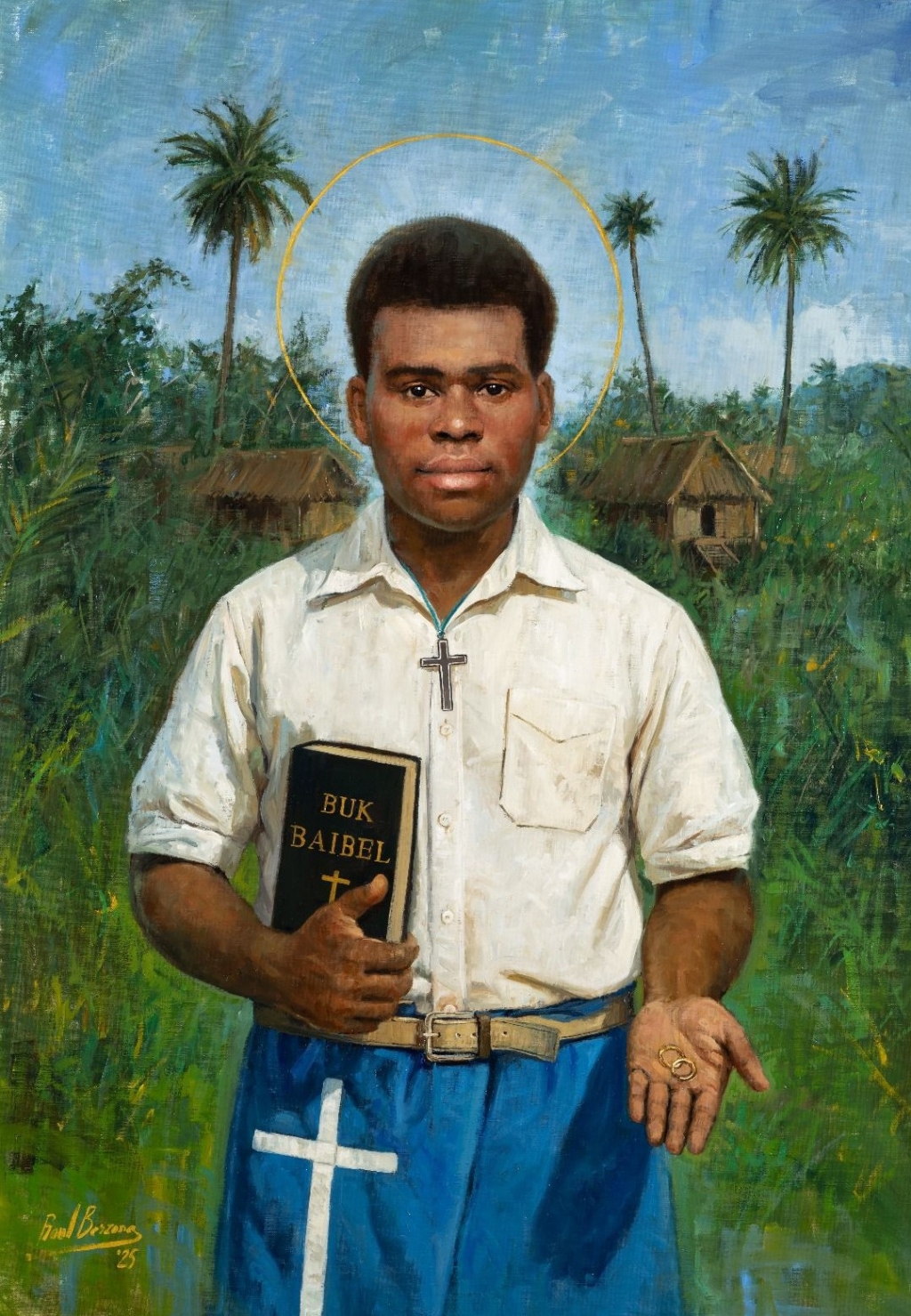
(ANS – Port Moresby – Papua New Guinea – October 13, 2025) - On Sunday, October 19, besides Blessed Maria Troncatti, FMA, 6 other blesseds will be canonized.  One is Papuan layman and catechist Peter To Rot, who will be the first saint for the Church of Melanesia, and a source of further joy and pride for the flourishing local Salesian Family.

Pope St. John Paul II beatified Peter To Rot on January 17, 1995 in Port Moresby.  After his beatification, many miracles were attributed to his intercession.  His reputation for holiness is now widespread in Oceania.

The cause for his canonization had been at a standstill for many years, however.  One of the major difficulties was the oral culture of Papua New Guinea.  It’s very difficult to document the requested miracle, because there are few hospitals that can provide the scientific documentation needed to prove an alleged miraculous healing, and because the culture of the local population is mainly based on oral communication, making it difficult to record any miracles in writing.  The bishops of Papua New Guinea and Solomon Islands requested that the miracle required for canonization be dispensed with.

On March 22, 2024, Pope Francis granted a dispensation from the formal process of canonization, for which the Church requires a regular investigation and the corresponding miracle.  Through this dispensation, the Pope, after careful examination, recognizes a devotion that has already existed for some time, without waiting for the recognition of a miracle.  Pope Francis did the same in the case of John XXIII, who was canonized on the basis of his decades-long worldwide reputation for holiness, without a 2d miracle being recognized (after his beatification).  In his first consistory, Pope Leo XIV set the canonization of Pieter To Rot, together with the other blesseds, for World Mission Day on October 19, 2025.

Born on March 5, 1912, Peter was educated in the Christian faith and became a catechist; his life was characterized by charity, humility, and dedication to the poor and orphans.  During the Japanese occupation of Papua New Guinea in World War II, Peter continued to prepare couples for marriage while the missionaries were imprisoned.  When his pastoral activities were banned, he continued his apostolate in secret, fully aware that he was risking his life.

Peter To Rot’s Eucharistic devotion is also extraordinary.  He took the Eucharist to his people while the missionaries were prisoners of the Japanese imperial army.  He staunchly defended the sanctity of marriage and opposed the practice of polygamy, even confronting his older brother, who had taken a second wife.  The latter reported him to the Japanese police, and Peter was sentenced to two months in prison, where he died of poisoning by the Japanese military in July 1945.

Peter To Rot was a Melanesian.  The Catholic faith was deeply enculturated in him.  He exercised his ministry as a catechist with deep respect for his cultural heritage and in a manner that resonated with his community.  But he didn’t hesitate to challenge traditional practices contrary to the teachings of Jesus Christ.

Peter To Rot’s journey of holiness is a powerful confirmation of what St. John Paul II wrote in the post-synodal exhortation Ecclesia in Oceania, no. 10: “The way of Jesus is always the way of mission; he now invites his followers to proclaim the Gospel anew to the peoples of Oceania, so that culture and the preaching of the Gospel may meet in a mutually enriching way and the Good News be heard, believed, and lived more deeply.”

The official portrait of Peter To Rot, which will be used for the canonization, was created by renowned Spanish artist Raul Bersoza Fernandez.

The canonization of Peter To Rot is also an invitation to the whole Salesian Society and Salesian Family to grow in awareness of the Church in Oceania, particularly in Melanesia, where 51 sons of Don Bosco in 9 presences in Papua New Guinea and the Solomon Islands make up the Blessed Philip Rinaldi Vice Province.

Also present in Melanesia are the Daughters of Mary Help of Christians (FMAs), the Salesian Cooperators, the Don Bosco Volunteers (DBVs), the Association of Mary Help of Christians (ADMA), the Sisters of Charity of Jesus (SCG), the Association of Past Pupils of Don Bosco (EX.DB), the Past Pupils of the FMAs (EX.FMA), and the Missionary Sisters of Mary Help of Christians (MSMHC).

Sunday, October 12, 2025

Homily for 28th Sunday of Ordinary Time

Homily for the
28th Sunday of Ordinary Time

Oct. 12, 2025
2 Kgs 5: 14-17
Luke 17: 11-17
The Fountains, Tuckahoe
Our Lady of the Assumption, Bronx
St. Francis Xavier, Bronx

Naaman bathing in the Jordan

“I will no longer offer holocaust or sacrifice to any other god except to the Lord” (2 Kgs 5: 17).

Thus says Naaman, a Syrian general, a pagan, after he’s been cleansed of leprosy by washing in the Jordan River as instructed by Elisha, prophet of the Lord.  When you get home, go to your Bible and read the whole story in 2 Kings 5.  Just now, you’ve heard only the end.

Did you notice that Naaman asked to be allowed to load 2 mules with Israelite dirt?  In the ancient world, people believed that each nation had its own gods—the Philistines, the Syrians, the Egyptians, the Babylonians, etc.  Gods ruled particular territory but were powerless outside their own boundaries.  Thus the Israelite God, who revealed his name YHWH to Moses, usually rendered simply as “Lord” in caps in our English translations, governed and protected the tribes of Israel in their own land.  By taking Israelite dirt back to Damascus with him, Naaman will have some of that land that belongs to the God of Israel, and he can worship him properly.

It would take a long time for people to understand that there’s only one God who created everything and rules everywhere.  Even when the prophets foretold the day when all the nations would seek YHWH, the Jews were slow to believe that the Lord cared about those others, the goyim.  In the gospels, we see Jesus gradually reaching out to those nations—to Samaritans, to Romans, to Greeks outside the boundaries of Galilee and Judea.

Naaman’s story links to that of the 10 lepers healed by Jesus, not only because both involve the healing of lepers and not only because both involve non-Jewish foreigners.

Jesus healing 10 lepers
(Fresco by Grisopolo, baptistery of Parma)

The 10 lepers realize they’ve been healed while they’re on their way to find the nearest priest.  Priests could live anywhere in Jewish territory, not only near the Temple in Jerusalem.  We see one prominent example of that in Zechariah, the father of John the Baptist (Luke 1).  The priest will certify that they’re clean of leprosy, as Torah commands (17:14), and thus can return to their families and their communities.

One of the 10 goes back to Jesus; we’re not told whether he’s already presented himself to a priest, only that he’s the only one to come to Jesus to say thank you.  Jesus seems displeased that only one returns to give God public praise and thanks (17:15-18).  “Where are the other 9?” he asks.

Dear friends of God, that’s one reason why we come publicly every week to celebrate the Eucharist.  Eucharist means “thanksgiving.”  We thank God for cleansing us of our sins thru Christ our Lord.  This is the mystery of faith that we acclaim.  It’s our faith in Jesus that saves us, and we need to give God credit for that.

All 10 lepers were cleansed.  Only the one who came back to Jesus was blessed to hear, “Your faith has saved you” (17:19).  We aren’t to suppose that the 9 cleansed lepers were un-healed because they didn’t return.  Rather, Jesus’ words suggest a deeper level of healing, a more profound salvation.  Jesus heals bodies thruout his public ministry, overcoming paralysis, blindness, leprosy, and other illnesses, and even death in 3 recorded instances.  “Your faith has saved you” means more than that.  Jesus offers us more than physical health.

Jesus is the sacred soil of Israel, more sacred than what Naaman hauled to Damascus.  Grounded on Jesus, we can truly worship YHWH.  “Thru him, with him, and in him,” we give all glory to God our Father, and this faith saves us for eternal life.

Thursday, October 9, 2025

Homily for Thursday, Week 27 of Ordinary Time

Homily for Thursday
27th Week of Ordinary Time

Oct. 9, 2025
Mal 3: 13-20
Christian Brothers, St. Joseph’s Residence, N.R.

Will Kane takes out Frank Miller and wins his girl (in High Noon).  Shane takes out Jack Wilson and rides off alone.  John Wayne takes out more high-powered bad guys than anyone can count.  Frodo destroys the ring and saves Middle Earth.  The Jedi take on the Empire and save the universe.

Reality is more complicated.  The prophet Malachi addresses the reality that evildoers prosper and God’s people hesitate to fear the Lord and listen to him (3:15-16).

Malachi
(Duccio di Buoninsegna)
Malachi, one of the last Old Testament prophets, is not a comfortable prophet.  Even after the Jews have been thru defeat, destruction, exile, and return to a ruined country, they aren’t completely faithful to their covenant with the Lord.  Malachi warns, “Lo, the day is coming, blazing like an oven” (3:19),  and he promises “the sun of justice” will arise and God will put everything right, punish evildoers, and reward the just (3:19-20).

When John the Baptist was born, Zechariah prophesied, “You, child, … will give his people knowledge of salvation …, of the tender mercy of our God, by which the daybreak from on high will visit us to shine on those who sit in darkness and death’s shadow…” (Luke 1:76-79).  That “daybreak from on high” is the “sun of justice,” our Lord Jesus, the dawn that drives away the darkness of our lives, purifies our hearts, and shows us how to make the situation of men and women even on this earth more just and more tranquil.

At the end of one of his parables about persistence in prayer, Jesus asks, “When the Son of Man comes, will he find faith on earth?” (Luke 18:8).  We affirm that on the Last Day we shall indeed “see the distinction between the just and the wicked, between the one who serves God and the one who does not” (Mal 3:18), and so we persist in fear of the Lord (3:20), in “keeping his command” (3:14), in the fundamental prayer of the Book of Revelation:  “Come, Lord Jesus!” (22:20).

Wednesday, October 8, 2025

The Miracle for Sister Troncatti's Canonization

The Miracle That Paved the Way for Sister Troncatti’s Canonization


(ANS – Rome – October 8, 2025) 
- If Sister Maria Troncatti, FMA, will be canonized 2 Sundays hence, on October 19, along with several other blesseds, it’s due not only to her docility to the action of the Holy Spirit thruout her life, but also to the recognition of the supernatural nature of the healing of Shuar Juwà Bosco – an extraordinary event that testifies to the value of prayer and entrustment to God. This was the miracle that paved the way for her canonization.

The beneficiary was Juwa, an indigenous Shuar from the community of Nunkui Nunka, Ecuador. Born in 1975 in Tuutin’entsa in the province of Morona Santiago, he is married to Natalina and father of 6 children and is a farmer and carpenter by profession. On February 2, 2015, at 10:00 a.m., he was working in the Amazon rainforest to sharpen the blade of his machine, and a piece of the grinder broke off, hurling a large stone fragment at the front right side of his head, causing a deep skull fracture with the loss of brain matter.

He was immediately rescued by his son and two associates, and later by a nursing assistant from the Nunkui Nunka Health Center, who alerted the Taisha Hospital to send an air ambulance. A stretcher was improvised and, after crossing the Macuma River in a canoe, they arrived at the Yasnunka airstrip after half an hour.

Juwa was in a very serious condition. He arrived by helicopter at the Macas hospital where, after first aid, he was referred to the hospital in Ambato. He arrived there at 5:30 p.m. He was diagnosed with an “open encephalic head injury, with exposure of brain tissue, in Glasgow 6T over 15”. The neurosurgeon immediately pointed out that the situation was very serious and life-threatening.

After the operation, Juwa was taken to intensive care: the diagnosis was left hemiplegia and absence of speech, and a depressed area 12 cm in diameter and 5 cm deep remained in the right side of the skull. On February 18 he was discharged and taken to a rented house in Macas. His brothers-in-law, even before the operation, had entrusted him to the intercession of Blessed Maria Troncatti, together with the educating community of the Daughters of Mary Help of Christians of Tuutin Entza, Juwa’s home town.

In addition, a large painting of the Blessed was placed in the room in Macas, in front of Juwa’s bed, and the family encouraged him to entrust himself to her, who had worked so hard for the Shuar people. The family was also encouraged to pray to Sister Troncatti for Juwa’s recovery. No rehabilitation took place.

In the night between late March and early April 2015, Juwà dreamt of Sister Maria Troncatti reassuring him of his recovery. The Blessed asked him where it hurt, and with an ointment she massaged his neck and left leg. She assured him that he would be able to walk again the next day. Then she asked him why he did not speak and, with a flick of her mouth, told him that he would speak and walk the next day.

She asked him if he had a tortoise shell, because she wanted to put it where the bone in his head was missing, but Juwa lacked one. She also asked him about a picture with her image on it, which had been folded and placed in a cardboard box when he changed houses. She invited him to put the picture back in front of the bed and then bade him farewell.

Waking up, Juwa immediately had the feeling that he was cured. His leg no longer hurt. He asked his wife with signs to help him walk and said a few words. Thus began a gradual improvement.

After the dream, he experienced an unexpected change in his condition. His radical change was witnessed by his family members and those who visited him. He recovered first his speech and then his movements. On April 5, 2015, with the help of his brother-in-law, he went to the cathedral of La Purissima in Macas and returned there alone on July 6 to participate in the Eucharist.

The doctor who had operated on him was amazed, because he thought he was looking at a resurrected dead man. He saw him again in 2017 and found him perfectly healed.

Juwà is now 50 years old and is very grateful to God and Sister Troncatti, who restored his health and serenity, so much so that he now carries out his activities with absolute normality. His healing was not only physical, but integral, because since the miracle, his life has “completely changed” in his relationship with his wife and children – as he himself said in an interview.

Blessed Maria Troncatti, thru the miracle obtained from God through her intercession, confirms her vocation as a “madrecita,” a missionary for the Shuar people, to whom she had dedicated her entire existence.

The video with the interview, in Spanish, with Juwà Bosco is available here

For further information, visit the site specially created for the canonization of Sister Maria Troncatti: https://www.mariatroncatti.org/ 

Homily for Wednesday, Week 27 of Ordinary Time

Homily for Wednesday
27th Week of Ordinary Time

Oct. 8, 2025
Jonah 4: 1-11
Luke 11: 1-4
Salesian Missions, New Rochelle, N.Y.

Image from First Baptist Thomson webpage
Oct. 6, 2022

“Jonah was greatly displeased and became angry that God did not carry out the evil he threatened against Nineveh.  He prayed, … ‘I knew that you are a gracious and merciful God…” (Jon 4: 1-2).

Jonah thought the people of Nineveh, hated enemies of the Jewish people, were evil and deserved to be destroyed.  He was very upset that God didn’t do that but, instead, showed them mercy when they repented of their evil.  The whole point of the prophetic book of Jonah is to show God’s unlimited kindness, compassion, and mercy.

When the disciples asked Jesus to teach them to pray, he taught them the Our Father, including a twofold petition about forgiveness.  We ask God to grant us the mercy of forgiving our sins, and we commit to forgive “everyone in debt to us” (Luke 11:4), i.e., those who’ve hurt us in some way.

We’re all eager for God to show us compassion.  But we struggle to extend God’s mercy to others, especially the mercy of forgiveness.

In the last month we’ve witnessed 2 outstanding examples of Christian forgiveness, forgiveness offered in the aftermath of terrible evil.

The 1st example came from Erika Kirk.  In front of a packed stadium and a national media audience on Sept. 21, she forgave the man who had shot and killed her husband 11 days earlier.  She did that, she said, “because it was what Christ did.”

The 2d example came from the Church of Jesus Christ of Latter-day Saints, better known as the Mormons.  Days after a very sick man on Sept. 28 attacked a Mormon church near Detroit, killed 4 worshipers, and set the church on fire, the Mormons set up a Go Fund Me page to assist the man’s widow and child and raised hundreds of thousands of dollars for them.  That was extraordinary compassion in the name of Jesus.

With examples like that, not to mention Jesus’ very direct command to love our enemies and to forgive, the least we can do is to put vengeance out of our hearts after we’ve been hurt emotionally or physically, and to pray for the well-being of our offenders; then, by God’s grace, even to treat them with kindness.  Because that’s what Jesus did for you, for me, for the whole world.

Tuesday, October 7, 2025

Homily for Memorial of Our Lady of the Rosary

Homily for the Memorial of
Our Lady of the Rosary

Oct. 7, 2025
Collect
Jonah 3: 1-10
Christian Brothers, St. Joseph’s Residence, N.R.

The Battle of Lepanto
by Antonio de Brugada

“God may relent and forgive, and withhold his blazing wrath, so that we shall not perish” (Jon 3: 9).

On Oct. 7, 1571, a fleet of galleys—the sort of oared ships we saw in Ben-Hur—from Spain, Venice, Genoa, and the Papal States won a stunning victory over a Turkish fleet in the Gulf of Patras, off Lepanto in western Greece.  They crushed a force poised to invade Italy, where the Christian faithful—insofar as they were aware of international affairs—feared they’d perish.  Lepanto was the last sea battle involving galleys, involving hundreds of vessels on each side.  Heavily gunned sailing vessels were the future of naval warfare.

That’s a matter of history, as is the fact that Catholic Europe had been praying desperately for the expected Turkish assault to be stopped.  In particular, Pope St. Pius V urged the praying of the Rosary, and aboard the Christian galleys, so did the commander, Don Juan of Austria, half-brother of Philip II of Spain.

It’s reported that in Rome at the moment of victory, Pius V had a vision that the battle had been won.  Gratefully, he added the invocation “Help of Christians” to the Litany of Loreto and instituted the feast of Our Lady of Victory, soon changed to Our Lady of the Rosary.

Faith interprets the historical facts to agree with the Pope’s vision.  Victory is attributed to the Mother of God for inspiring the Christian battle tactics, guiding the seamanship of the commanders, causing a beneficial shift in the wind, even choosing the narrow confines of the Gulf of Patras as the place where the 2 fleets met.

As Catholic believers, we may interpret the facts of battle to say that God intervened, “withholding his blazing wrath” so that Christian Italy should not perish, as for example much of the Christian Balkans did.

The collect today, so familiar to us from the Angelus, speaks of the Incarnation of Christ, which is a faith statement—that the Son of God intervened by taking our human flesh so that humanity should not perish.  The collect speaks of Christ’s passion and cross.  His birth, suffering, and death are historical facts, like Lepanto.  Faith tells us those facts are prelude to resurrection and eternal life for all who believe in the power of his cross and cry to him from the depths of their struggles with the Devil (cf. Ps 130:1).

Mary of Bethany chose the better part by sitting at Jesus’ feet and listening to him (Luke 10:30,42).  The Virgin Mary chose the better part when she assented to Gabriel’s message (collect), prodded him to act at Cana, stood under the cross, and joined the 120 faithful disciples in the Cenacle.

When we look at our own lives, we may see how God’s grace intervened so that we might turn from, or avoid altogether, the invasion of sin and attain victory.

Monday, October 6, 2025

Homily for Monday, Week 27 of Ordinary Time

Homily for Monday
27th Week of Ordinary Time

Oct. 6, 2025
Jonah 1: 1—2: 1-2, 11
Salesian HS, New Rochelle, N.Y.


This week we’ll read most of the book of Jonah today, tomorrow, and Wednesday.  It’s one of the shortest books of the Old Testament; you read it all in about 15 minutes.  It’s a parable like the stories that Jesus tells, e.g., our gospel reading this morning (Luke 10:25-37, the Good Samaritan), only longer.

Jonah is a parable about God’s mercy, altho that’s not evident from its 1st chapter, which we heard today.

You’ve heard the saying, “You can run, but you can’t hide.”  That seems to have originated with heavyweight boxing champ Joe Louis in the 1940s, referring to his opponents in the boxing ring.  Law enforcement officers have picked it up to warn criminals they’re pursuing.

And that’s what’s happening in ch. 1 of Jonah.  He’s trying to run away far away from the Lord and the mission of mercy that God wants him to carry out.  But God pursues him dramatically, and Jonah will have no peace until he follows God’s plan.

Don Bosco always reminded young people that God sees them at every moment.  God even knows what we’re thinking.  And he has a plan for each of us.  If we want to be at peace and be happy, that will follow from our seeking to know what God wants of us, what his personal plan is for us, and not running from that plan but trying to follow it.  Otherwise, our lives might become stormy rather than peaceful—altho God won’t likely send a large fish to swallow us up and spit us out.

Something St. Augustine wrote over 1,700 years ago is fitting here.  He wrote, “You have made us for yourself, O Lord, and our hearts are restless until they rest in you.”  Deep within us, we want God and his intention for each of us.

Sunday, October 5, 2025

Homily for 27th Sunday of Ordinary Time

Homily for the
27th Sunday of Ordinary Time

Oct. 5, 2025
Luke 17: 5-10
St. Francis Xavier, Bronx
Our Lady of the Assumption, Bronx

The Unprofitable Servant
(by Eugene Burnand)

“We are unprofitable servants; we have done what we were obliged to do” (Luke 17: 10).

The little parable in today’s gospel, just 4 verses, is unique to St. Luke’s Gospel.  In it, Jesus tells the apostles they’re “unprofitable servants.”  Luke’s Greek word here, douloi, could also be translated as “slaves” instead of “servants,” and “slaves”  might better fit the social condition of Jesus’ time.

Not only is the parable unique, but some commentators also find it difficult.  As I said, Jesus is speaking to the apostles, and therefore also to us who’ve received his teaching thru the apostles.  That’s one meaning when we speak in the Creed of the Church as “apostolic”:  we profess the faith handed down to us from the apostles.

Jesus, then, is comparing us to slaves, which he does in some other places, as well, as when he tells us to be like slaves waiting for their master’s return from a wedding—an admonition to be ready for the Lord when he returns at the end of time, or the end of our individual lives (Luke 12:35-38).  At the Annunciation, the Virgin Mary called herself the doule, the “slave,” of the Lord, which our English translations soften into “servant” or “handmaid” (Luke 1:38).

It sounds harsh, indeed, to hear Jesus call us “slaves”—or “servants” at best.  At the same time, we call him “Lord” or “Master”—Dominus in Latin, from which we get the word dominate.  There’s clearly a humble relationship between us and our Lord Jesus.  He’s reminding us that when we carry out his instructions or his commands, we’re just doing what we’re supposed to do.  We have no special claim or privilege due to us when we obey God’s laws or when we practice virtue.  God owes us nothing.

That’s all the more evident when we consider our sins.  How often are we unfaithful servants because we lie, omit our prayers, speak ill of others, snap at them impatiently, think or act against purity, swipe something that belongs to another person, eat or drink greedily, ignore the needs of the poor, and so on.  Such thoughts, actions, and omissions really do make us “unprofitable slaves,” or “worthless slaves,” as some translations put it.

And yet….  In that other parable of the master returning from a wedding and finding his servants watching diligently for him, Jesus calls them “blessed” or “happy” and says that their master “will gird himself, have them recline at table, and proceed to wait on them” (12:37)—quite the opposite of what we hear in today’s parable.  The master becomes the slave—like Jesus who says, “The Son of Man did not come to be served but to serve and to give his life as a ransom for many” (Mark 10:45), like Jesus at the Last Supper when he washed the apostles’ feet (John 13:1-17).  That kind of behavior is unbecoming of a master.

Today’s gospel began with 2 verses that seem unrelated to the 4 verses of the parable:  the apostles ask Jesus to give them greater faith, and he tells them a little faith will do something impossible like transplanting a tree into the ocean.  Maybe there’s a relationship between that and our unworthiness as the Lord’s slaves.  Can we believe, do we have the faith, that Jesus thinks of us as more than slaves in spite of our sins?  That our good deeds and our virtues don’t earn us God’s forgiveness but are God’s love and mercy at work in our lives?  We can’t earn our way into heaven, but God in his gracious mercy will give us eternal life.  Yes, it takes faith to believe that God loves us and forgives our sins, and to try to return his love and to believe God has a wonderful master plan for us:  thru our Lord Jesus he wants to give us a place at his heavenly table after we’ve done our humble best to carry out his wishes while we look forward to his return on the Last Day.

Friday, October 3, 2025

Sr. Maria Troncatti, Artisan of Peace

Sister Maria Troncatti

Artisan of peace and reconciliation

Sr. Maria Troncatti in front of the Pius XII Hospital
with the SDB provincial and Bp. Dominic Comin

(ANS – Rome – October 2, 2025)
 – “Craftswoman of peace and reconciliation” is the third element of the motto chosen for the canonization of Sister Maria Troncatti, FMA, scheduled for October 19.

Highlighting this dimension of the Salesian sister, in a video promoted by the Historical-Spiritual-Liturgical Commission specially created for the canonization, is Bishop Pedro Gabrielli, SDB, bishop emeritus of the vicariate apostolic of Mendez, Ecuador.

The prelate was born on March 17, 1931, in Pove del Grappa (Vicenza), Italy. He arrived in Ecuador in 1958 and was sent to the jungle, where he worked passionately for the indigenous Shuar people and the settlers of Morona Santiago. He met Sister Troncatti in the 1960s, when she was working intensively at the Pius XII Hospital. He admired her great sense of motherhood and her self-sacrificing dedication in defense of the physical and spiritual health of everyone.

He remembers, first and foremost, “the sensitivity she had in all the activities we did at Sucua, with the teachers, with the patients, with the people.... In a word, she made herself co-responsible for all the activities that the mission promoted, for social growth and promotion.”

At the time, the social context was tense, particularly in relations between the indigenous people and the settlers, who fought over the land, the main source of livelihood for everyone at the time: “Relations, unfortunately, were not the most desirable nor the best,” he recounts. “Sister Troncatti wanted peace, and for peace, tranquility, and collaboration, I believe she gave her life, offering her existence so that there might be greater harmony and peace between the two ethnic groups.”

On July 4, 1969, a large fire was set in the Salesian house, probably by some settlers. Everything was burnt, but fortunately there were no victims.

How did Sister Troncatti react? “She reacted like a real mother,” recalls the bishop emeritus. “We left the house with what we had on us, because the flames of the fire were raging everywhere. . . . She acted with incredible promptness: she ran away in the night, despite her swollen feet and physical discomfort. She went to open the only clothes shop there was in Sucua to buy us immediately something with which to protect ourselves from the cold of the night.”

She showed an equal love and care for all, Bishop Gabrielli testifies: “For me, Sister Maria Troncatti was a true blessing. She was the benefactor, the nurse, the helper of everyone, both colonists and Shuar; everyone turned to her. Therefore, expressing one’s love and gratitude to Sister Maria Troncatti necessarily meant considering the relationships she cultivated. Sister Maria Troncatti loved the settlers and desired their good, their health, their lives. At the same time, she loved the Shuar because they were the heart of the mission, her children, and they were the object of her care and accompaniment.”

Mother Troncatti also sought help from outside so that they could help her, and she favored the work of many young volunteers of Operation Mato Grosso within the mission, for the development and growth of the indigenous population.

“She was at the service of everyone: if she could do something for the Shuar, she did it; if she could do something for the settlers, she did it. So attentive was she to all the needs that when she saw that some Shuar were not receiving treatment at the Pius XII Hospital she directed because it was too different from their environment, she immediately had two tents erected on either side of the hospital, where even the proudest natives could find hospitality.”

The video with the interview with Bishop Gabrielli, entirely in Spanish, is available here.

Thursday, October 2, 2025

Homily for Memorial of Guardian Angels

Homily for the Memorial of the
Guardian Angels

Oct. 2, 2025
Collect
Christian Brothers, St. Joseph’s Residence, N.R.

Guardian Angel Guards a Child's Sleep
(Melchoir Paul von Deschwanden)

“O God, you … are pleased to send your holy angels to guard us” (Collect).

We praise God today, and we thank him because he’s given us angels, messengers of his divine providence, to protect and guide us.  Angels appear often in the sacred Scriptures in such roles as well as bringing messages from heaven, and they continue to fill such roles in the Church.  E.g., in France they’ve just begun to celebrate the 600th anniversary of the appearance of St. Michael to Joan of Arc.

In recent decades, we’ve become more aware of the dark powers at work in the world.  Pope Francis frequently warned about them, and the office of exorcist is kept busy in many dioceses.  We’re mystified as to why angels, beholding God, would have turned away from him, become devils, and work to separate us from God and one another.  There’s certainly a warning against pride there, the most capital of the capital sins.

But we’re glad there are other spirits who remain loyal to their Creator and loyal also to us, our allies in resisting evil and discerning our path toward happiness, the goal of our lives.  As each of us has his own path according to God’s plan, isn’t it fitting that each has his own heavenly guide?

As the collect says, the angels defend us by their protection.  That can be even physical protection—there are stories from Don Bosco’s life attesting to that[1]; so we do well to pray to them for that.  But especially it means moral protection, and we do even better to pray for that.  When we were young, we all learned a prayer to the Guardian Angel, didn’t we?

When our Savior was born, the angels sang, “Glory to God in the highest.”  They do that continually, and with their help and by the grace of our Savior, we’ll eventually join them in choir, “united in exultant adoration.”  May they help us attain that goal.


[1] Biographical Memoirs of SJB, 2:204-207.

The Motherly Heart of Sr. Maria Troncatti

The Motherly Heart of Sister Maria Troncatti

Salesian Sister to be canonized on October 19


(ANS – Rome – September 25, 2025) 
– The historical-spiritual-liturgical commission established by the Daughters of Mary Help of Christians in view of the canonization of Sister Maria Troncatti (1883-1969), scheduled for October 19, has drawn up a program to get to know the figure of the now-Blessed, her message, and her relevance better – starting from the motto “Mother, missionary, craftswoman of peace and reconciliation.” Thanks to this material, today we deepen precisely the first aspect highlighted by the motto for canonization: the spiritual motherhood of Sister Trocatti, fruit of her encounter with Jesus and her becoming an “auxiliary” among the people.

Hers was a true mother’s heart. All those who needed her were welcomed without distinction; colonists and Shuar found in her a word of consolation, a maternal gaze, profound listening to their difficulties. Just as a mother gives more attention for her weaker child, so Sister Maria had an eye of predilection for the neediest and most disinherited: women, children, orphans, people in difficulty were the object of her care. Caring for the sick, educating, and saving children was her mission. In the course of her life, she gave everything to others and kept nothing for herself.

Her true wealth was relationships with people. Even as an older woman, like a real mother, she was visited by her beloved “children.”

“I can no longer work,” she said, “but I’m happy to stay with my poor people of the forests. They’re always sick in the hospital; they always come from far away to visit me.”

Anyone could find the beloved “abuelita” (grandma) at the door of the Pius XII Hospital – which she had strongly desired – sitting, now with swollen legs, ready to welcome everyone. As a Salesian missionary, she had learned to love Christ passionately, demonstrating the same passionate love in concrete gestures of every day to the people to whom she was sent.

In 1922, in Nizza Monferrato, the young student Marina Luzzi, at the end of her life at that time, had foretold to her the land where she would live Da mihi animas cetera tolle. Sister Maria, who was assisting her as a nurse, had been perplexed, but a few days later she received the message from Mother General Catherine Daghero: she would be a missionary in the Ecuadorian jungle. Don Bosco’s words in the letter from Rome of 1884 would mark her presence among those people: “It is not enough to love… but they must realize that they are loved.”

Sister Maria, with her motherhood, with great humility, with listening and loving-kindness, won the hearts of all. Her concern was always able to bring relief. She could not remain indifferent to any kind of suffering, but immediately brought help and comfort as a “true mother.”

It is her motherhood that the young Salesian Cosimo Cossu experienced, recipient of the last letter written by Sister Maria on the eve of her death – which occurred in Sucua, Ecuador, on August 25, 1969, in an airplane accident – with the best wishes for his feastday before her departure to Quito.

“I’m truly happy; for me it is a dream come true, in such a short period of time,” says Bro. Cossu in an interview, referring to the now imminent canonization. “Never would I have thought that I would live to see this day in which Sister Maria is placed by the Lord as an example and guide, a teacher for each one of us.”

On Sister Troncatti's motherhood, then, the Salesian has no doubts: “From the beginning of her apostolic life in Ecuador, she was a mother to all the people she met, especially to the most underprivileged.” And recalling the arson attack suffered by the Salesians in the Sucua mission, he adds, “She was the guardian angel in the most difficult moment experienced not by the mission, but by the entire population of Sucua.”

The secret of her holiness, he concludes, was her ability to recognize the face of Jesus in every person she met.

The video with the interview with Bro. Cossu is available here

For further information, please visit the site specially set up for the canonization of Sister Maria Troncatti: https://mariatroncatti.org/