Sunday, August 16, 2015

Three Salesians Make Perpetual Profession

Three Salesians Make Perpetual Profession

In order “to devote all [their] strength to those to whom [God the Father] will send [them], especially to young people who are poorer; to live in the Salesian Society in communion of spirit and action with [their] brothers; and in this way to share in the life and mission of [God’s] Church,” Bros. Paul Phuoc Trong Chu, Minh Duc Dang, and Dieunel Jean Paul Victor pronounced a perpetual vow of obedience, poverty, and chastity on August 9.  The words come from the SDB formula of religious profession.


The two-hour Mass of Perpetual Profession took place at the Marian Shrine chapel in Haverstraw, N.Y., with Fr. Steve Shafran, provincial, presiding and receiving the vows in the name of the Rector Major. Another 40 SDB priests and brothers took part in the Mass, along with 7 Salesian sisters, 14 Salesian Lay Missioners, many members of the families of the three men who professed vows, and parishioners and friends from their home parishes and works where they have served as Salesians, especially St. Paul the Apostle Church in Springfield, Mass., and Holy Rosary Church in Port Chester.


Bros. Paul Chu and Dieunel Victor are members of the New Rochelle Province.  Bro. Minh Dang began his SDB life in our province but was accepted two years ago as a volunteer for the foreign missions and incardinated in the Middle East Province. All three brothers made their novitiate at St. Joseph’s Novitiate, attached to Holy Rosary Parish in Port Chester and currently are students of theology at the Ratisbonne Institute in Jerusalem, about to start their third year of immediate preparation for the priesthood.


Bro. Paul Phuoc Trong Chu, SDB, 32, a native of Vietnam, came to the U.S. in 1992 and was raised in Springfield, Mass., where his family belongs to St. Paul the Apostle Parish.  His mother is Son Thi Pham, and his father the late Duong Van Chu. He has two younger sisters.


Bro. Paul entered the Salesians as a candidate at Orange, N.J., in 2006 after earning a degree in computer science and math at the University of Massachusetts-Amherst (2005). His vocation was inspired by his pastor in Springfield, Fr. Quynh Tran, and SDBs whom he met on a trip to Vietnam. He was “drawn to working with and for young people, especially those marginalized,” and attracted by “the joyful witness of fraternal life of many Salesian priests and brothers.” After his college graduation, he felt a “growing attraction” to the idea of “offering back my whole life to God because He has been so good to me and my family.”


He made his novitiate in 2008-2009 and made his first profession of religious vows on August 16, 2009. During two years of further formation and studies in Orange, he enjoyed the philosophical studies at Immaculate Conception Seminary in South Orange and “the profound experience of spiritual direction and spiritual accompaniment by a professor at Seton Hall University.”


Bro. Paul did his practical training at Salesian High School in New Rochelle in 2011-2013, teaching religion, math, and computer science and assisting with intramural and extracurricular activities. “Though teaching was a challenging experience,” he says, “I matured much in the human, intellectual, pastoral, and spiritual dimensions.” He also found inspiration in the lives of his students.

While he is studying  in Jerusalem, his pastoral ministry has consisted of assisting in sports and other activities at the Salesian youth center in Bethlehem, and in the summers at Salesian camps in the New Rochelle Province, particularly helping with faith formation activities.


Continuing his Salesian life and vocation, Bro. Paul hopes “to work closely with young people who are poor and those who need vocational guidance in life. I desire to offer the gifts that God gave me, especially in the technical field, to the service of young people and my brother Salesians for the glory of God and the salvation of souls.” He would like to help young people “be empowered by technology rather than being enslaved by it.”  “Technology,” he says, “expresses our human desire to become one with our Creator.”


Finally, Bro. Paul notes that he has been sustained over the years by Jesus’ encouragement to his disciples, “Be not afraid,” and he has “been comforted many times by Jesus’ presence and friendship,” which he aspires to make known to others, especially anyone who may be discerning a vocation to the consecrated life.


Bro. Minh Duc Dang, SDB, 32, also is a native of Vietnam and immigrated with his family to the U.S. in 1992, settling in Burke, Va., where they belong to Nativity Parish. His parents Thuy Van Dang and Tin Thi Do worship also at Vietnamese Martyrs Church in Arlington. Bro. Minh is the 2d-youngest of the 6 brothers and 3 sisters.


Bro. Minh started college at the University of Illinois in Champaign-Urbana but transferred to Seton Hall University after entering the Salesian formation program in Orange in 2006. He completed a B.A. in philosophy there in 2007. In 2008-2009 he made his novitiate, and he professed first vows on August 16, 2009. He became a Salesian, he says, because he wants to bring Christ to others.


Returning to Orange for two years of postnovitiate formation, he worked toward a master’s degree in education at Seton Hall. In 2011 Bro. Minh began his practical training as a freshman theology teacher at Don Bosco Prep in Ramsey, N.J., serving there till 2013. He also assisted with intramural sports and other after-school activities.


While he is studying theology in Jerusalem, a ordination. Bro. Minh has been doing youth work at the Salesian youth center in Bethlehem.


He credits a now-deceased priest at Nativity Parish in Burke, Fr. Richard Martin, and an aunt, Sister Binh, with stimulating in him thoughts of a religious vocation. Among the Salesians he found a good many “witnesses of joy, patience, and love.” Asked what part of his postnovitiate formation was best, he answered, “Going to confession and spiritual guidance with Frs. Peter Granzotto and Philip Pascucci.”


At the end of Bro. Minh’s period of practical training, the Rector Major accepted his application to become a missionary and assigned him to the Middle East Province. He is studying Arabic now so that he might “work with people who have been displaced by war, especially children,” in that “unstable and volatile” part of the world—and, of course, continue his aspiration to “be a witness of Christ to others.”


Bro. Dieunel Jean Paul Victor, SDB, 32, was born in Haiti and came to the U.S. in 2000 with his family. They made their new home in Crown Heights, Brooklyn, and are members of St. Jerome’s Parish there. His parents, Camil and Noeleda, are both deceased. He is the sixth of their eight children.


At St. Jerome, Dieunel was strongly influenced by Msgr. Guy Sansaricq, now an auxiliary bishop of Brooklyn, and felt the desire to be a priest. Seeing a film about Don Bosco and meeting a Haitian-American Salesian inspired him to join the Salesians. He entered the formation program at Orange in 2004, and in 2007 started his novitiate. He made his first profession on August 16, 2008.


Bro. Dieunel very much admires the Salesians’ way of caring for young people, their friendliness, their availability, and their devotions to the Holy Eucharist and the Virgin Mary. Among the Salesians who most positively influenced him have been Fr. Del Labonté, Fr. Pat Angelucci, and Fr. Jim Heuser. With the Salesians he wants to spend his whole life for the young, letting them know that they are special and Christ loves them.


Bro. Dieunel did his practical training at Salesian High School in New Rochelle, teaching religion and Salesianity to all the freshman classes from 2011 to 2013. He also assisted with the Friday evening youth center and after-school intramural games.


In Jerusalem his pastoral ministry is to work with the Filipino community in and around Jerusalem. This summer he was on the staff of the day camp at Holy Rosary Parish in Port Chester.


Bro. Dieunel’s hopes for the future are simple: “To finish studying theology, to strive to be a good and holy Salesian priest, and to teach in our schools.” He would like “to specialize in education, family psychology and child psychology because I want to teach and help others, especially family and children who are in need of psychological help.”


Fr. Shafran’s homily, based primarily on the Sunday gospel (John 6:41-51), referred to Jesus as the only Bread that truly satisfies the hunger of humanity. All of us find some sustenance in our families, friends, and the Salesian Family, especially as these have helped us to know Jesus. And the three confreres making their commitment to Jesus forever are committed to sharing the Bread that is Jesus with the world, especially the young. The large congregation present for the Eucharistic celebration finds joy in their “yes” to this invitation from God and is inspired by them to reaffirm their own yes.


At the end of Mass each of the perpetually professed spoke, Bro. Dieunel first and at greatest length, Bro. Minh second and most briefly, and Bro. Paul last and at medium length. All of them thanked God, Mary, their families, and their confreres for helping them respond to their vocations. They all said something about their vocational journeys, perhaps hoping to inspire some of the young people present, as well as acknowledging some individuals who particularly helped them. All asked for prayers that they be faithful to the call they have been given.


A reception for all the participants followed Mass in the cafeteria of the Don Bosco Retreat Center, which is part of the Marian Shrine complex of ministries.
As many SDB and FMA attendees as we could round up after the profession Mass posed with Bros. Paul, Minh, and Dieunel by the statue of Don Bosco outside the chapel--with the late afternoon sun glaring at the photographers. Some sisters from Bro. Paul's parish in Springfield also joined the photo (at left).

Saturday, August 15, 2015

Salesians, Lay Missioners Conclude Retreat

Salesians, Lay Missioners
Conclude Retreat

From August 9 to 15, thirty-five SDBs and fourteen Salesian Lay Missioners were on retreat at Don Bosco Retreat Center in Haverstraw, N.Y. (street address Stony Point).

More on the SLMs in a forthcoming post, as well as on the SDB religious professions that sandwiched the retreat in more posts.

It's been customary for years beyond reckoning that on the last evening of the retreat there be a good meal and some entertainment.  In recent years (going back at least 10 years), when the SLMs have been on the same retreat as SDBs in August, they've participated in the entertainment as well as the meal (and all the other meals--the purpose of the simultaneous retreats being that the 2 groups get acquainted and especially that the SLMs soak in some Salesian family spirit).

So this year's retreat ending heard a lot of song and saw a lot of dancing.

There were Fr. Tri Nguyen and Fr. Dominic Tran singing "You Can't Get to Heaven":


and Bro. Adam Dupre singing a song written by the late Fr. Del Labonte:


and Bros. Steve Eguino and Steve DeMaio doing some religious rapping, eventually backed by Bro. Lenny Carlino on the guitar:


and Fr. Javier Aracil, who can play classical guitar, rendering (instead) "Sixteen Tons":

Then it was the SLMs' turn, and they presented a song they'd put together to express something about their week:
 (you had to be there)

Fr. Steve Ryan and Adam Rudin, the SLM director, followed with a song that's been sung on many an SDB retreat, especially by the late Fr. Gus Kita:
(They're both planning to keep their day jobs.)

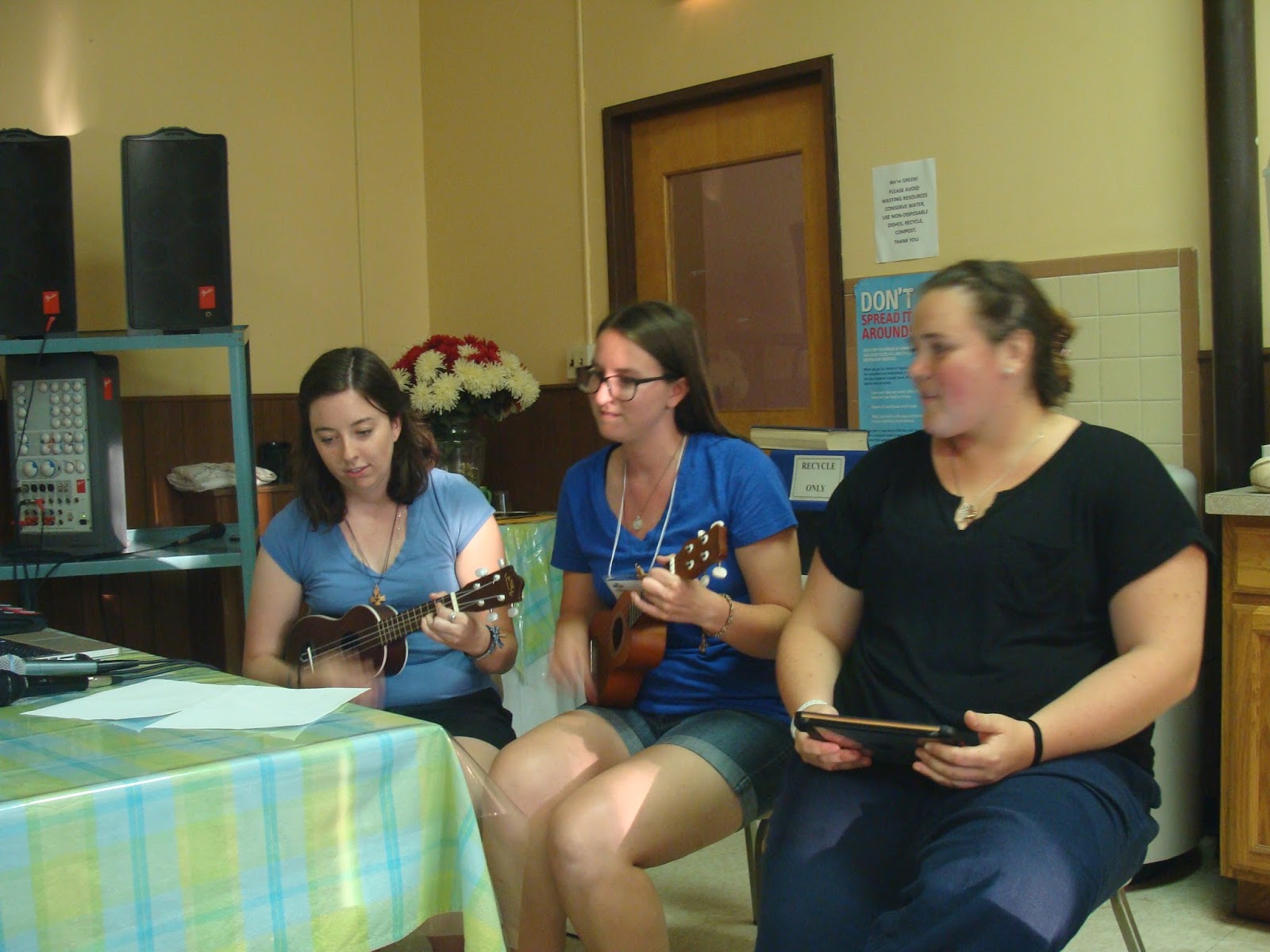
SLMs Colleen Quigley, Catherine McNeal, and Cara Weidinger brought up 2 ukuleles and an ipad to present a song (and I can't tell you what it was called because I'm not quite "with it" with youth music):


Someone tried to cajole SLM Mike Gordon into doing some juggling, but he demurred. Instead, he recited a brief German poem with some dramatic gestures. Unfortunately, the photographer wasn't as good as Mike's German.

Fr. Dennis Hartigan, "the youngest Salesian in the U.S. and Canada" (by profession, but he doesn't say that out loud, and it will no longer be true after tomorrow, August 16), came forward to thank the retreat preacher, Fr. Frank Molony, SDB. He began, however, by roasting him and his conferences (and himself to some extent for having missed 2 of the conferences); then he got to the genuine thanks.

Fr. Frank responded by expressing his appreciation for the SDBs in any part of the world he's gone to, certainly including this province (where he lived in Washington for about 7 years:

Bro. Rafael Vargas then got drafted to do some breakdancing:

which was followed by several of the SLMs taking to the floor to show some different kinds of moves alongside Bro. Rafi:

In turn, that led to more contemporary youth group dancing, which even the observers (such as your humble blogger) enjoyed:


That ended the dinner entertainment.  But there were still an evening of retreat for both groups, and on Saturday morning the closing Mass on the solemnity of the Assumption.


Sunday, August 9, 2015

Homily for 19th Sunday of Ordinary Time

Homily for the
19th Sunday of Ordinary Time
Aug. 9, 2015
1 Kgs 19: 4-8
Ursulines, Willow Dr.

“Elijah went a day’s journey into the desert…” (1 Kgs 19: 4).

Superficially, we could observe that Elijah prepared very poorly for his hike into the wilderness.  If you do that today—and it happens regularly in the White Mountains and other wilderness areas—and search and rescue has to go find you, you’ll probably get a big, fat bill from the local or federal government.  But there’s no record of the angel’s having left an invoice with Elijah’s bread and water.

Elijah calling down the Lord's fire on Mt. Carmel (1 Kings 18)
More seriously, Elijah has fled in haste from Queen Jezebel, whose 400 prophets of Baal he’s just slain on Mt. Carmel (ch. 18).  As he says after reaching Mt. Horeb, he’s been “most zealous for the Lord” (19:10).  He’s the prototypical fanatic of an OT prophet, but his zeal has won him the vengeful enmity of the rulers of Israel.

When we take a stand for the Lord, when we’re truly committed to him—even without our trying to slay the Lord’s perceived enemies—we’ll make enemies of our own and run into obstacles.  So we must expect opposition when we try to do good, practice virtue, live out our commitment to serve the Lord wholeheartedly.  Jesus ben Sirach cautions us, “When you come to serve the Lord, prepare yourself for trials.  Be sincere of heart and steadfast, undisturbed in time of adversity” (Sir 2:1-2).  Satan never rests in his opposition to goodness, and unfortunately he finds many allies.

Elijah “prayed for death: … O Lord, take my life” (19:4).  Even prophets and saints can get discouraged.  So we shouldn’t be surprised that sometimes we do too, whether our discouragement arises from the aforementioned obstacles and opposition, from our own physical or emotional or moral weaknesses, or from our inability to see clearly just what God wants of us.  Occasional discouragement is part of being human.

What’s important when Elijah is in this state of dejection—we could almost say of despair—is that he opens his heart to God.  We know how he feels because he voices his prayer.  I think Elijah has been on intimate terms with the Lord for a long time; I think his story in 1 Kings testifies to that.  When we’re close to God, we can tell him everything that’s in our hearts:  our joys and sorrows, our fears and hopes, our anger and praise, our sins and virtues.  We ought never to be afraid to speak our minds to the One who made us, who loves us, who saves us—and who already knows our thoughts and feelings anyway—but who delights, according to St. Augustine (somewhere in the patristic readings of the Breviary) to hear his children speak those thoughts and feelings.  Like Samuel’s mother Hannah (1 Sam 1:9-18), Queen Esther (4 C:12-30), Susanna (Dan 13:42-43), Jeremiah (passim), and the Psalmist, we can pour out to God our woes, fears, desperation, frustration.  Jesus himself does that in Gethsemane (Matt 26:36-44 ||).  And of course besides complaining or crying to God, we can also praise and thank him for our blessings.

The angel who came to Elijah provided him with food and drink to sustain him on his journey to Horeb, which is another name for Sinai.  “Strengthened by that food, he walked 40 days and 40 nites to the mountain of God” (19:8).  In the context of today’s liturgy, that food and drink are supposed to remind us of the Eucharist.  The Eucharist is truly our sustenance as we journey toward God’s holy mountain—on a long and arduous trek beset with temptations and dangers, a trek that’s wearisome at times, frightsome at times.  The Eucharist supplies us with both spiritual strength and courage to get up and continue steadfast on our way.

Thursday, August 6, 2015

2015-2016 SLMs Start Their Orientation

2015-2016 SLMs Start Their Orientation

On July 24 thirteen candidates for this year’s batch of Salesian Lay Missioners began their orientation at Salesian Missions.  Their first week introduced them more deeply to Don Bosco, the Salesians, the Preventive System, safe environment practices, and cross-cultural issues.


Julie Lupien led the SLMs through cross-cultural training for four days at Salesian Missions.
This week (August 3-7) the candidates are doing practical service in Corpus Christi-Holy Rosary Parish at Port Chester, all getting experience in both the day camp and the soup kitchen.  Next week (August 9-15) they’ll join the Salesian retreat at Haverstraw, which will culminate in their commissioning. All the weeks include recreational and social activities, of course, in addition to the “serious” material. The group of eight women and five men has quickly become a Salesian family.

The candidates come from Arizona, California (3), Florida, Massachusetts (3), Michigan, Minnesota, Missouri, Pennsylvania, and Virginia and are tentatively destined for Bolivia, Cambodia, Ethiopia, South Sudan, and Tampa.

Returned SLMs Amber Kraft, Manny Mendez, and Matt Bauer are assisting Adam Rudin and Fr. Mark Hyde with the orientation.

Some of the SLMs enjoy a volleyball-variation game
at Salesian HS’s pool and picnic area on August 5.

Sunday, August 2, 2015

Homily for 18th Sunday of Ordinary Time

Homily for the
18th Sunday of Ordinary Time
Aug. 2, 2015
Eph 4: 17, 20-24
Iona College, New Rochelle

“You must no longer live as the Gentiles do” (Eph 4: 17).

This is the 4th Sunday, out of 7, in which we’ve been reading from Paul’s Letter to the Christian community at Ephesus—an important seaport on the coast of what is now western Turkey.  Today Ephesus is only an archeological site with interesting Greek and Roman ruins and the site of the house where the Virgin Mary is reported by tradition to have lived her last years with the Apostle John.

This Christian community, converted by Paul himself, as we read in the Acts of the Apostles (ch. 19), was mostly Greek, not Jewish; therefore mostly Gentiles, converted pagans.  So Paul refers to their former way of life, which included not only idolatry—the worship of Zeus, Athena, Dionysius, and the rest of the Greek pantheon—but also the practice of various vices:  “your former way of life, corrupted thru deceitful desires” (4:22).  We may suppose that Paul is referring here, 1st of all, to various forms of sexual immorality; but also to drunkenness (he refers to that in 5:18, which we’ll hear in a couple of weeks) and excessive eating; gambling; gladiatorial contests; greed; cheating and fraud; lying and slander; jealousy and envy; unwillingness to forgive and the seeking of vengeance; factions and dissensions within the community.  Those are some of the sins that Paul lists in other letters, and certainly we can suppose that they existed at Ephesus too—as they seem to exist everywhere, including among us.


The Seven Deadly Sins & the Four Last Things
(Hieronymus Bosch)
Paul calls all of this “futility” (4:17).  It leads us nowhere, at least nowhere we want to go.  Such behavior breaks up homes and families, destroys businesses and friendships, produces wars and other forms of violence.  Rather than satisfying us, a pagan way of life frustrates us.

Therefore, Paul urges his converts, his friends, “you should put away the old self of your former way of life, corrupted thru deceitful desires, and be renewed in the spirit of your minds”—because our conversion must begin within, in our hearts, in our attitudes, before our behavior will change—“and put on the new self, created in God’s way in righteousness and holiness of truth” (4:22-24).  Paul has already introduced them to this new way (new for them), God’s way, revealed to us in Christ, this way of righteousness and truth.  This is the way that satisfies the ultimate desires of our minds and hearts and souls:  to know goodness and truth and authentic beauty.  It remains good advice for us today because our lives, too, constantly need conversion.

Our ongoing conversion is not helped by the age we live in, the culture around us, which seems to be shedding rapidly the influences of religion and be adopting a neo-paganism.

Maybe the shock engendered by the recent Planned Parenthood videos will wake the nation to the barbarity of destroying human life, to the ugliness of turning human beings into commodities to be bought and sold.  Or maybe it will blow over, and society will close its eyes again and go along with the lies of “choice,” “the war on women,” “it’s my body,” “it’s just a lump of tissue,” etc.  Maybe when a polygamy or an incest lawsuit reaches the Supreme Court we’ll realize the foolishness of “marriage equality” and “freedom to marry whomever you love.”  Or maybe not.

Our country was founded on the premise of truth—not your truth or my truth, some arbitrary belief or inclination or feeling, but on eternal truth:  “we hold these truths to be self-evident…,” truths resting upon the Creator of the universe.  Take away the Creator, bring in a self-referenced paganism, and truth evaporates into moral and social chaos, everyone’s opinion as true as anyone else’s, everyone’s claims as valid as anyone else’s, every man for himself—a state of what the 18th-century philosopher Thomas Hobbes called homo homini lupus:  men are wolves toward each other.  That’s the futility of the Gentile or pagan way of thinking and acting.

“That is not how you learned Christ,” Paul remarks (4:20).  Not only have we committed ourselves to living in a holy manner according to the ways of God taught to us by Christ (cf. 4:21), but we commit ourselves to living in a holy manner, a virtuous manner, in the face of a pagan world—as the earliest Christians did.  We will maintain our commitment to the truths of human dignity regardless of age, race, gender, or social status; of sexual complementarity; of marriage as an institution for fostering new life; of this world’s goods given by God for the benefit of all and not just of a few.  Not only will we maintain our commitment personally, but we’ll do what we can to keep these truths alive in society—because it’s truth that leads us to harmony and justice, truth that sets us free, truth that enables us to be the people God created us to be.

As Catholic Christians we can’t become hermits—go off and live in our own Amish-style world.  Christ has sent us into the world to make it new, to give it life, to win over the pagans—because what we have is universally appealing:  goodness, truth, and beauty.  In their hearts everyone wants these things; the pagans seek them in the wrong places.  We can show them the right places:  in virtue, in a healthy relationship with God based on the “truth that is in Jesus” (4:21), in joy, in our care for our brothers and sisters—in short, “in God’s way of righteousness and holiness.”

Sunday, July 26, 2015

Homily for 17th Sunday of Ordinary Time

Homily for the
17th Sunday of Ordinary Time
July 26, 2015
Collect
St. Ursula, Mt. Vernon, N.Y.

“O God, protector of those who hope in you, … bestow in abundance your mercy upon us” (Collect).

Abundance can be seen as the key word of today’s liturgy.  I just quoted it from the Collect (what we used to call the “opening prayer”).  It will turn up again in the Prayer over the Gifts.  It’s evident in the meals provided by the prophet Elisha and Jesus in the OT and Gospel readings.  (As an aside, the Latin word used in the liturgy is the same word that we translate as “bounty” in our traditional blessing before meals—“from your bounty.”)

Multiplication of the loaves and fish
Hours of the Duc du Berry, 1413
In the Collect we pray for an abundance of God’s mercy.  The gospel story of Jesus’ multiplication of loaves and fish is the sequel to our gospel reading last Sunday, in which we heard how a crowd of people—today we hear them numbered at 5,000 men (males, according to the Greek word used by all 4 evangelists; Matthew adds, “not counting women and children” [14:21])—this crowd greeted Jesus at the supposedly deserted place where he wanted some R&R with his apostles.  And “when he saw the vast crowd, his heart was moved with pity for them, for they were like sheep without a shepherd; and he began to teach them many things” (Mark 6:34).

So there’s mercy in this story, not only in our prayerful plea.  Jesus shows mercy 1st by teaching the crowd hungry for God’s word—“he was moved with pity for them,” with compassion; and then by feeding them with the physical food they’d not had the foresight to bring with them.  (Wouldn’t most of us have done what the apostles suggested in Mark’s telling of the story [6:36])—send them away to hunt up their own supper?  How many of you would be willing to throw a spontaneous picnic for 5,000 men—besides women and children?)

Our Collect today began, as the collects almost always do, by singling out some praiseworthy quality of God—in this case, “protector of those who hope in you.”  Certainly Jesus is doing that for the crowd, for “they were like sheep without a shepherd,” and he took them into his pastoral care with food both spiritual and physical.  We, of course, are among those who hope in God.  We look to him to protect us—come to mind those constant biblical refrains that God is our strength and our helper, that we look to God to save us from our enemies.  The Bible also tells us not to put our trust in princes, in human beings in whom there is no salvation (Ps 146:3)—in people who are powerful—for human help is vain against so much that can go wrong in life.  I’m sure I don’t need to elaborate.  And human help is completely useless in the ultimate issues that we face—the 4 last things:  death, judgment, heaven, and hell.  We need God’s protection against our own sins and their consequences; against the claim that the Prince of Darkness tries to make against our souls.

Perseid meteor shower
(source unknown)
The prayer continues, “without whom nothing has firm foundation.”  That could be taken in a universal sense:  God created the universe and thus is its firm foundation.  Without him creation would collapse; the Big Bang would be reversed, if you will.  It could also be taken to refer to our individual lives or to human society.  Both society and our lives collapse when they’re not founded on God.  Jesus tells us in one his short parables (it’s in the Sermon on the Mount) that whoever hears his words but fails to act on them is like a man who built his house on sand (or on a barrier island); when a storm came, that house had no foundation and collapsed or was swept away (Matt 7:26-27).

So we pray that God’s protection will be the sturdy foundation of our lives and of society.  The prayer then adds, “nothing is holy”; that is, without God nothing is holy.  That phrase doesn’t seem to follow from the preceding one about a firm foundation.  But we should take it, in fact, as a kind of parallel.  In other words, holiness is the firm foundation of our lives.  The whole purpose of our lives, of our existence, is to become saints, to become God’s friends forever.  Most of us learned in our catechism a long time ago that “God made us to know him, to love him, and to serve him in this world and to be happy with him forever in the next world.”  Those who base their lives on God are striving to be saints, striving to be joined forever with Christ in our Father’s house.  We depend for that on God’s goodness, on his sharing his holiness with us, because obviously holiness doesn’t come from ourselves.  Did you ever read Lord of the Flies, and see what supposedly innocent human beings do, even in a tropical paradise, when left to themselves?  “Lord of the Flies,” of course, is the translation of Beelzebul, another name for the devil.  Oh, we need God’s protection, all right!

The Samaritan woman experiences Christ's mercy
(source unknown)
So after acknowledging all this about God, we come to the prayer proper:  “bestow in abundance your mercy upon us.”  We sinners need that mercy, and lots of it, to be transformed into saints, to be made worthy of dwelling with God in his home.  It was precisely to give us that mercy that God’s Son came down from heaven, became a human being, lived with us, died for us, and offers us forgiveness of our sins and the possibility of being raised up on the Last Day.

We continue our prayer:  “that with you as our ruler and guide, we may use the good things that pass in such a way as to hold fast even now to those that ever endure.”  That’s a big mouthful!

We confess again that we need God’s help:  “with your as our ruler and guide.”  It’s more than help invoked here, tho.  God’s is our ruler.  He guides us in the right ways of living.  If he’s our final destination—being happy with him forever in eternity—then we depend on him to show us how to reach that destination.  We subject ourselves to his rule.  We follow his roadmap.  We’re guided by his Scriptures.  We’re guided by Jesus his Son, who is “the way, the truth, and the life” (John 14:6).  We’re guided by the Church that Jesus founded to preserve and spread his message and link us all with him.

We pray that with all that governance and guidance “we may use the good things that pass”:  use everything that is created but has no permanence, all the wonderful things in our world and in ourselves, things like health, beauty, intelligence, wealth, leisure, relationships, material things—use all these “in such a way as to hold fast even now to those [good things] that ever endure.”  There are good things that last forever, and those are the things that matter, the things that we must “hold fast to,” must cling to, must make a part of ourselves:  things like virtues (e.g., faith, hope, charity, purity, patience, honesty), things like truth, things like our relationship with our Lord Jesus.  If we have these goods, anything created is secondary—useful, even good, but “passing,” as the prayer says, fading, undependable.  So we pray that we might set our hearts and our souls on what lasts, on what really counts toward eternal life.

Sunday, July 19, 2015

Homily for 16th Sunday of Ordinary Time

Homily for the
16th Sunday of Ordinary Time
July 19, 2015
Mark 6: 30-24
Ursulines, Willow Dr., N.R.

“The apostles gathered together with Jesus and reported all they had done and taught” (Mark 6: 30).

The commentators observe that this is the only time that Mark refers to the 12 as “apostles” rather than as disciples.  On all other occasions they’re with Jesus as learners, as disciples, of the ways of God, of God’s love for men and women, of God’s relationship with us.  But here they’re returning from the mission on which Jesus “sent them out two by two” (6:7), as we heard last Sunday.  An apostle is precisely “one who has been sent.”

Christ sending out his disciples (James Tissot)
They were sent in Jesus’ name to do what he does:  to preach repentance, to heal, to drive out demons (6:7-13).  Now they return to tell Jesus what they’ve done, to render their accounts.  The apostle, one who has been sent, is accountable to the one who sends him, must represent the sender, must do what he was sent to do, say what he was sent to say.  The apostle can also be called an ambassador, which Paul does in 2 Corinthians (5:20).

Thus, a diplomat, e.g. John Kerry, carries messages and conducts negotiations in his country’s name, reflects the official policies of his government.  The apostles have spoken and acted for Jesus, and all who bear the name of apostle, all who carry out an apostolic ministry, likewise must be faithful to the message and the ministry of Jesus:  preachers, teachers, catechists; Christian writers, journalists, bloggers, commentators; whoever claims to be evangelizing, conveying the Gospel—for we have been sent by Jesus to preach, teach, catechize, evangelize in his name.  The apostle isn’t free to speak his own opinion and attribute it to Jesus, as the country’s 2d-most-famous Baptist did last week in the matter of homosexual “marriage.”[1]

When the 12 return to Jesus, he attempts to take them aside for some rest.  Yes, even apostles need to rest, need downtime, need vacations.  Comes a time when we even need to retire!  (I’m sure retirement wasn’t an issue for the 12 or many of their 1st-century successors; life spans were so much shorter then even if you weren’t being persecuted.)  We have a tendency to feel guilty if we even take a nap.  Maybe we feel less guilty now that we know the Pope takes a nap.

But you know the adage about all work and no play—no unwinding, no using different sets of brain cells, no recharging our batteries.  An archer must unstring his bow when he’s not using it, or the bowstring gradually loses its tension, becomes weak and, you might say, flabby.  And we need to rest:  get good sleep on a regular basis, take short breaks during the day, enjoy the weekend (or at least part of it), read for relaxation, practice a hobby, and get a few days off now and then.

But we rest or take a break “together with Jesus.”  Do you think Jesus meant just to take the 12 for a picnic and a day at the beach?  (There will be a picnic, indeed, a most unusual one, as we’ll hear next Sunday.)  I would guess that Jesus meant to have the 12 probe their experience, reflect on what they’d said and done, what problems they’d encountered, what the people had been like.  From what we know of the 12’s behavior in the rest of Mark, he’d probably have found out that they hadn’t prayed much or reflected critically, and he’d have pushed them in those areas.

Likewise, our downtime has to include time spent alone with Jesus, checking on our relationship with him and on our motivations and aspirations; on our interactions with others; on how our ministries are going and why, if we’re still active.  We have our daily practices for part of that—meditation, formal and informal prayer, reflections on the Scriptures (homiletic and otherwise), our retreat, and (I hope) some spiritual direction—we’re never on vacation from these even when away for a day or a week from community or from our regular routines.

You know all that.  You haven’t persevered thru 50, 60, 70 years of religious life by accident but by “gathering together with Jesus” as a community and privately.  You’ve spent a lot of quiet, restful time with him, and you know how that has energized your lives and put your ministries and your experience in perspective.  And in these mostly more quiet days that you have now at St. Theresa’s, I’m sure you’re growing still closer to Jesus.  All of which enables you still to be apostles—to one another, to your families, to your former students, and for some of you to your present students or other people with whom you’re active (to whom you’re sent as an apostle).

So, if you’re now completely retired, enjoy this time you have with Jesus—and with your sisters.  Rest, but not from prayer and sisterly concern.  If you’re still active, get your due rest, to recharge and to keep your life in proper balance with Jesus.

God bless you!


      [1] I figure the most famous Baptist is Billy Graham; he’s not the one I’m talking about.

Friday, July 17, 2015

Pope Francis's Letter for Don Bosco's Bicentennial

“Like Don Bosco, with the young and for the young”

Pope Francis’s Letter for Don Bosco's Bicentennial

(ANS - Vatican City) - On the occasion of the bicentennial of Don Bosco’s birth, Pope Francis has sent the Rector Major a letter in which he thanks God for the gift of the Saint of Youth, “recalls the essential aspects of the spiritual and pastoral heritage of Don Bosco, and urges [us] to live them with courage.”

Given the importance of the letter from the Pope, Fr. Angel Fernandez has issued a short video message for the Salesian Family by way of comment.

The letter is dated symbolically June 24—feast of St. John the Baptist, celebrated from the early days of the Oratory as Don Bosco’s name day.


LIKE DON BOSCO, WITH THE YOUNG FOR THE YOUNG
LETTER OF THE HOLY FATHER, POPE FRANCIS

to Reverend Fr. Angel Fernandez Artime
Rector Major of the Salesians
on the bicentenary of the birth of St. John Bosco

The memory of St. John Bosco is alive in the Church. He is remembered as the founder of the Salesian Congregation, the Daughters of Mary Help of Christians, the Association of the Salesian Cooperators, and the Association of Mary Help of Christians, and as the father of the present-day Salesian Family. He is likewise remembered in the Church as a holy educator and pastor of the young who opened the way of holiness for young people, offered a method of education that is at the same time a spirituality, and received from the Holy Spirit a charism for modern times.

In the bicentenary of his birth I had the joy of meeting the Salesian Family gathered in the Basilica of Mary Help of Christians in Turin, where lie the Founder’s mortal remains. Through this message I wish to join with you again in thanking God, and at the same time in recalling the essential aspects of Don Bosco’s spiritual and pastoral legacy and urging you to live them courageously.

Italy, Europe, and the world have changed considerably in these two centuries, but the soul of the young has not: even today boys and girls are open to life and to the encounter with God and with others, but there are so many of them exposed to discouragement, spiritual anemia, and marginalization.

Don Bosco teaches us first of all to not stand idly by, but to put ourselves in the vanguard by offering young people an integral educational experience which, firmly based on the religious dimension, affects the mind, the emotions, and the whole person, always considered as someone created and loved by God. This leads to a genuinely human and Christian pedagogy, one that is animated by a concern for prevention and inclusion, especially of the children of the working classes and the marginalized groups of society, and offers them an opportunity for education and learning a trade in order to become good Christians and honest citizens. By working for the moral, civil, and cultural  education of youth, Don Bosco worked for the good of people and civil society, following his particular view of man that combines happiness, study, and prayer, or to put it another way, work, religion, and virtue. An integral part of this process is the development of a person’s vocation in order to enable him to assume the concrete way of life in the Church to which the Lord calls him. This wide-ranging and demanding educational vision which Don Bosco condensed in his motto, “Da mihi animas,” accomplished what we today express in the phrase, “educate by evangelizing and evangelize by educating” (Congregation for the Clergy, General Catechetical Directory  [August 15, 1997], n. 147).

A characteristic feature of Don Bosco’s pedagogy is loving kindness, which is to be understood as a love that is manifested and perceived, and reveals itself in caring, affection, understanding, and involvement in the life of another person. In the experiential process of education, according to Don Bosco, it is not enough to love, but love needs to be expressed in gestures that are concrete and effective. Thanks to this loving kindness, so many children and adolescents in Salesian settings have experienced an intense and serene emotional growth, which has proved very valuable in the shaping of their personality and in their life’s journey.

Within this framework lie other distinctive traits of Don Bosco’s educational method: a family environment; the presence of the educator as a father, teacher, and friend of the young person, which is conveyed by a classical term of Salesian pedagogy: assistance; a climate of joy and celebration; ample space offered for singing, music, and the theater; the importance of the playground, games, sports, and outings.

We can summarize the salient aspects of Don Bosco’s personality in the following manner: he lived the total surrender of himself to God in his dedication to the salvation of souls and lived his fidelity to God and to the young in one and the same act of love. These attitudes led him to “go out” and make courageous decisions: the decision to devote himself to poor youth with the aim of giving rise to a vast movement of poor people for poor people; and the decision to extend this service beyond the boundaries of language, race, culture, and religion, thanks to his tireless missionary impulse. He realized this project through his style of joyfully accepting and personally caring for each one whom he met and accompanied.

He was able to elicit the cooperation of St. Mary Domenica Mazzarello and the cooperation of lay people, giving rise to the large tree of the Salesian Family, which has received and enhanced his legacy.
In short, Don Bosco lived with a great passion for the salvation of the young, appearing as a credible witness of Jesus Christ and an outstanding herald of his Gospel, in profound communion with the Church, and in particular with the Pope. He lived in constant prayer and union with God, with a strong and tender devotion to our Lady, whom he invoked as the Immaculate Virgin and the Help of Christians; he was endowed with mystical experiences and the gift of miracles for the sake of his boys.

Even today the Salesian Family opens out to new frontiers in education and missionary work, pursuing the paths traced out by the new means of communication and by an intercultural education among peoples of different religions in countries of the developing world or in places marked by migration. The challenges of the Turin of the nineteenth century have assumed global dimensions: the idolatry of money, an inequality that generates violence, an ideological colonization, and cultural challenges related to urban contexts. Some aspects are more directly connected with the world of the young, such as the spread of the Internet, and therefore they pose a challenge to you, sons and daughters of Don Bosco, called as you are to work and to keep in mind, together with the hurts, also the resources that the Holy Spirit inspires in crisis situations.

As a Salesian Family you are called to let the creativity typical of your charism flourish once more in and beyond your educational institutions, as you take your place with apostolic dedication among young people, especially those on the peripheries.

“Youth ministry, as traditionally organized, has also suffered the impact of social changes. Young people often fail to find responses to their concerns, needs, problems, and hurts in the usual structures. As adults, we find it hard to listen patiently to them, to appreciate their concerns and demands, and to speak to them in a language they can understand” (Evangelii Gaudium, 105). Let us ensure that, as educators and as a community, we accompany them on their journey so that they feel the joy of bringing Jesus to every street, to every square, to every corner of the earth (cf. ibid., 106).

May Don Bosco help you to not disappoint the deep aspirations of the young: their need for life, openness, joy, freedom, and the future; their desire to collaborate in building up a more just and fraternal world, in fostering the development of all peoples, in safeguarding nature and the living environment. Following his example, you will help them to experience that only in the life of grace, i.e., in friendship with Christ, does one fully attain the most authentic ideals. You will have the joy of accompanying them in their search for a synthesis of faith, culture, and life at moments when they make weighty decisions or attempt to interpret a reality that is complex.

In particular, I want to point out two tasks that arise today from a discernment of the youth reality: the first is that of educating, in accordance with a Christian anthropology, to the language of the new means of communication and of the social networks that deeply shape the cultural and value systems of the young, and therefore their outlook on the reality of man and religion; the second is that of promoting forms of social volunteering, and not resigning yourselves to the ideologies that place the market and production above the dignity of the person and the value of work.

To be educators who evangelize is a gift of nature and grace, but it is also the result of formation, study, reflection, prayer, and asceticism. Don Bosco used to say to young people: “For you I study, for you I work, for you I live, for you I am ready even to give my life” (Salesian Constitutions, art. 14).

Today more than ever, in the face of what Pope Benedict XVI often referred to as an “educational emergency” (cf. “Letter to the diocese and the city of Rome on the urgent task of educating young people,” January 21, 2008), I invite the Salesian Family to promote an effective educational alliance between different religious and secular agencies so as to move forward with the diversity of your charisms at the service of youth in the different continents. In particular, I remind you of the imperative need to involve the families of young people. There can indeed be no effective youth ministry without a good family ministry.

The Salesian is an educator who, in the midst of his many relationships and commitments, always lets the first proclamation resound, the good news that directly or indirectly can never be absent: “Jesus Christ loves you; he gave his life to save you, and now he is living at your side every day to enlighten, strengthen, and free you “(Evangelii Gaudium, 164). To be faithful disciples of Don Bosco requires you to renew the choice of catechesis that was his lifelong commitment, understanding it today within the mission of a new evangelization (cf. ibid., 160-175). This evangelizing catechesis deserves pride of place in Salesian institutions, and must be made with theological and pedagogical competence and the educator’s transparent witness. It requires a process that involves listening to the Word of God, frequenting the sacraments, especially Confession and the Eucharist, and a filial relationship with the Virgin Mary.

Dear Salesian Brothers and Sisters, Don Bosco testifies that Christianity is the source of happiness, because it is the Gospel of love. It is from this source, and in your Salesian educational practice as well, that joy and celebration find their consistency and continuity. “We become fully human when we become more than human, when we let God bring us beyond ourselves in order to attain the fullest truth of our being. Here we find the source and inspiration of all our efforts at evangelization”(Evangelii Gaudium, 8).

The Church has great expectations concerning the care of the young; great too is the charism that the Holy Spirit bestowed on St. John Bosco, a charism that has been carried forward by the Salesian Family with a passionate dedication to the youth of all continents and a flowering of numerous priestly, religious, and lay vocations. I therefore cordially encourage you to take up the legacy of your founder and father with the Gospel radicalism that he made his own in his thinking, speaking, and acting, with a proper competence and a generous spirit of service, like Don Bosco, with the young and for the young.

From the Vatican, June 24, 2015
Solemnity of the Birth of St. John the Baptist