Sunday, February 17, 2013

Homily for 1st Sunday of Lent

Homily for the
1st Sunday of Lent
Feb. 17, 2013
Deut 26: 4-10
Rom 10: 8-13
Ursulines, Willow Dr., N.R.

“My father was a wandering Aramean who went down to Egypt … and became a nation great, strong, and numerous” (Deut 26: 5).
Jacob Meets Esau, by Francesco Hayez
Today’s reading from Deuteronomy is a basic profession of faith for the Israelites within the context of the annual harvest.  It’s a profession about who they are, where they came from, what God has done for them, how they are to respond to his graces.

God took a nomad named Jacob, nicknamed Israel, who wandered the deserts of Aram, i.e., Syria (broadly construed to include Palestine), and God guided this nomad to Egypt, where his offspring prospered.  Then their fortunes were overturned (by a change of dynasty), and they became slaves.

When the people cried to the Lord in their affliction, he came to their rescue and, with a great display of power, led them out of Egypt into “this land flowing with milk and honey” (26:9) thru his chosen instrument, Moses.  On account of all this, the Israelites celebrate the annual harvest by presenting its firstfruits to the Lord and “bowing down in his presence” (26:10).

The last line of the reading, “you shall bow down in his presence,” provides a link to the gospel reading, wherein the Devil suggests that Jesus worship him; Matthew’s version of the temptations even uses the phrase “fall down and worship” or “prostrate yourself and worship” (4:9).

The 2d reading transfers that worship to Jesus himself:  “if you confess that Jesus is Lord…” (Rom 10:9) and offers salvation as the prize to such allegiance (vv. 9,13).

Thus the Romans text points us toward our confession of faith in Jesus risen from the dead for our salvation—toward Easter.

Easter, the Lord’s Passover, the paschal mystery, is the heart of our Christian profession of faith:  “Jesus is Lord and … God raised him from the dead” (10:9).  It tells us who we are, where we’ve come from, what God’s done for us.  It’s our Passover too, and thus the Deuteronomy reading, recalling the mighty deeds by which God thru Moses rescued Israel from oppression, points us toward Easter.  That reading reminds us of our own slavery to the Devil and of our own passing thru water and into the promised land of God’s grace and eternal life because of the “terrifying power, with signs and wonder” (Deut 26:8) displayed by God in the life, passion, and resurrection of our Lord Jesus.  In his rescue of us, God doesn’t use a 3d-party instrument like Moses but carries out the mission himself.

As the Israelite brings to the Lord “the firstfruits of the products of the soil” in his gratitude for all that the Lord has done for him, the Christian brings her worship to the Lord in Christ.  In our Eucharist day after day we offer God’s own firstfruits:  his firstborn Son, begotten from eternity.  In Paul’s words, God’s firstborn is also “the firstborn from the dead” (Col 1:18), the beginning of a very great harvest; in Paul’s words again, “the firstborn among many brothers” (Rom 8:29).  Each day we remember God’s marvelous doings on our behalf and, like the Israelites, become part of the story, part of God’s saving activity.  God delivers us and glorifies us (cf. Ps 91:16).

In the Collect we prayed that “we may grow in understanding of the riches hidden in Christ.”  There are Pauline echoes in those words, but in the context of this 1st Sunday of Lent and its readings, we may think of the riches of salvation offered to us in the Promised Land when we’ll have completed our passover from here to hereafter,[1] “confessing that Jesus is Lord and … God raised him from the dead,” and “believing with the heart” (Rom 10:10)—believing with such conviction that we, too, resist all the blandishments and enticements and temptations of the Devil:  “by [our] worthy conduct pursuing the effects” (Collect) of those “riches hidden in Christ.”
Satan Tempts Jesus, by Tissot
In a few moments we’ll pray further that the Lord “give us the right dispositions to make these offerings” (Prayer over the Offerings)—the offering of our bread and wine that will become Christ our Lord, and the offering of ourselves in union with Christ, of ourselves “wholly conformed to the mystery that is Christ”[2] in our worship of the Lord our God alone, in our absolute trust in his power to save us, in our complete submission to God’s will for us.

And there’s our Lenten program of conversion, dear sisters:  to make our self-offering ever more complete, our submission to God ever more complete, our union with Christ ever more total, so that our daily Eucharist may truly be a grateful “bowing down in God’s presence.”


      [1] Cf. Preface of the 1st Sunday of Lent: “…celebrating worthily the Paschal Mystery, we might pass over at last to the eternal paschal feast.”
      [2] Daniel J. Merz and Marcel Rooney, OSB, Essential Presidential Prayers and Texts (Chicago: LTP, 2011), p. 43.

Thursday, February 14, 2013

Pope Benedict Resigns; Salesians in Conclave

Pope Benedict Resigns

Salesian Cardinals to Participate in Conclave
This post has already been published in at least 2 places in an earlier version, so I guess I'd better post it myself, updated.
On Feb. 11 Pope Benedict XVI surprised the world by announcing his resignation, effective Feb. 28. It was the first papal resignation since 1415, when three men claimed to be Pope during the Great Schism of Western Christianity (see http://www.newadvent.org/cathen/13539a.htm) and all three were compelled to resign as the way to end the schism; and the first freely chosen resignation since 1294, when Pope St. Celestine V resigned on grounds of incapacity to carry out the papal office to which he had been elected only five months earlier.

If there are no deaths before Feb. 28, there are 117 cardinals who will be under age 80 when Peter's Chair is vacated at 8:00 p.m. Rome time (2:00 p.m. EST), and thus eligible to take part in the conclave that will elect the new Pope. According to Catholic News Service (Feb. 18, 2013), 19 of these are members of religious orders, and the Salesians have the largest number of religious cardinal-electors, with four: Cardinals Tarcisio Bertone, 78, secretary of state of the Holy See and camerlengo; Raffaele Farina, 79, prefect emeritus of the Vatican Archives and Library; Angelo Amato, 74, prefect of the Congregation for Saints’ Causes; and Oscar Rodriguez Maradiaga, 70, archbishop of Tegucigalpa.

One of the 117 cardinal-electors, however, will not make the journey to Rome. Cardinal Julius Darmaatmadja, SJ, archbishop emeritus of Djakarta, Indonesia, has informed the world that he is too ill to make the journey and take part.

On Feb. 25 another cardinal-elector bowed out. The already-tendered resignation Cardinal Keith O'Brien, archbishop of Edinburgh, who will turn 75 shortly, was accepted by the Holy Father, and he decided not to go to the conclave because of serious accusations leveled against him (which he sort of admitted to on Mar. 3) lest his presence be a distraction from the serious business in Rome.

There are 3 Franciscan cardinal-electors, 1 Jesuit (besides Card. Darmaatmadia), and 10 other religious, including 2 of the American cardinals, Sean O'Malley (Capuchin) and Francis George (Oblate of Mary Immaculate).

Blogging for America, Fr. Thomas Reese, SJ, writes that the camerlengo “is the most important official during the interregnum. . . . On the death of the pope, the camerlengo takes charge of and administers the property and money of the Holy See, with the help of three cardinal assistants chosen by lot from among those cardinals under 80. During the interregnum he reports to the college of cardinals, which governs the church until a pope is elected. He also organizes the conclave. By appointing the cardinal secretary of state as the camerlengo, Benedict simplified the organizational structure and made sure that his secretary of state had an important role during the interregnum.”

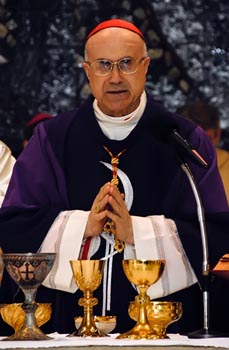
Cardinal Bertone


Cardinal Bertone (see Salesian Bulletin Fall 2006) professed vows as a Salesian in 1950 and was ordained in 1960. A canon lawyer, he has been a professor at the Salesian Pontifical University, archbishop of Vercelli and of Genoa, and secretary of the Congregation for Doctrine of the Faith under then-Cardinal Ratzinger. John Paul II made him cardinal in 2003, and Pope Benedict named him secretary of state in 2006.
Cardinal Farina


Cardinal Farina professed as a Salesian in 1949 and was ordained in 1958. A church historian, he taught at and was rector of the Salesian Pontifical University, and served in the Roman Curia prior to becoming prefect of the Vatican Library in 1997, then archivist of the Vatican Secret Archives in 2007. Pope Benedict made him cardinal in 2007. He retired in 2012.
Cardinal Amato with Mother Reungoat


Cardinal Amato professed as a Salesian in 1956 and was ordained in 1967. He was professor of dogmatic theology and dean of the school of theology of the Salesian Pontifical University, as well as a prolific writer before succeeding then-Abp. Bertone as secretary of the Congregation for the Doctrine of the Faith in 2002, under then-Cardinal Ratzinger. In 2008 he became prefect of the Congregation of Saints’ Causes. Pope Benedict made him cardinal in 2010.


Cardinal Rodriguez ordaining Fr. Manny Gallo
Cardinal Rodriguez professed as a Salesian in 1961 and was ordained in 1970. He was both a high school teacher and a professor of theology before becoming bishop in 1978 and serving as general secretary of the Latin American Bishops Conference (CELAM) and other posts at CELAM and in his native Honduras. In 1993 he became archbishop of Tegucigalpa and in 2001 the first cardinal from his country. Since 2007 he has been president of Caritas International, the Church’s worldwide relief organization. He has been a prominent spokesman on social justice issues such as Third World debt. He loves to play music, can pilot a small plane, speaks seven languages, and enjoys meeting and speaking with young people. He has presided over several priestly ordinations in the U.S.

Two other Salesian cardinals are beyond the age of 80 and not eligible to take part in the conclave: Cardinals Miguel Obando Bravo, archbishop emeritus of Managua, and Joseph Zen Ze-kiun bishop emeritus of Hong Kong.

Sunday, February 10, 2013

Homily for 5th Sunday of Ordinary Time

Homily for the
5th Sunday of Ordinary Time
Feb. 9, 1992
Isaiah 6: 1-8
1 Cor 15: 1-11
Luke 5: 1-11
Holy Cross, Fairfield

“Whom shall I send?  Who will go for us?” (Is 6: 8).

It’s unusual for all 3 readings to be as closely linked as todays are.  Week by week the OT reading is deliberately linked to the gospel, but the NT reading ordinarily follows a particular book sequentially.  Today’s passage from 1 Corinthians opens a discourse on the resurrection, parts of which we will hear on the next 3 weekends.  But in passing St. Paul touches on the central theme of the 1st and last reading, viz., God’s call.

God calls Isaiah, Paul, and Simon Peter for special missions, to be prophets and apostles.  All of them are immediately aware of their unworthiness.  “Woe is me, I am doomed!” Isaiah exclaims as he beholds the heavenly vision, “for I am a man of unclean lips” (6:5); he is just as sinful as the rest of Israel.  Paul laments his past, for he persecuted the Church of God (1 Cor 15:9).  Simon Peter begs Jesus:  “Leave me, Lord, for I am a sinful man” (Luke 5:8). 
The Miraculous Catch of Fish: Tapestry by Raphael in the Vatican Museums

No one whom God calls to be one of his intimate friends or to be an apostle or prophet, a priest, a religious, a missionary—no one is worthy of God.  Everyone whom God calls is sinful and, alas, remains a sinner, as even the saints have frequently testified.

But human imperfection and unworthiness don’t stop God.  God has chosen to work with human tools, imperfect tools, in order to save all of us and in order that his own power and goodness may be the more evident.  He comes to Isaiah, who’s afraid he’s about to die, and he purges away his wickedness.  He bestows his favor, or grace, on Paul, overcoming the hatred in his heart, filling him with love, rechanneling his zeal.  It’s not Paul’s doing but God’s: “by God’s grace I am what I am” (1 Cor 15:10).  Christ reassures Simon: “Do not be afraid.  From now on you will be fishing for men” (Luke 5:10).

All of us, when we look at God’s ministers, see defects and faults.  God calls human beings, not angels.  God is in the process of saving his priests and religious, as well as the rest of his people.  Sometimes we need to remind ourselves not to lose faith in God or in God’s Church because of the sins of individuals.  Follow St. Paul’s advice and correct us when it is necessary.  For instance, he writes to the Galatians:  “If a man is overtaken in any trespass, you who are spiritual would restore him in spirit of gentleness” (6:1).  Be patient with us.

When God calls someone, it is an act of grace.  Whatever the defects of a priest, a sister, a brother, or anyone with a special calling, the grace of Christ will still work thru the person.  If the person cooperates as Christ’s instrument of grace, grace will gradually have its sanctifying effects in that person.

If God is calling you to be one of his apostles or prophets, fear not for your unworthiness or weakness.  God calls whomever he wishes, in order that his work of salvation may be made known.  Have confidence in the power of God’s love, not only to work thru you but also to transform you as it did Isaiah, Paul, and ever so gradually, Simon Peter.

And may God’s grace work in and thru all of us, according to our particular callings.

Saturday, February 9, 2013

Old Man Winter Comes to New Rochelle

Old Man Winter Comes to New Rochelle

Altho we've had a lot of frigid days this winter, there hadn't been a lot of snow--till yesterday.  The much ballyhooed big winter storm actually was a pretty ordinary storm for us, just outside New York City and on the shore of Long Island Sound.  The snow in our garden was "only" 9 inches deep this morning.
 

The storm as seen by NOAA
It was, of course, quite another story not far inland (e.g. Bronxville and Scarsdale) and in the upper reaches of Westchester County, in Connecticut, in eastern Long Island, etc.

The storm started yesterday (Feb. 8) by 6:30 a.m., while I was driving to Mass in the Bronx.  Looking out the big windows of the convent chapel during Mass (should I be doing that?), I could see the snow blowing almost horizontal to the ground, and City Island on the other side of Eastchester Bay was almost obscured.  But the snow didn't start to accumulate until late afternoon, and there wasn't anything that Bro. Andy could plow off our driveways until after supper.

Our outside Masses for this morning had already been cancelled.  As far as I know, the evening Masses are on because the main roads are cleared.  Bro. Andy and Fr. Ken were out early this morning, and again after breakfast, to plow our driveway and parking lots clear, and four of us took up snow shovels, brooms, and scrapers, to free up five cars.
 

It was all pretty to look at, for sure!

Thursday, February 7, 2013

Mother Marinella Castagno (1921-2013)


Mother Marinella Castagno, FMA
(1921-2013)

(ANS – Nizza Monferrato) – Mother Marinella Castagno, seventh successor of St. Mary Domenica Mazzarello as Superior General of the Daughters of Mary Help of Christians (Salesian Sisters), passed away at 6:10 p.m. on February 5 at Nizza Monferrato, Italy.
As soon as he heard the news, Fr. Adriano Bregolin, vicar general of the Salesians, sent a message of condolence to Mother Yvonne Reungoat and her general council. The vicar general is the liaison between the Rector Major and all the other groups that make up the Salesian Family.
Fr. Bregolin wrote: “Mother Marinella, as Superior General, lived through a very important apostolic time both from the Church's point of view, in the busy and fruitful post-conciliar period, when she took part in two synods of Bishops, but also from a historical and political perspective given the fall of the Iron Curtain in 1989; she opened new presences and apostolic enterprises in Eastern Europe.
During her two terms as superior she had the joy of seeing the beatification of Laura Vicuña and Mother Madeleine Morano.
These were important and powerful events within the framework of her active daily life, including much sacrifice, in the animation and government of the FMA Institute.
We were impressed by her enormous apostolic activity over her years as Mother General, preaching retreats to her sisters, accompanying formation courses, her closeness to the younger sisters preparing for perpetual profession at the mother house in Mornese.
You knew her much better: and therefore have even more reason to praise God for her long and fruitful life and for what she gave to the Institute.
We look at this moment in a Christian spirit, strong in our faith in the resurrection of Jesus and certain that he is sharing with Sr. Marinella and each one of us his eternal life in Paradise.
We feel close to you, Mother, and dear sisters in the council, in affection and prayer in suffrage for Sr. Marinella's soul and a prayer of consolation for those who knew and loved her.”
Born May 21, 1921, at Bagnolo Piemonte, Italy, Mother Marinella studied with the Salesian Sisters at Giaveno and Turin. In 1946, at 24 years of age, she was accepted as a postulant. She was a novice in Turin, where she made her first vows as a Salesian sister on August 5, 1948. She worked in Turin for 18 years as assistant, teacher, and school counselor.
From 1965 to 1971 she was superior at the provincial house in Milan. In 1973 Mother Castagno was called to replace Mother Elba Bonomi as a general councilor, and in the 1975 general chapter was officially elected as councilor for youth ministry, a role in which she was reconfirmed in 1981 along with responsibility for past pupils. At the 1984 general chapter, after the death of Mother Rosetta Marchese, she was elected Superior General, then re-elected at the 19th General Chapter in 1990. She stepped down in 1996 after her second term.

Sunday, February 3, 2013

Homily for the 4th Sunday in Ordinary Time

Homily for the
4th Sunday in Ordinary Time
Feb. 3, 2013
Luke 4: 21-30
Ursulines, Willow Dr., N.R.

“They rose up and drove him out of the town” (Luke 4: 29).
Nazareth. Superstock Photo.
Our gospel reading today picks up where last week’s left off, even repeating a transitional verse.

It’s an astounding passage.  At one moment Jesus’ compatriots are “all speaking highly of him and are amazed at his gracious words” (4:22), and the next moment they’re trying to kill him.  Perhaps Luke has conflated more than one episode from Nazareth.  Perhaps he’s so drastically synthesized Jesus’ sermon that we’re missing too much of it to figure out what caused such a mood swing on the congregation’s part or why Jesus suddenly seems to provoke them with his remarks about Elijah and Elisha.

In any case, the Synoptics agree that Jesus wasn’t well received in his hometown, all referencing his family and quoting Jesus about prophets without honor.  Mark comments:  “He wasn’t able to perform any mighty deed there, apart from curing a few sick people by laying his hands on them.  He was amazed at their lack of faith” (6:5-6), and Matthew’s even starker:  “He didn’t work many mighty deeds there because of their lack of faith” (13:58).

Perhaps the people of Nazareth resent that he left them, settled in Capernaum, and was going all over Galilee preaching and healing.  Did they want to keep him and his powerful preaching and healings for themselves, and make Nazareth a center of religious pilgrimage (with the fame and the economic advantages thereof)?  Were they jealous that such an ordinary fellow had suddenly become “somebody,” the way people might get jealous of a lottery winner or an American Idol star in their circle of acquaintances?

Jesus’ hometown and even his own family don’t accept his teaching, the Synoptics agree.  They’re a microcosm of the whole Jewish people, of whom St. John writes, “He came to his own, and his own didn’t receive him” (1:11).  What the Nazarenes attempt, in Luke’s telling, to kill Jesus (4:29), the whole people as represented by the Sanhedrin and a mob at Pilate’s court, will succeed in doing.

If the people of Nazareth were jealous of Capernaum because Jesus had made his home there and was working miracles there—“Do here in your native place the things that were done in Capernaum” (4:23)—the people of Capernaum ultimately aren’t any better off than the Nazarenes.  Jesus elsewhere in both Luke and Matthew denounces the lack of faith of the people of Capernaum, along with the people of other lakeside towns who haven’t responded to his preaching and his healings by repenting:  “As for you, Capernaum:  ‘Will you be exalted to heaven?  You will go down to the netherworld.’  For if the mighty deeds done in your midst had been done in Sodom, it would have remained until this day.  But I tell you, it will be more tolerable for the land of Sodom on the day of judgment than for you” (Matt 11:23-24; cf. Luke 10:15).

Why do we come to Jesus?  What do we want from Jesus?

Are we looking for a show, for entertainment, regarding his miracles as something like watching Houdini or David Copperfield?  That seems to have been King Herod’s desire:  “he had been wanting to see him for a long time, for he had heard about him and had been hoping to see him perform some sign,” Luke’s words (23:8), vividly portrayed in Jesus Christ Superstar:  “So you are the Christ, the great Jesus Christ!  Prove to me that you’re divine—change my water into wine,” etc.  (It’s a really catchy tune!)

Are we looking for Jesus to do something for us?  To make our life easier somehow?  To relieve us of our day-to-day worries?  To make someone else easier to live with?

Assuredly, there are some things we might well look for from Jesus.  When we listen to the Lord’s call of Jeremiah to be a prophet, we realize that we need courage and fortitude far beyond our own capabilities to follow our Lord Jesus, whether as ordinary Christians, as religious, or as priest.

When we listen to St. Paul’s description of authentic love, we realize how far short of the ideal we fall, how much help we need to approximate real love.

When we realize that there are things about ourselves that we need to change, or to have God help us change, then we’re closer to what Jesus refers to as faith; closer to the behavior of the widow of Zarephath and of Naaman the leper, who believed and acted upon the words of the prophets; closer to the repentance that Jesus looked for but didn’t find in Nazareth, in Capernaum, or in many other villages.

When we realize how much wisdom and generosity we need to serve others the way Jesus wants us to, then we have something to go to Jesus to ask for.

Jesus’ words are “gracious” (4:22), literally “pleasing” or “charming,” but we may also call them “grace-filled,” when we find in them the power to effect a change in our own hearts—conversion of our attitudes, thence of our words and actions.

What a miracle that is!

Friday, February 1, 2013

Fr. Paul Cossette, SDB

Fr. Paul Cossette, SDB (1941-2013)

Fr. Paul Cossette died suddenly in Sherbrooke, Que., on Jan. 28. The initial diagnosis was a pulmonary blood clot, but Fr. Romeo Trottier was informed that evening that Fr. Paul apparently suffered a heart attack.

Fr. Paul was 71 and had been a Salesian for more than 52 years, a priest for almost 42 years. He was a member of the Salesian community at Séminaire Salésien, where he in fact spent 40 of his Salesian years.
 
According to Fr. Romeo, on the morning of the 28th Fr. Paul became ill in his room but was still conscious, very weak and breathing with much difficulty, when EMTs arrived. While they were bringing him down from his room, he lost consciousness and never regained it. The EMTs took him to the local hospital, Hôtel-Dieu, where he was examined and then transferred in very serious condition to University Hospital for specialized care. He died at 3:35 p.m.

Paul Cossette was born in St.-Narcisse de Champlain, Que., on May 7, 1941, and baptized that very day in the local parish church, St. Narcisse. He was just six when he was confirmed (June 23, 1947) in the same church.
 
His parents were Edouard and Marie-Rose Ayotte Cossette. When Paul was five, his father died.
 
He was educated by the Daughters of Jesus and then the St. Gabriel Brothers in grade school. Planning to enter a Franciscan seminary, he had the good fortune to meet Fr. Pierre Décarie, the Salesians’ vocation director in Canada, who induced him to go instead to Don Bosco Juniorate in Haverstraw, N.Y., in September 1954. Like most of the boys from Quebec who went to the juniorate in those years, Paul needed to learn English; thus it took him five years to complete his high school courses. He graduated in June 1959.
 
Paul entered the novitiate in Newton, N.J., in September 1959, with Fr. Aloysius Bianchi as master of novices, and professed first vows on September 8, 1960.
 
As a young Salesian, Bro. Paul was assigned to summer apostolates at Camp Don Bosco in Newton and Camp Savio in West Milford, N.J., where he put his artistic talents to use teaching boys arts and crafts. After his graduation from Don Bosco College in 1964, he completed three years of practical training at the Salesian school in Jacquet River, N.B., where his directors were first Fr. Ronald Quenneville, then Fr. Maurice Petit. He made his perpetual vows on June 26, 1966, at the end of his annual retreat in Ellenville, N.Y.
 
Bro. Paul studied theology at Sherbrooke Major Seminary and University from 1967 to 1971 and was ordained by Bishop André Cimichella, OSM, auxiliary bishop of Montreal, at the Salesians’ Ste-Claire’s Church in Montreal on May 9, 1971. He earned bachelor’s degrees in theology in 1970 and in pedagogy in 1972 at the university.
 
Fr. Paul exercised two primary apostolates during his Salesian life. The first was educational. He taught at Séminaire Salésien in Sherbrooke from 1971 to 1984 and was director of the SDB community at Sherbrooke from 1990 to 1996. From 1992 to 2000 he was also in charge of the school’s campus ministry. Fr. Romeo says that he was very close to the students, not only during his time officially on staff but over the years—his noon time always spent at the pastoral room or the corridor adjacent, assisting as a volunteer not hired by school. Of the 700 students, there were few names he did not recall; he had a fantastic memory for names. Many of them attended his funeral Mass; they made up three-fourths of the congregation, according to Fr. Romeo.
 
Past pupil Kate Kendall wrote on her Facebook page:
May the soul of this great man be at peace! Human, friend of the young, serene, but welcoming, a stamp in his hand [he had a philatelic club for many years], a discreet but sincere smile on his lips. He had a lively eye for our projects at school so as to congratulate us for our work and give us a gentle word of encouragement at the right moment.
 
He was a man of God, accustomed to celebrate Mass with a really beautiful passion. From having sometimes participated at his Mass, whether he was presiding or concelebrating, I cherished the shared moments when our glances met and I felt he was happy just to share his faith with us young people. Séminaire Salésien, the alumni, the teachers, and all those who knew him will miss him very much.
 
Thank you, Paul.
 
Another past pupil spoke at Fr. Paul’s funeral. He said:
It’s often said of Don Bosco that he was “the friend of the young.” The young were always the center of Paul’s life. It’s important to pay this tribute to him today because he was, right up to the end, the friend of the young in a very simple way.
 
In the name of all these young people who had the good fortune of crossing your path, we thank you heartily for your patience and your devotion to us. You’ll be carried in the memories of hundreds of students and alumni. Now it’s time for you to rest, a rest well earned after so many years of service to the young.
 
His other main apostolate was communications. From 1972 to 1976 he contributed to  the Canadian SDB newsletter Nouvelles Salésiennes/Salesian News. In 1976 he became editor of Carrefour Salésien, the Salesian Bulletin of Canada, and carried out that responsibility until his death “with artistic taste and intelligence,” says his colleague Fr. Romeo. From 1996 he was also director of Don Bosco Audiovisuals, which distributed Salesian printed, audio, and visual materials.
 
In addition, Fr. Paul was assistant pastor of Ste-Claire’s Church from 1984 to 1990, as well as during the summers of 1977-1983, and directed the Salesian mission office in Canada from 2000 to 2006. He was active in the Salesian summer camp at Hatley, Que. (1963-1975).
 
Fr. Romeo writes:
Fr. Paul was conscious of his commitment as a Salesian priest and as a religious, and what that implied. He was very faithful to the daily celebration of the Eucharist and the other Salesian practices of piety.
 
He was very close to the students and their lives, interested in school life and the students’ various activities. With the young he was always aware that he was an educator, very present but discreetly.
 
He had a vast collection of newspaper clippings that concerned our alumni, and he would post them on the bulletin boards. Putting up bulletin boards was another of his favorite tasks: liturgical and Salesian feasts, photos, artistic events, current events, etc. He had a great knowledge of the history of art.
 
Fr. Paul is survived by his cousins Solange Carbonneau, Jeannine Carbonneau, and Jean-Jacques Carbonneau and his aunts Gertrude Cossette, Simonne Gervais, and Jeannine Ayotte.
 
Fr. Paul was waked in Sherbrooke on Thursday evening, January 31, and Friday morning, February 1. The Mass of Christian Burial was celebrated at Nativity of Jesus Church on Friday morning, with former provincial Fr. Rich Authier presiding and Fr. George Harkins, director of the Séminaire Salésien community, preaching.
 
In his homily Fr. George said:
Yesterday was the feast of our Founder. I imagine that Don Bosco is welcoming Paul to the Salesian Garden.
 
Paul and Don Bosco had a lot in common. Both of them lost their fathers in their childhood, both worked to make young people happy, both were educators, both were religious.
 
Paul had a great knowledge of the Salesian world and a love for Salesian things. More than 50 years ago Paul committed himself to following Christ Jesus as a Salesian after the example of the Good Shepherd, giving his life for others.
 
Do you see the three books on his coffin, next to the crucifix and the flowers? They’re the Bible, the Salesian Rule of Life, and a copy of Carrefour Salésien. That tells us a lot about Paul’s life.
 
Fr. Paul was buried in the Salesian plot of Repos St-François d’Assise in Montreal.

Sunday, January 27, 2013

Homily for the 3d Sunday in Ordinary Time

Homily for the
3d Sunday in Ordinary Time
Jan. 27, 2013
Luke 1: 1-4; 4: 14-21
St. Vincent Hospital, Harrison, N.Y.

“I too have decided … to write everything down in an orderly sequence … so that you may realize the certainty of the teachings you have received” (Luke 1: 3-4).

Back on the 1st Sunday of Advent we began a new church year.  In this year 2012-2013 our Sunday gospel readings come primarily from St. Luke.  During the 33 weeks of Ordinary Time, which started last Sunday and go until Lent, then resume after Pentecost and go until next Advent, we’ll read selections from St. Luke in sequence—not the entire gospel, but significant portions of it.  During Advent, Lent, and Easter seasons, instead, we heard or will hear thematic sections rather than sequential ones.

So today we begin where Luke himself begins, with a prolog that precedes his stories about the conception and birth of John the Baptist and Jesus—stories that we heard in Advent and Christmas.  In these 4 verses, Luke tells us what he’s planning to do and why.

He addresses his gospel particularly to someone named Theophilus, “most excellent Theophilus” (1:3), someone important, someone who would be addressed as “Your Excellency.”  We don’t know whether that was an actual person or a literary fiction.  In Greek Theophilus means “lover of God.”  Since every authentic Christian is a lover of God, Luke could be addressing every Christian and not just one individual —every Christian in his own time, around 70 or 80 A.D., and by God’s grace, in all times since, including you and me.

Luke says he wants to make an orderly presentation of “the events that have been fulfilled among us” (1:1), viz., all the things that Jesus did and taught, based on “those who were eyewitnesses from the beginning and ministers of the word,” i.e., based on all the evidence or testimony that he has been able to gather from the men and women who knew Jesus and were sent by him to spread his teachings.

Luke himself didn’t know Jesus.  He wasn’t an eyewitness himself, the way St. John was (cf. John 21:24-25).  According to tradition, he was a Greek from Antioch in northern Syria—in fact, now it’s in southern Turkey and is called Antakya.  He became a Christian when some of the earliest followers of Jesus came to Antioch to preach the Gospel.  We know that Luke became a travel companion of St. Paul, presumably hooking up with him at Antioch, which Paul used as his base.  Since Antioch was a very important city in the 1st century, Luke probably heard and saw many people with stories about Jesus, and some early writings about him probably were available too—St. Paul’s letters presumably, St. Mark’s gospel, and various collections of Jesus’ words and deeds, especially the stories of his passion, death, and resurrection. 

Furthermore, according to tradition again, Luke was a physician (Col 4:14):  a man of science, a man trained to evaluate evidence.  So we’d expect him to collect and pass along credible reports and not just any old thing he came across, the way so many people today do on the Web.  Luke intends to collect and synthesize the most reliable information there is about Jesus.  And we have to say he did a very good job of it, which you can see just by reading his gospel.

Why’s Luke doing this?  So that Theophilus (and we) may realize that the teachings he (and we) have received are certain; they’re reliable; they’re true; they’re life-giving; they’re the word of salvation.  They’re not just a bunch of rumors circulating on the Net or some National Inquirer gossip.  Luke is presenting historical events, facts, not mythology (with which pagan Greeks and Romans were quite familiar).  Luke the doctor, a man who relies upon evidence, has “investigated everything accurately anew” and is passing along what he finds credible about Jesus so that we might place our faith in him:  in his words, in his resurrection.

After the 4 verses of the prolog, our reading today leaps to the middle of ch. 4, to the beginning of Jesus’ public ministry.  After his baptism by John, which we celebrated 2 weeks ago, and after his temptations by the devil, which we’ll recall on the 1st Sunday of Lent, Jesus returns to his home country, to Galilee:  “returns in the power of the Spirit,” Luke says (4:14).  That’s the Spirit who descended upon him when he was baptized—you remember the gospel 2 weeks ago—the Spirit who accompanied him into the desert for 40 days and nites and during his temptations, the Spirit who now guides his teaching “in their synagogs” (4:15), teaching that makes him famous and earns him praise (4:14-15).

Apparently he makes a circuit of some sort thru Galilee before he gets to his hometown of Nazareth, which was a little out of the way, off the beaten track.  It seems that he no longer made his home there, for Luke describes the town as “where he had grown up” (4:16), and we know from Matthew (4:13) and Mark (2:1) that he had settled in Capernaum, which was on the beaten track along the Sea of Galilee, and thus was a good place to practice the carpenter’s trade, if Jesus himself was a carpenter like his foster father, and a good place to meet a lot of people:  merchants, rabbis, soldiers, farmers coming to market, fishermen, and pilgrims on their way to or from Jerusalem.

Anyhow, he goes back to Nazareth, perhaps to visit his mother and his cousins, perhaps to preach there as he has elsewhere.  In the synagog on the Sabbath, “according to his custom” (4:16)—when you go faithfully to church every weekend, you’re imitating Jesus—he’s asked to do the Scripture reading and then to comment on it, to preach.  He chooses a passage from the prophet Isaiah and announces to the congregation, to the world, to us 20 centuries later, that he’s the one who fulfills that passage.  He’s the one anointed by “the Spirit of the Lord to bring glad tidings (‘gospel’ in old English) to the poor,” to liberate people, to heal people, to lead people “to the Lord” (4:18-19,21).
In the rest of his gospel Luke is going to describe just how Jesus does all that in his deeds and his words.

Luke doesn’t do that only so that we might know about Jesus.  We can go to Barnes and Noble or Amazon and get big, fat books that will tell us about all manner of historical persons—statesmen and writers, artists and movie stars, explorers and feminists, saints and criminals.  Such biographies, or narrative histories about the great events of human history (wars and discoveries, the Renaissance and industrialization, the spread of the Gospel) may inspire us or teach us, or at least satisfy our curiosity.

But Luke aims at something else:  “so that you may realize the certainty of the teachings you have received.”  What does it mean to “receive” a teaching, in this case the teachings of the apostles about Jesus?  It means to take them to heart, to put our faith in them, to own them and make them part of ourselves, to live by them—so that we might be among those who find in them “glad tidings,” so that we might be given sight by Jesus, be filled with that same Holy Spirit who filled Jesus, and be set free (from sin and from eternal death) by Jesus’ life and teachings.

Sunday, January 20, 2013

Homily for 2d Sunday in Ordinary Time

Homily for the
2d Sunday in Ordinary Time
Jan. 20, 2013
John 2: 1-11
Ursulines, Willow Drive, N.R.

“Jesus did this as the beginning of his signs in Cana in Galilee and so revealed his glory” (John 2: 11).
Stained glass: OL of the Valley, Orange, N.J.
We’ve heard countless times this beautiful story of Jesus’ 1st miracle.  No doubt we’ve also heard many interpretations of it.  What realities lie beneath this “first of his signs”?

The 1st reality is that Jesus uses his power to benefit others.  The apocryphal gospels have a number of stories about Jesus using his power for display or for his own interest.  In the authentic gospels of Matthew (4:1-10) and Luke (4:1-12), display and self-interest are 2 of the temptations the devil throws at him in the desert.  But the Son of Man came to serve others, not to be served (Mark 10:45).  He came to save others, not to save himself (cf. Matt 27:42).  So while there seems to be some hesitance on his part in this story—“my hour has not yet come” (2:4), for when his hour does come in its completeness, he “will draw all people to [himself]” (John 12:32)—still, the sign that he performs is for the immediate benefit of 2 families and their guests, even if the groom’s family was guilty of poor planning (some have suggested that Jesus himself had brought along some uninvited, unplanned-for guests—a bunch of thirsty fishermen—who were the causes of the wine’s having run out; but John says, “Jesus and his disciples also had been invited” [2:2]).

The 2d reality behind the outward sign of the water turned into wine is the superabundance of grace, God’s free gift.  It’s self-evident that the miraculous abundance of wine was a freely given gift, as is God’s grace.  Each of the 6 stone water jars held “2 or 3 measures,” John reports (2:6).  A “measure” was about 40 liters or 10 gallons; thus the “20 to 30 gallons” of our translation.  (God knows how the servants were able to move those jars after they were filled.  Backpackers know that a gallon of water weighs about 7 lbs.)  The superabundance isn’t about only the quantity, as John makes clear (2:10), but also about the quality—of the wine, of our eternal life.

We don’t know how far along this multi-day wedding had gone, nor how far it had yet to run, but God provides an abundance of the best wine to keep it going happily and to save the groom’s family from public humiliation.  There you have, obviously, a “type,” an analogy, of what God’s abundant grace does for us—not in terms of our civil lives, our social lives, but for our moral standing, our relationship with him, and our standing on Judgment Day.  On that day we hope not to be placed among the goats at the Judge’s left hand, humiliated before the whole community of mankind, but to be glorified among the sheep at his right hand—redeemed by superabundant grace.

The 3d reality is just that:  redemption.  You all know that wine, feasting, and weddings are biblical signs of God’s relationship with his people, of salvation, of eternal life.  We had an example in the 1st reading (Is 62:1-5).  This 1st of Jesus’ signs inaugurates Jesus’ “hour,” the working out of our redemption by which the broken relationship between us and our Creator is repaired.  Redemption brings us home to our Father’s house, like hostages successfully rescued—Peter preaches in Acts that “Jesus cured all who had fallen into the power of the devil” (10:38)—and the Father will throw a feast for his restored children, like the father in the parable of the lost son (Luke 15:11-32).

The 4th reality is sacramental.  “Jesus’ signs” begin with water and wine, which we naturally associate with the sacraments, and so they also end:  “One soldier thrust his a lance into his side, and immediately blood and water flowed out” (John 19:34), eternal life pouring from the cross in those signs of the Eucharist and of Baptism:  the means of our incorporation into Christ’s body, into God’s family—an incorporation that will be celebrated in its fullness when the “bridegroom rejoices in his bride” (Is 62:5) at “the wedding feast of the Lamb” (Rev 19:9).

Saturday, January 19, 2013

How the World Has Changed!

How the World Has Changed!

This Tuesday marks the 40th anniversary of an event that changed America, for the much worse.  Read Deacon Greg Kandra's homily on that topic: http://www.patheos.com/blogs/deaconsbench/2013/01/homily-for-january-20-2013-2nd-sunday-in-ordinary-time/