Monday, October 13, 2014

The Trail of 10,000 Acorns

The Trail of 10,000 Acorns

The six-day retreat that I made in August was more like half a retreat, what with the work that needed to be done during it, covering two religious profession ceremonies, assisting with the Salesian Lay Missioners’ orientation and covering their commissioning Mass, and (against my own preferences) editing and proofreading the regular weekly issue of the province newsletter.

After the retreat ended on August 16, I worked non-stop to finish the proofing of an issue of the Salesian Bulletin, get out assorted press releases (the professions, the SLMs, the province celebration of jubilees on Sept. 20) to the province newsletter and individual diocesan newspapers.

Section of the AT north and east of Anthony's Nose
So for about 3 weeks I was telling myself and others that I need to get out and spend a little time in the woods.  On Sept. 28 that opportunity finally came—3 days of vacation-retreat on the Appalachian Trail, hiking northward from just beyond the Bear Mountain Bridge in the town of Philipstown, Putnam County, to Fahnestock State Park in Putnam Valley.

For the 1st 2 days of the hike, the most consistent sound of the hike, over a distance of about 12 miles and thru 2 nites, was that of acorns hitting the ground. The forest along that stretch of the AT, from the bridge to Highland Road, is all hardwoods, and evidently there are lots and lots of oaks amid the maples (plenty of those) and birches and whatever else.  It was strangely quiet on the 3d day, from Highland Road into Fahnestock, with only a few acorns to be heard.  I guess there were a lot more ash or hickory; there were more beeches, and beyond Sunken Mine Road a lot of hemlocks.

The New York-New Jersey Trail Conference does a fantastic job blazing the trails, keeping them reasonably free of obstacles (especially fallen trees), and otherwise maintaining them.

Trail turns are usually indicated by just a pair of blazes, one over the other!
Sunday, Sept. 28, was sunny and unseasonably warm.  I packed my last couple of items into my pack —hot dogs and eggs—then delayed my departure while waiting for our Internet to be restored (because I still had press releases on the jubilarians to dispatch!); when the Net didn’t look like it would be ready before noon, at best, we headed off.

“We” was Fr. Mike Leschinsky and me.  He’d return the car home and on Wednesday come and fetch me.  I’d invited Fr. Mike to join me for a day hike, but he opted not to.  Around 11:00 a.m. we got to the point on Rte. 9D where the AT starts to climb the mountain behind Anthony’s Nose, and off I went with my 30-lb. pack, canteen, and camera.

I met 9 hikers coming down the trail, all day hikers who’d already been to the Nose.  I figured once I was heading away from the junction with the Camp Smith Trail (toward the Nose), I wouldn’t see many hikers.  That proved not to be so.  1st, I met a party of 5 or 6 people, young and old, with 5 dogs, who told me I looked like I knew where I was going and asked for directions to the Nose; apparently they’d kept going on the AT after climbing the mountain and missing the right turn of the CST.  Then, when I’d stopped to eat lunch at the Hemlock Springs camp site, a party of about 6 older hikers came by, heading northward.  Lunch was peanut butter on Ritz crackers, a granola bar, and water. Around the time I was finishing, the hikers returned.  “Déjà vu!” I exclaimed.  One of them answered, “Maine wasn’t that interesting, and we decided to come back.”

Hemlock Springs campsite
I crossed South Mountain Pass Road and started up Canada Hill, stopping several times to catch my breath.  Once I reached the ridge at the top, the hiking was easy, and the sun was quite warm.  At occasional spots where the trees thinned out a little, I thought maybe I should put on some sunscreen (as per the dermatologist), but it wasn’t worth it to take off my backpack and rummage thru it to find the bag with the medicals.

The trail running easily along the ridge of Canada Hill
No other hikers along this entire stretch.  Once I was past the Osborn Loop, I was in new territory for me.  I’d hiked from the bridge to South Mountain Pass Road a couple of times, and thence around the Osborn Loop once.  My legs were moaning about the exercise, my shoulders seriously painful from the weight of my pack (no matter how many times I cinched up my hip belt); the strap across the my chest popped off the left shoulder strap twice, so there wasn’t anything to be done about tightening that to reduce the shoulder strain.

I was also getting a little low on water, having brought only a canteen-full (a quart).  But Annsville Creek was a disappointment—easy to cross on a very rickety boardwalk (photo below), but not a drop to water to be seen across the whole morass of reeds and mud.  If I’d been desperate for water, I could’ve gone into the deli at the NY 403-US 9 intersection, but I knew Graymoor wasn’t far ahead (altho it was quite a bit farther than I thought).  A kind driver waved me across 403, but I had to wait for a light change to cross 9 and enter Graymoor’s property.  It was still half a mile (of agony) before I actually got to the friary.

The write-up that I’d seen about the trail was accurate:  it was yet another half mile of hiking (on a blue-marked trail) from the AT to the ball field where the friars make hikers welcome.  I stopped at a picnic area sooner, hoping there’d be a place to pitch a tent (and shorten my hike), but there wasn’t.  The pain in my shoulders gave me a chance to identify with the Savior carrying his cross to Calvary.

I paused at the friars’ cemetery to pray for the dead.  Then there was a long downhill to the ball field.  The hospitality there was all that an AT hiker could want unless he got carried away and demanded HOT water.  There’s a lot of flat, open space (it IS a ball field) to pitch tents.  There are lots of picnic tables and benches.  There’s a pavilion (which was being used for a large family picnic when I arrived).  There’s a water spigot.  There’s a shower room for one, cold water only.  There are 2 clean port-a-johns.

It was about 4:00 p.m., and 6 miles of hiking from my start, when I set my pack down on a table and picked out a shaded spot to pitch my tent.  I filled my canteen and 3 water bottles.  I gathered some small branches for firewood, made a small fire pit, and got a little blaze going easily, then prayed Daytime Prayer.  (I’d photocopied all the parts of the Office that I’d need—no lugging around a 2,200-page book!)  When the fire was down to embers, I put my 2 foil-wrapped hot dogs on them, and in 10 minutes supper was ready.  The menu wasn’t much—just the dogs and buns with mustard, followed by an orange and washed down with Crystal Lite.

I prayed Evening Prayer and read from a back issue of America.  The family picnic concluded, and the family left.  After maybe half an hour, a couple of hikers walked in and settled in the pavilion.  Eventually (after they settled and phoned out a pizza order for supper), they came over and introduced themselves as John and Henry; they were hiking just the New York portion of the AT, southward.  I gave them some tips, particularly about water (or the lack of it) and the shelters in Harriman State Park, and they advised me about the lack of water on the northward trail (which I’d already suspected).

I continued reading in my tent for a while, but by 8:30 I was done for the nite.  The nite was punctuated till at least 10 by the bells of the friary, by the hooting of an owl from time to time—and by falling acorns.

First light woke me from whatever sleep I was able to get, and I rose at 6:45, offered Mass on a picnic table for the feast of St. Michael—discovering that somehow I’d managed not to bring the stole that I always have with the rest of the backpacking Mass supplies.  Then breakfast of scrambled eggs (I forgot to bring salt and pepper) and trail mix and a good cup of coffee (instant).  I prayed the Office (Readings, Morning Prayer), then broke down the tent and packed up.  There’d been some dew overnite, but the tent fly wasn’t very damp by that time.

It was 9:15 when I hit the trail (ahead of my short-time buddies in the pavilion).  Even with my full load of water this time, about 3 quarts, the hiking was considerably easier.  There weren’t any really steep climbs, and I guess my legs had adjusted.  Even my shoulders felt a little better.

The woods of this section of the AT (between South Mountain Pass Road and Fahnestock)
are full of old stone walls, some still pretty well maintained.
The trail climbed gradually, and after setting my pack down by the trail, I took the little side trail to Little Fort Hill, which holds the ruins of something—it looked like it might have been a gazebo, but a wooden sign off to the side reading in Spanish “Missionary Virgin, Mother of the Immigrants” suggests that maybe there was a little shrine.  And there was a picnic table!  Did someone take the trouble to lug that thru the woods?  Or were the pieces brought and assembled up there?  The view wasn’t much, but once the leaves are off the trees, it probably will be a good one.  The area is flat and open, but pretty hard; it wouldn’t be easy to pitch a tent there, but otherwise it’d be a nice camping spot.

Looking up at Little Fort Hill from the AT

Missionary Virgin sign
Top of Little Fort Hill
I passed by the side trail that goes up Denning Hill.  At Fort Defiance Hill there was finally a fine vista to look at—and then a wicked descent almost all the way to the Old Albany Post Road.  I stopped there a little before noon, sat on a rock, and ate my lunch (sardines on Ritz crackers, a granola bar, and water; dummy forgot that he also had cup-o-soup with him).  There was quite a bit of traffic, locals going in and out Chapman Road, a FedEx truck, and a couple of guys going by so fast that they raised big clouds of dust (the post road being unpaved)—not very pleasant to me, sitting less than 10 feet away.  One local stopped and inquired whether everything was OK, was pleased that I was just having lunch, and asked whether I needed anything.  I replied, “Stamina!” to which he laughed, and said, “We all need that.”

The Old Albany Post Road brought me to a section of the AT that I’d been on before with Troop 40 for a Four Rivers District trek-o-ree; it must have been in the fall of 2004.  I don’t remember much in the way of the trail but do remember the hike itself because we had a couple of the moms with us part of the way and some Scouts doing their 1st hike.  Before long I was left behind with the slowest lads (not that I was slow, but it fell to me to be their shepherd), and eventually we finished at Dennytown Road, whence we were shuttled back to what was then still called Clear Lake Scout Reservation (now called Durland).  More famously, our Scoutmaster, an Assistant Scoutmaster, and the latter’s son got lost and wound up at the park office in Fahnestock instead of back at Scout camp.

That’s another story, of course.  A short distance beyond the road I met a couple from the NY-NJ TC (with their dog) who were out doing maintenance work (the gent’s power saw had been audible all the way up on Ft. Defiance Hill) and boundary-checking.  They tried to cajole me into joining the Trail Conference.


Colors on Canopus Hill
The hike up Canopus Hill wasn’t bad, but I still had to pause for breath a couple of times.  Once up, the hiking was pretty easy.  The only water that I found all day was in the creek below Canopus Hill Road, where I topped off my containers, using my filter.

The creek below Canopus Hill Road--
the only water between Graymoor and Dennytown Road
on this hike
From there it was a fairly short trek to Highland Road, and I was already looking for a camp site, having come about 6 miles from Graymoor.  It was only about 3:00 p.m., too early to stop hiking (and physically I could have continued); but of course I didn’t know what kind of sites I might find ahead.  About a quarter mile beyond the road, up a slight rise and still within sight of a rooftop, I found an existing camp site—with enuf room for 1 tent near a fire ring and lots and lots of fallen wood in the area.  So I decided that was the end of the day’s hiking.

I pitched the tent, gathered firewood, sat on a too-low rock, the only flat one anywhere in the area, and prayed and read for a quite some time.  Not a single soul came by.  In fact, the only people I saw on the trail all day were the NY-NJ TC couple.  I made a supper of freeze-dried chicken teriyaki, which was tasty and filling, and another orange.  (Those oranges certainly added to the weight in my pack, but they were worth it.)  Like last nite, there were a few mosquitoes, but not too many for my repellant to take care of.  I made a nice little fire and sat by it, and then by its glowing embers, till about 8:00 p.m., doing a little reading, a little praying.  Once the embers were down to only a glow, I retired to the tent.  No church bells tonite, nor hoot owls; but still lots of acorns.

Tuesday dawned, if you can say that, with fog.  It didn’t look like a promising day even tho rain wasn’t forecast (as of Sunday a.m.) till possibly in the afternoon.  I got up at 6:30, said Mass on the little flat rock, had oatmeal, trail mix, and coffee for breakfast, prayed the Office, and broke camp.  This time at Mass I discovered something else missing:  the weekday Scripture readings.  How did I manage that?  Fortunately, there were 1 NT reading and 1 Gospel with the proper Masses for St. Jerome (Sept. 30) and St. Therese (Oct. 1), so I used those, twice.

At 9:05 a.m. I was on the trail, aiming perhaps to get all the way to Fahnestock’s campground, or certainly close to Rte. 301.  About a mile along, up on a ridgetop, I came to a really nice camp site.  Too bad I hadn’t known of it on Monday afternoon!  It was about a quarter mile before the intersection with the Three Lakes Trail.

After last nite’s supper and clean-up, this morning’s breakfast and clean-up, and several hand-washings, I was down to about 1 pint of water, which I had to nurse for more than 2 hours till I got to Dennytown Road.  I’d totally forgotten that there’s a water spigot there, and hadn’t noticed the “W” on my map either, so I went right past the road and the clearing and looked for water to pump from a runlet or the swamp.  Just as I was about to settle for a little puddle in a runlet, a young couple came down the trail from the north and informed me (on the basis of their reading) that there was a spigot back at the road.  They went on as I was collecting my bottles, and then a 2d young couple came down the trail.  I hiked back a quarter mile with them, leaving my pack and even my camera by the side of the trail.  This couple was from South Carolina and had started the AT in Maine on July 15 and were just taking their time going south as far as they could before it got too cold or they got tired; then they’d bus home.  We caught up with the 1st couple at the water spigot, where we all filled up.  This couple had hiked from Georgia to Harper’s Ferry, then flown to Maine and were making their way back to Harper’s Ferry; I didn’t ask where they were from.  I gave them water and camping info about the trail ahead and wished them well, and from them I picked up a useful piece of information about a trail marking in Fahnestock.

From Dennytown Road north I was on somewhat familiar terrain again, having hiked that section out of Durland Scout Reservation in April 2013.  About a mile up the trail I came to a nice spot to stop for lunch, shortly before noon.  By now the sun was out brightly too.  Just as I was setting up my stove to boil water for that cup-o-soup, a guy popped over the rocks, said hello, and asked whether he could stop in.  His name was Mike also, and his trail name was Obi-won.  I assume that he was another Maine-starter.  Again we shared some trail information.  He didn’t eat; just chatted.  And he was on his way again before I finished eating my peanut butter and crackers.

Lunch stop north of Dennytown Road
From there it didn’t seem to take very long to reach Sunken Mine Road.  My legs were doing OK, but my shoulders were bothering me again, and from here on I was having to stop every 15 minutes or so to sit and rest.  The trail beyond SMR was new to me, and apart from the ascent just beyond SMR wasn’t particularly challenging altho it did climb quite a bit.  After descending a lot and crossing some wetlands (amid which there’s a decent camp site), and after crossing the Three Lakes Trail again, one comes to an old rail bed that’s now converted into AT.  That brings you almost right up to NY Rte. 301, which I was very happy to reach, a little before 3:00 p.m.

On north side of Sunken Mine Road is a swamp. The AT passes on its east side,
and a creek flows from it, which the trail crosses and which even at this time of year has water.
Between the ridge north of Sunken Mine Road and Rte 301, much of the AT looks like this.
The old rail bed with the AT running over it.
At 301 were 2 signs advising hikers to avoid the highway and continue north on the AT for 1.5 miles, then take the green trail to the beach and concession stand.  (My young friends back at Dennytown Road had complained that the sign said “green,” but the blazes actually are blue.)  My gut told me just to walk up the highway, but the shoulder on the left side going east (toward the park office) was really narrow).  I figured the office is probably close to the beach and concession stand.

NOT!  Big mistake.  I called home to get word to Fr. Mike Leschinsky that he could pick me up in the campground on Wednesday morning, then started this 1.5-mile trek, which was the worst section of the trail that I did in the 3 days—lots of climbing and descending, and of course my shoulders were really moaning now, and my legs weren’t so happy either.  And the sky had clouded over again, causing me to fret about rain.  It took me an hour and a half to get to the beach, which was deserted, and so was the large complex of concession stand, bath house, first aid station, etc.  There was another hike up to the highway, which I finally reached about 4:45.  I was relieved to see a sign reading “Campground” directly across the highway.

Canopus Lake
A hundred yards or so in, there’s a small registration office.  It was deserted, with a sign directing campers to go back to the highway and proceed a quarter mile to the park office.  Not with my pack, I wasn’t!  Besides, I was confident that the office closed at 5:00 (as per our Scoutmaster’s experience), so it would be pointless anyway.

I went looking for a camp site, not right on the road just in case my presence might be challenged by either a park ranger or someone who’d actually registered for the site.  I came shortly to the bathroom, showers, and water spigot, and I found a decent site off the road not far away.  I dumped everything on the picnic table, rooted out my soap and backpacking towel, changed down to gym shorts, and went up and enjoyed a warm shower.

I prepared a supper of cup-o-soup, freeze-dried turkey breast and mashed potatoes, and my 3d orange.  The turkey was pretty dry, the potatoes pretty tasty.  Then I prayed, did some reading, and finally pitched my tent.  I’d waited for that in case of what I called a challenge, above.  By 8:00 I was in the tent; no reading this time, except for Night Prayer.

I usually don’t sleep well when I camp, and this 3d nite was the most sleepless of my 3 nites.  There weren’t any acorns to keep me awake, and traffic on the highway, while audible, wasn’t excessive.  The screen door of the bathroom banged fairly regularly for a while.

In the wee hours, there was a rain shower, not a surprise.  Fortunately, it didn’t last long.  I was glad that I’d covered my backpack with my poncho (my tent being barely large enuf for me).  At 1st light, before 6:30, I got up, figuring I’d better break camp before any serious rain might come along.  I celebrated Mass on the picnic table, packed my gear in a light drizzle, and hiked up to the registration office, which has a little roofed porch.  I settled down there to cook my breakfast (oatmeal, trail mix, coffee again), pray, and read until Fr. Mike came.  A pretty steady drizzle began to fall.  A park ranger stopped by at one point to check on me and invite me to let them know if I needed anything.

Set up for Mass on the picnic table at Fahnestock
Fr. Mike arrived around 9:30 a.m., and my little vacation-retreat was over.  By 10:50 I was back in my office, sending out press releases about SDB jubilarians.

Tuesday, October 7, 2014

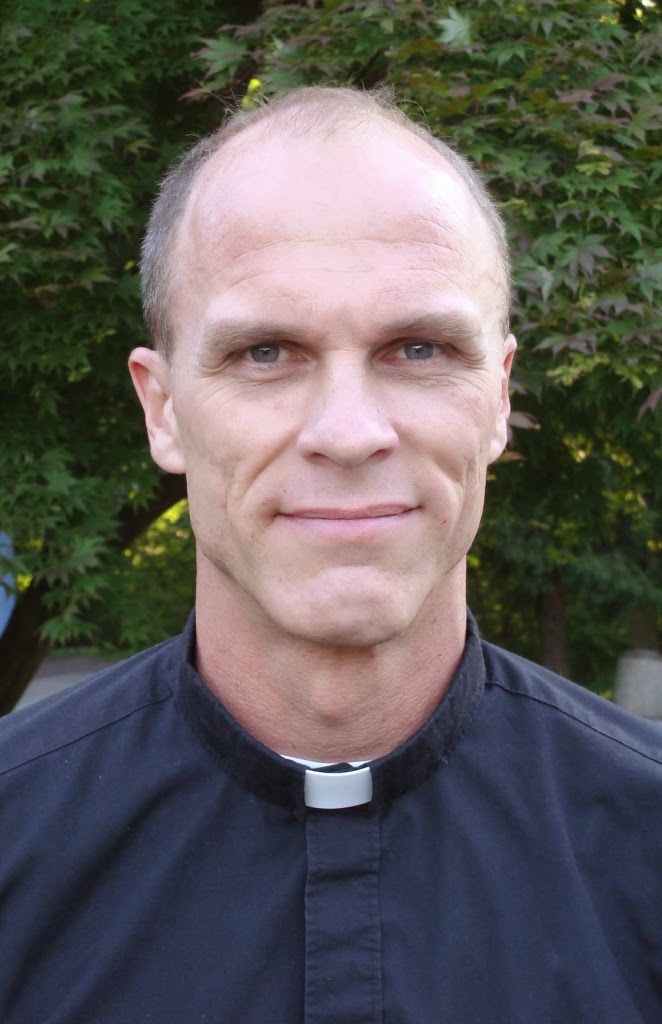
Fr. Dennis Hartigan Professes Vows as a Salesian

Fr. Dennis Hartigan
Professes Vows as a Salesian

In the presence of 25 Salesians, the 830 students of Don Bosco Prep in Ramsey, N.J., the school staff, a priest and a deacon from the Diocese of Toledo, family members, and Ohio friends, Fr. Dennis Hartigan, SDB, made his profession as a Salesian, for one year, on Friday, October 3.

With Fr. Jim McKenna and Bro. Bernie Dube' as witnesses,
Fr. Dennis pronounces the vows of poverty, chastity, and obedience
as a Salesian. Fr. Tom Dunne, provincial, receives his profession.
Fr. Dennis returned to the Salesians as a candidate in July 2013 after 33 years as a priest of the Toledo Diocese in Ohio; he had been a Salesian in temporary vows from 1971 to 1977 but departed to become a diocesan priest. As a candidate he taught religion at Don Bosco Prep, and he continues as a teacher there. Fr. Tom Dunne, provincial, received his profession.

Fr. Dennis was born in Kearny, N.J., in 1950, and after his graduation from Kearny High School entered the Sons of Mary program at Don Bosco College in Newton in 1969, where his classmates included the future Fr. Jim McKenna and Bro. Bernie Dubé. Last Friday Fr. Jim and Bro. Bernie were the official witnesses of Fr. Dennis’s renewal of Salesian profession.

After his first profession on September 1, 1971, then-Bro. Dennis completed his college studies at DBC, then did two years of practical training as a missionary in the Dominican Republic. He started theological studies in 1976 at the Pontifical College Josephinum in Worthington, Ohio, where almost all our province’s men went for theology from 1967 until the late 1990s. But at the end of his first year and the expiration of his triennial vows, Dennis opted to seek the diocesan priesthood, was accepted as a candidate by Bishop Donovan of Toledo, and transferred to Mount St. Mary’s Seminary of the West in Cincinnati.

Fr. Dennis was ordained in 1980 and spent the next 33 years as a parish priest, high school teacher and administrator, and college professor. He earned a doctorate in educational leadership from the University of Dayton in 2004.

Fr. Tom Dunne rehearsed some of those biographical details for the DBP students as he started his homily. He observed that in Ohio Fr. Dennis had retained his Salesian spirituality and brought it to his ministry in the Toledo Diocese. His priorities were the same; only the manner of living them out as a diocesan priest was different.

After being vested with the medal of a temporary professed SDB
and receiving a copy of the Constitutions, Fr. Dennis makes his way
back to his seat with the other concelebrants.
But Fr. Dennis felt called, finally, to live those priorities by vow in the context of religious community and to evangelize the young through living poverty, chastity, and obedience as a member of a community.

The vocational journey of Fr. Dennis, Fr. Tom said, is a lesson for everyone’s life. He continually discerned God’s movement in his heart. God has a role for us in life, a way for each of us to contribute to society, and we go through life trying to discern that role. It’s a process of listening and being sensitive to the movements of our hearts.

Fr. Tom expressed his appreciation for how Fr. Dennis made a transition from using a PhD in education to teach at the university level to teaching five periods of freshman religion at DBP, and doing so with great joy.

We all rejoice, Fr. Tom said, because Fr. Dennis has answered God’s call, and we rejoice also because of the support his vocation has received from the DBP community—SDBs, staff, and students.

At the end of Mass, Fr. Dennis spoke, making three points. 1st, he thanked Fr. Tom for all his assistance in the long process of returning to the Congregation, then thanked the SDBs of Ramsey, the students, and the rest of the confreres of the province for their support. 2nd, after commenting on how proud he has been to represent DBP in the area (and how much he’s enjoyed teasing alumni of certain other schools), he urged the students to listen to Don Bosco’s call to become his sons and continue his apostolic mission. Finally, he explained how joyful it is to be a Salesian in general and a member of the DBP community in particular, commenting on some of the fun the SDBs have at home.


Sunday, October 5, 2014

Homily for 27th Sunday of Ordinary Time

Homily for the
27th Sunday of Ordinary Time
Oct. 5, 2014
Is 5: 1-7
Phil 4: 6-9
Matt 21: 33-43
Iona College, N.R.
St. Ursula, Mt. Vernon

“Let me now sing of my friend, my friend’s song concerning his vineyard” (Is 5: 1).

(At Iona: Unfortunately, the recent work on the little house over yonder resulted in the removal of the chain link fence behind it, and thus also of the grape vines that graced the fence.  I’m sure those few vines didn’t qualify as a vineyard, and I never heard any of the brothers singing out there.  Then, again, I think the grapes were wild, so maybe they weren’t worth singing about.)

The poem from Isaiah that we read this evening/morning obviously was chosen to match Jesus’ parable of the wicked tenant farmers—a parable that’s a kind of a follow-up to the parable we heard last week, in the 5 verses immediately preceding this parable in Matthew’s Gospel, about the 2 sons who were asked to go and work in the family vineyard (21:28-32).
Vineyard in Tuscany (Rita Mendl)
But Isaiah’s prophecy stands on its own as a kind of parable about the Lord’s care for the Jewish people and his bitter disappointment at their failure in Isaiah’s time (the 2d half of the 8th century B.C.) to respond to his care, a disappointment that leads to disaster for them:  “Yes, I will make it a ruin” (5:6).

The Lord is the prophet’s friend, according to the prophetic poem (5:1), and the Lord’s care for his vineyard bespeaks love, a desire to befriend all of Israel and not just the prophet:  the friend has chosen the vineyard’s location carefully, worked hard to prepare the ground, made choice plantings, taken protective measures, prepared equipment for the harvest.  Such care merits a response of good fruit, of loving devotion.  “What more was there to do for my vineyard that I had not done?” the Lord asks with frustration (5:4).  The vineyard has gone its own way—an image of what the kingdom of Judah, its kings and nobles and priests, has done in Isaiah’s time.

When people go their own way, the Lord does 2 things:  he sends prophets to warn them, to try to lead them back to the right path, and Jesus seems to suggest that in his parable of the tenant farmers today (Matt 21:36); and if they don’t respond to the prophets, he allows them to suffer the consequences, which are inevitably disastrous.  That’s a theme of the Book of Judges, of 1-2 Samuel, and of 1-2 Kings, and it’s a constant warning in the prophetic books of the O.T. as well as in some of Jesus’ parables.

It’s not fashionable to make statements today like those prophecies of old; it’s quite politically incorrect.

Do you think the prophecies of Isaiah, Jeremiah, Amos, and the rest are only for our knowledge of ancient Israel?  Do you think they don’t have anything to do with us today?  Or perhaps that they’re only about individuals—if you personally are unfaithful to God, you’ll be punished here or hereafter or both?

Then consider the serious natural disasters afflicting us, year after year:  storms, wildfires, epidemics, and so on.  Consider the sad state of public life.  Consider the tens of thousands of people who’ve fled and are fleeing their homes because they can’t find work, can’t feed themselves, or are threatened by deadly violence.  Consider drug trafficking and human trafficking.  Consider war and terrorism.  Did I leave anything out?

The Bible tells us, “Sow the wind and reap the whirlwind” (Hos 8:7).  Like the vineyard of Israel, when any society goes its own way and has no regard for the One who designed and planted it, that society will collapse.  If we don’t respect the natural world that God created for us, the natural order of that world will break down:  global warming, melting glaciers, rising oceans, weird weather patterns, etc.  If we’re not concerned about justice, we’ll have injustice.  If we’re not concerned about truth, we’ll have lies and deception.  If we’re not concerned about integrity, we’ll have corruption.  If we’re not concerned about the natural meaning of sexuality, marriage, and family, we’ll have a selfish and chaotic society.  If we’re not concerned about human dignity, we’ll have domestic abuse, sexual abuse, abortion, gang violence, and slave labor.  If we don’t honor God’s law, we’ll have only human law:  which mostly means “might makes right.”  Using the Jerusalem Bible translation for Isaiah’s last verse, the Lord “expected justice, but found bloodshed; integrity, but only a cry of distress” (5:7).

St. Paul today advises us how to address life’s difficult issues:  “Have no anxiety at all, but in everything, by prayer and petition, with thanksgiving, makes your requests known to God” (Phil 4:6).  We pray.  We pray for ourselves and for our society.  We do that in our general intercessions and in our private prayer.

Paul continues:  “Whatever is true, whatever is honorable, whatever is just, whatever is pure, whatever is lovely, whatever is gracious, if there is any excellence, and if there is anything worthy of praise, think about these things” (4:8).  Think about these things:  shape your interior attitude; shape your heart; shape your soul.  For your actions will follow your heart.  Be a person of truth, honor, justice, purity, etc.  Be an example for your children, grandchildren, students, colleagues, et al., so that your message, mostly unspoken, will be Paul’s:  “Keep on doing what you have learned and received and heard and seen in me” (4:9).  Peace, purity, justice are attractive and make people want to be with us, be like us.

And in this free society of ours, hold our public officials, corporations, banks, places of business, schools, and sources of entertainment accountable.  Demand that they too be persons or institutions of truth, honor, justice, purity, and general excellence.  The renewal of our society begins with you and me.

“Then the God of peace will be with you” (4:9).  Then the Lord’s face will shine upon us, and we shall be saved (cf. Ps 80:20).

Saturday, October 4, 2014

Homily for 26th Sunday of Ordinary Time

Homily for the
26th Sunday of Ordinary Time
Sept. 28, 2014
Matt 21: 28-32
Iona College, New Rochelle

“Jesus said to the chief priests and elders…:  ‘A man had 2 sons. . . .  Which of the 2 did his father’s will?’” (Matt 21: 28, 31).

The short parable that Jesus tells today presents his audience with a choice, a decision, that affects their relationship with God, with “the Father.”  The short passage from the prophet Ezekiel does the same:  shall one lead a virtuous life or a wicked one?

The parable and the prophecy aren’t about choice alone but also about change, the possibility of change, the conversion of one’s behavior—which should follow one’s decision for obedience to God’s will, for a life of virtue.  Take note:  both readings are about one’s actions, not one’s interior attitudes, one’s heart, altho in Jesus’ parable the 1st son’s behavior is motivated by an interior conversion:  “Afterwards he changed his mind and went” (21:29).

It’s true—a fundamental doctrine of the faith—that our actions are not the cause of our salvation.  It’s impossible to earn grace, and it’s always the grace of God thru Jesus Christ that saves us.  Yet Jesus demands a response to his grace:  “If you love me, keep my commandments” (cf. John 15:10).  “Not everyone who says to me, ‘Lord, Lord,’ will enter the kingdom of heaven, but only the one who does the will of my Father in heaven” (Matt 7:21).  “Whoever hears my words and acts on them is like a wise man who built his house on a rock foundation, so that it withstood a flood and wasn’t swept away” (cf. Matt 7:24-25).

In other words, our actions indicate whether we’ve accepted God’s grace or not.  We must act like Christians 7 days a week—in our home lives, our professional lives, our recreational lives, our friendships—and not just go to Mass and recite the Creed.  One commentator has said this about our 3 most recent Popes:  John Paul II told us what to do.  Benedict XVI told why we should do it.  Francis tells us:  “Do it!”

Jesus makes plain that a positive response to his word—or conversion—is possible for anyone at any time.  Here he cites the prostitutes and tax collectors who followed him, their lives changed (21:32), to the scandal of all the “best” people.  On Calvary the so-called Good Thief found redemption (Luke 23:42-43)—whether he was a highway robber like those who waylaid the traveler on the road to Jericho in the parable of the Good Samaritan, or a murderer, or an insurrectionist like Barabbas, isn’t clear; but we can be sure he was more than a pickpocket.  The Collect today notes that God “manifests [his] almighty power above all by pardoning and showing mercy,” and of course Jesus is the embodiment of that mercy, God’s Word made flesh.

Perhaps some of us are burdened by our sins, sins of the distant past, sins in the present that we can’t seem to shake off.  While we breathe, it’s never too late to start over, to pick ourselves up and get ourselves into the vineyard (21:28); to let Jesus pick us up and to get back onto the journey with him of doing the Father’s will.  As for the past, what we said or did or failed to do years ago, it’s the past and we can’t change it; but we can give it to Christ and let him take care of it:  to pardon it, to erase it from the divine memory chip.

What about the 2d son, the one who said he’d go into the vineyard but didn’t go (21:30)?  The juxtaposition of today’s readings invites us to link him with “someone virtuous [who] turns away from virtue to commit iniquity, and dies” (Ezek 18:26).  Just as we can always turn to God and be saved as long as we’re still in this world, it’s also possible for us to turn away from God, to blow the save in the 9th inning, and lose everything.  We must beware of the sin of presumption, thinking that we’re secure in God’s grace, that we’ve got it (salvation) made and can relax our vigilance against temptation and sin, or worse yet, thinking that God’s infinite mercy will unfailingly overcome our own willfulness if we should “break bad.”

Some Protestants hold to a doctrine that once you’re saved—once you’ve accepted Jesus Christ as your personal Lord and Savior—you’re saved for good.  “Brother, have you been saved?”  Truly, Jesus died and rose to save us all from sin and death.  But in our individual cases, our redemption is never complete and guaranteed in this life, no matter what we profess in our Creed or catechism, not until our final “yes” to God, whether we’re affirming a life-long commitment like St. John Paul II, for instance, or making an end-of-life conversion like the Good Thief.  Even for the saints—read St. John XXIII’s Journal of a Soul—conversion is an ongoing project, a daily response to Jesus’ invitation to turn away from sin, believe in the Gospel, and walk alongside him until he escorts us into his Father’s kingdom.

Sunday, September 21, 2014

Homily for 25th Sunday of Ordinary Time

Homily for the
25th Sunday of Ordinary Time
Sept. 21, 2014
Matt 20: 1-16
St. Vincent’s Hospital, Harrison, N.Y

“The kingdom of heaven is like a landowner who went out at dawn to hire laborers for his vineyard” (Matt 20: 1).

The parable that Jesus tells today is usually called the Parable of the Workers in the Vineyard.  But the focus of the parable isn’t really on the workers; it’s on the owner of the vineyard.  At least one commentator aptly notes that it should really be called the Parable of the Compassionate Landowner.

1st, some context.  In the 2 passages in Matthew’s Gospel right before this parable, a rich young man has turned away from following Jesus, who apparently has told him that just keeping the commandments isn’t sufficient for salvation; he must give away his wealth and become totally reliant on God, like Jesus (19:16-22).  Jesus then remarks to his disciples, “It will be hard for one who is rich to enter the kingdom of heaven” (19:23)—an opinion that runs against everything that society believed then (and believes now).

Then the disciples question Jesus, particularly about the reward they might anticipate as his followers who have given up a lot of earthly goods.  He answers that they’ll be well rewarded with eternal life (19:27-29), and he concludes by saying, “Many who are first will be last, and the last will be first” (19:30), linking all that to today’s parable.

That saying of Jesus announces that he’s turning things upside down.  In our 1st reading, we heard something similar from the prophet Isaiah:  “My thoughts are not your thoughts, nor are your ways my ways, says the Lord” (55:8).  Jesus is reversing the way we are to judge everything in our lives.  It’s the same saying with which he ends our parable today, and it also appears in the middle of the parable when the vineyard owner instructs his steward to issue their pay to the laborers.  The parable illustrates the kingdom of heaven, as Jesus says—“the kingdom of heaven is like this”—and the kingdom doesn’t work the way most of us think it should.

What happens in the parable?  A vineyard owner goes to the village marketplace looking for day laborers, as a contractor or landscaper might do today at the DB Community Center in Port Chester, off Mamaroneck Ave. near the A&P in Mamaroneck, on Union Ave. in New Rochelle, or in numerous other designated spots in our area.  This landowner needs a certain number of men for the day (only men and youths in 1st-century Palestine; the women are home baking bread, washing clothes, fetching water and firewood, tending the small children), and he hires that many, agreeing to pay them a denarius, a silver coin that was a common laborer’s standard wage for a day—a basic wage to meet a family’s essential needs for the next day.

But the landowner returns again and again to the market:  at midmorning, at noon, in midafternoon, and late in the afternoon.  This is not the usual practice.  In fact, it’s not usual that the landowner would be doing any of this hiring; that’s the job of the estate’s steward (the foreman in our translation).  Doesn’t the owner know how many men he’ll need for the day’s work—pruning the vines, hoeing the weeds, watering, or whatever?  If not, what kind of a businessman is he?

As we see, he’s not really a businessman but a philanthropist.  He goes out repeatedly not because he needs workers but because all those men need work.  They need their meager income to live on.  There’s no unemployment, no health insurance, no social security, no soup kitchen.  If they don’t work, their families may not eat tomorrow, and if they work only part of the day, their families may eat only a little.

The landowner, thus, is extremely compassionate, 1st, by returning 4 times to the market and offering work to these unfortunate men; 2d, by giving them work to do and not merely a handout, which, most of us understand, lessens one’s self-image; and 3d, as we hear, by paying all of them a full day’s wage, not out of “fairness” or justice or duty, but out of compassionate generosity.

Did those later workers earn a denarius?  Did they deserve one?

The kingdom of heaven, Jesus says, is like this.  There’s also a subtle change in the word used for the landowner that’s not reflected in our English translation.  In Matthew’s Greek text, vv. 1 and 11 use the word oikodespote, a head of household.  In the other places where our English text has “landowner,” Matthew’s Greek has simply “he”—except in v. 8, where, speaking to his steward or foreman, he is called kurios, “lord.”  Subtly, then, we’re being told that this is the Lord’s way of operating, or managing a “vineyard” called the kingdom of heaven.

What is that way, that way that turns things upside down?  Compassion for the needy—whether they’re needy in purely material terms (food, shelter, education, health care, personal safety) or needy in terms of grace, forgiveness, salvation.

Note too that the Lord goes personally to look for these needy men; he doesn’t send his steward.  Jesus looks for his people personally; he goes out looking for them, like the shepherd who loses one sheep (Matt 18:12-14); he doesn’t wait for them to come to him, doesn’t dismiss them, saying, “Too bad, but I have all the laborers I need.”  In another parable of the kingdom of heaven, a king sends his servants out far and wide to fill his banquet hall for his son’s wedding; he’s not satisfied till there’s no room left (Matt 22:1-10).

What do the laborers do to deserve such compassion?  Just show up; just answer the landowner’s invitation.  So we do need to do something to attain that reward we call the kingdom of heaven:  we have to say “yes” to Jesus, rather than telling him we don’t need him, like the rich young man who walked away from Jesus; we have to go where he wishes with our lives:  “You too go into my vineyard.”  But he’ll be generous with us far beyond our expectations or desserts.

What about the workers who “bore the day’s burden and the heat” and got only one denarius (20:12)?  For Matthew toward the end of the 1st century, perhaps they represent the Jewish people, who followed God and kept the Law for so long, and then saw the Gentiles, too, being invited suddenly to be saved by Christ’s grace and freely invited into the kingdom of heaven.  In our time, there are still people who look down on others and don’t think they’re worthy of God’s attention and mercy.

But the last shall be first.  Everyone’s welcome in God’s kingdom.  Just say “yes.”

Change at Salesiana Publishers

Change at Salesiana Publishers

Salesiana Publishers is the publication arm of the Salesians of Don Bosco in the U.S. For some years (in the 1970s-1990s) it went by the names Don Bosco Films & Filmstrips and Don Bosco Multimedia.

Since about 1995, SP has handled primarily books, pamphlets, and videos about St. John Bosco and the Salesian Family, and we have outsourced the fulfillment part of the business to a private company, SRM Distribution Services, located in Paramus, N.J.  They took orders (by phone, fax, or e-mail), filled them, billed them, collected payments, and made the bank deposits for us.

This month (Sept. 2014) SRM closed the business; it seems to have become a bit too much for the proprietors to handle.  We enjoyed collaborating with them for these 19 years.

Until some other arrangement is made, our customers may place orders directly to our office in New Rochelle thru Jo Ann Donahue during regular business hours (M-F, 9:00 a.m. to 4:00 p.m.):

By phone: 914-636-4225

By fax: 914-636-4925

By e-mail: butterfly10801@yahoo.com

We'll fill your orders as quickly and as competently as we can, as SRM did for us.

Update, Feb 20, 2015:  still unable to make fulfillment arrangement, and so filling orders from our editorial office,

Sunday, September 14, 2014

Homily for Feast of the Holy Cross

Homily for the
Feast of the Holy Cross
Sept. 14, 2008
Preface
Woodbadge Course, Putnam Valley

“You placed the salvation of the human race on the wood of the cross, so that, where death arose, life might again spring forth, and the evil one, who conquered on a tree, might likewise on a tree be conquered, thru Christ our Lord” (Preface).

Today’s feast is titled “The Exaltation of the Holy Cross”; in days of yore it was called “The Triumph of the Cross.”  It’s the feast of the triumphant lifting up of the cross, the glorification of the cross—not so much the cross itself, as Him who is fixed to it.  Thus it is a feast of the Lord Jesus, one of those occasional feasts that supplants our regular Sunday celebration in Ordinary Time.

The specific date, Sept. 14, commemorates 2 historic events and alludes to a 3d one.  According to the story—whether it’s embellished history, we’re not sure—on Sept. 14, 320, St. Helena, mother of Constantine, found and identified the cross on which Jesus had been crucified, and some years later, also on this date, that most sacred relic of our redemption was solemnly installed in the new basilica that Constantine had built on Mt. Calvary.  Early in the 7th century (not long before Mohammed’s followers changed everything in the Middle East), a Persian army invaded Jerusalem and carted off the cross along with other loot.  Then a Byzantine army pursued and defeated the Persians and got the cross back, which was triumphantly returned to its basilica.

Finding of the True Cross, by Piero della Francesca
Still, our feast celebrates not St. Helena or a church or a victory of Christians over pagans; it doesn’t celebrate a piece of wood.  Rather, it celebrates what happened thru the instrumentality of that wood:  our redemption, effected by the crucifixion of Jesus Christ, and of course also by his resurrection on the 3d day, which turned death into life, defeat into victory.

The preface for today, from which I quoted at the beginning of the homily, emphasizes the paradox of the cross.  It alludes to the sin of our 1st parents, whom “the evil one conquered on a tree,” the tree with the forbidden fruit; the image is of the serpent twined around the tree, as we see in classical art and in cartoons.  The preface tells us how God used another tree—the cross—to conquer the evil one and save us.

In the ancient world death by crucifixion was the most painful and most degrading form of capital punishment.  It was reserved for rebels, pirates, highwaymen, the worst criminals, and couldn’t be inflicted upon Roman citizens; it was beneath their dignity, fit for slaves and 2d-rate peoples.  You can imagine the humiliation of being stripped naked—at least in a less exhibitionist culture than ours; the pain of being nailed to a cross by your wrists and feet (the nails going right thru the ulnar nerve, they tell us); the trauma of trying to breathe while hanging by your arms for hours, or even days, as is known to have happened at times.  Recall Pilate’s amazement that Jesus had died as quickly as he did (Mark 15:44), which probably was because he’d been so savagely scourged the previous evening.  No wonder that early Christian hymn that Paul quotes lauds Jesus for “humbling himself, becoming obedient even unto death on a cross” (Phil 2:8).

Yet that humiliation, that suffering, that trauma, which the pagan world regarded (Paul says), and still regards, as foolishness (1 Cor 1:18,23), conquered Satan, won for mankind a victory over our sins and the condemnation that our sins deserve.

The preface proclaims that God “placed the salvation of the human race on the wood of the cross.”  That “placing” can be read as an allusion to Moses’ placing the bronze serpent on a pole, as we heard in the 1st reading (Num 21:4-9) or, perhaps more appropriately, Abraham’s placing his beloved son Isaac on the woodpile atop the altar, preparing to sacrifice him (Gen 22:9).  We can’t really understand what God’s will involved regarding the suffering and death of Christ; certainly not a sadistic desire for blood atonement, but we can say at least a desire that his Son be faithful to the truth, proclaim forgiveness, offer God’s love to everyone, regardless of the consequences, and so Jesus was “obedient to the point of death, even death on a cross,” and his obedience “placed” him there.

The Crucifixion, by Giotto
“The salvation of the human race” was “on the wood of the cross.”  That “salvation” is the act of our redemption, effected thru Christ’s death and resurrection.  It’s also Christ himself.  He is our salvation, our life, our resurrection, as the entrance antiphon proclaimed.  The cross killed him, but as the preface says, from that cross “life sprang forth again,” not only for him but for all who belong to him, who are incorporated into his Body, as we are thru our Baptism and the Holy Eucharist.  “For God so loved the world that he gave his only Son, so that everyone who believes in him might not perish but might have eternal life” (John 3:15).

Saturday, September 6, 2014

Homily for 23d Sunday of Ordinary Time

Homily for the
23d Sunday of Ordinary Time
Sept. 7, 2014
Matt 18: 15-20
Iona College, New Rochelle, N.Y.

“If your brother sins against you, go and tell him his fault between you and him alone” (Matt 18: 15).

The gospels of the last 2 Sundays have been concerned with the foundations of Christ’s Church:  with its faith in Jesus the Christ; with its authority, especially as exercised by Peter; with its following a Christ who was crucified.

Today, too, the gospel is concerned with the Church:  with the Church calling us to conversion, with the Church reconciling us to God and to others, with the Church interceding with God.

On 1st reading, it may appear that Jesus’ words address private faults of concern to 2 individuals:  he dumps his dirty clothes on the floor and won’t put them into the hamper; she’s a nag; he wants to read all my e-mail; she takes forever to get ready to go out; I love my boyfriend, but he hates my cat (that one was in “Dear Abby” on Friday).

But on closer reading, we see that Jesus is concerned about more public matters, offenses that affect the community.  (One of the Greek words for community is ekklesia, which is in our text, translated as “church.”)  Altho many people take private issues of the sort to which I’ve already alluded to Abby or Judge Judy, we can’t really imagine that Jesus means they should be brought to community authority—“2 or 3 witnesses” (18:16) or “the church” (18:17).  So Jesus is speaking of bigger issues.

What sorts of issues might come under the rubric “sins against you” (the Greek text uses the singular form of you, which in older English we’d render as “thee” or “thou”), and still be issues of general concern?

We might imagine fraud or theft of some kind; St. Paul seems to allude to that in 1 Cor 6.  We might imagine gossip or slander harmful to someone’s reputation.  Listen to Pope Francis at his general audience on Aug. 27:

"Sometimes, in fact, our parishes, which are called to be places of sharing and communion, are sadly marked by envy, jealousy, resentment." "This is human, but it is not Christian!" the Pope said.
"How much gossip (goes on) in parishes," the Pope lamented. "We mustn't do it! I won't tell you to cut off your tongue. No. Not that. But do ask the Lord for the grace to not do it, all right?"

The refusal to gossip, in fact, is such an outstanding Christian virtue, it should make a person a saint overnight, the Pope said. He recalled the sterling reputation of an elderly woman who used to work in a parish in … Buenos Aires. People remembered her as someone who "'never talked badly of others, never gossiped, was always with a smile.' A woman like that can be canonized tomorrow! This is beautiful, this is a great example," he said to applause.

http://clipart.christiansunite.com/
Conflict arises when people judge others; look only at others' defects, not their gifts; give more weight to differences than common ground; make themselves the top priority; and follow their own ambitions and points of view, he added. "In a Christian community, division is one of the gravest of sins because it turns it into a sign not of God's work, but of the devil, who, by definition, separates, ruins relationships and instills prejudice."[1]

We might imagine marital infidelity or other sexual immorality (see what Paul writes in 1 Cor 5).  Such sins are both personal and communal, damaging to individuals and to the community at large.  We might also imagine false teaching about faith or morals, altho in that instance we’ve already passed from “sins against you [singular]” to “you [plural].”

So Jesus teaches that those who sin against the community must be corrected, but with charity and with as little fuss as possible:  privately if possible; a little more publicly if necessary, with “2 or 3 witnesses.”  Witnesses to what?  Witnesses to the offensive behavior or false teaching; witnesses to the Church’s authentic faith and way of life.  E.g., various bishops say that they’ve spoken privately with certain politicians about their immoral and scandalous positions on certain public issues.  Our bishops have said that they would call out their fellow bishops if need be about how they address sexual abuses cases; whether they’re doing so privately, I don’t know, but I know of only one public instance involving an American bishop—Abp. Gomez’s sidelining of his L.A. predecessor, Cardinal Mahony.

Finally, Jesus would have the entire Church challenge or confront the offender:  “If he refuses to listen to them, tell the church” (18:17).  In 1st-century terms, “church” means the local congregation, such as the church at Jerusalem or Corinth or Ephesus.  And today we ought still to look to the local Church, in New York or Tokyo or Paris, as the case may be, before going to the universal Church—the Pope and his curia.

So the Church has authority to judge the faith and the behavior of her members and determine whether they’re genuinely Christian.  Jesus goes one:  “If he refuses to listen even to the church, then treat him as you would a Gentile or a tax collector” (18:17).  I.e., if he won’t repent, then he is to be removed from the fellowship of the community in some manner.  Some bishops have forbidden certain individuals to receive Holy Communion because of their scandalous public opinions.  Priests who engage in partisan politics or actively push women’s ordination have been sanctioned in various ways.

Jesus reinforces the authority of the Church by adding, “Amen, I say to you, whatever you bind on earth shall be bound in heaven, and whatever you loose on earth shall be loosed in heaven” (18:18).  You’ll remember that those same words were addressed to Simon Peter individually 2 weeks ago (16:19).  Now they’re addressed to all the apostles, and by extension to the apostles’ successors.  The binding and loosing may refer to interpretations of Christ’s teachings, to Church laws, or to membership in the community.  Jesus hands to his Church a great share of his own authority.

http://clipart.christiansunite.com/
“Treat him as you would a Gentile or a tax collector.”  How does Jesus treat Gentiles and tax collectors?  He calls them to conversion, and he welcomes their conversion.  So even if the Church must cast someone out of the community, we don’t consign them to hell!  We continue to invite them to return to the faith and the practice of the community, to treat them with the dignity due to every person, and to pray for them—which Jesus confirms with his words at the end of today’s gospel (18:19) even as he affirms his presence in the community (18:20).  The Church’s intercessory role for all of humanity is a vital part of her mission, of her exercising Jesus’ mission of reconciling everyone with God.

Note the repetition of “2 or 3” in this reference to prayer.  It hearkens back to the “2 or 3 witnesses” of someone’s fault.  As the first 2 or 3 testify to an individual about his failing, here 2 or 3 testify to God about their concern.

There’s one more thing to be said.  “If he listens to you, you have won over your brother” (18:15).  Whether we’re dealing with religious community, the family, the parish, or even our internal beliefs, are we humble enuf to listen to our brother or sister or relative or pastor or the Church’s authoritative teaching and to change our own behavior or our own opinions?  The call to conversion applies to me too!


                [1] Carol Glatz, “Pope: Being envious, mean-spirited may be human, but it's not Christian,” CNS Aug. 27, 2014.

Sunday, August 31, 2014

Homily for the 22d Sunday of Ordinary Time

Homily for the
22d Sunday of Ordinary Time
Aug. 31, 2014
Rom 12: 1-2
St. Ursula, Mt. Vernon, N.Y.

“I urge you, brothers and sisters, by the mercies of God, to offer your bodies as a living sacrifice, holy and pleasing to God, your spiritual worship” (Rom 12: 1).

In the ancient world, the Jewish people offered sacrifice to God, and pagans to their supposed gods, in several ways, including burning incense, pouring out wine on an altar, setting aside bread or other food, and especially animal sacrifice:  bulls, sheep, goats, and fowl.  Paul’s readers in Rome would’ve been very familiar with all those practices carried out in the temples of the pagan gods.  In some places, as we read in the OT and we know from the history of the Americas, human sacrifice was practiced.

Abraham preparing to sacrifice Isaac, with a ram caught in a bush nearby--
mosaic in the National Shrine of the Immaculate Conception, Washington
Christ changed all that for his followers.  As the Letter to the Hebrews says, he offered his body once for all (7:27).  No further sacrifice is necessary beyond the body of Christ offered on the cross.  Nothing more need be poured out beyond his blood.

It’s precisely his body and blood that we offer in the Eucharist, offering him to the Father as a sacrifice of praise and atonement, uniting our wills, our hearts, our minds with all that Jesus brought to Calvary—with all of Jesus that was raised up by the Father on the 3d day, so that we might be raised up with Jesus.

But this morning St. Paul urges us to take another sacrificial step:  “offer your bodies as a living sacrifice.”

A living sacrifice, not a dead one, like the animals slain upon an ancient altar, and their bodies then either burned or consumed in a sacred meal.

How do we followers of Christ offer our bodies as living sacrifices?  I’ll suggest 3 ways.

1st, when we come to worship the Father thru Christ our Lord, led by the Holy Spirit, we worship not only with our souls and our minds but with our bodies.  Some Christians really put their bodies into their worship—the “holy roller” type and those we call charismatics.  In some cultures, even ordinary Catholic worship is extremely lively; if you’ve ever been to the Bahamas or to Africa, you’ve seen that, and you might very well see it in an Afro-American parish.  The more sedate Catholic culture that we’re familiar with, whether it’s influenced by the Irish or the Italians or the Germans or the Poles, doesn’t go for the shaking, the dancing, the hand-waving, and shouting “Hallelujah” and “Amen” during the sermon.  But we still worship God with our bodies:  we sit, we kneel, we stand, we process, we respond verbally, we sing, we burn incense, we light candles, we use art and music, we celebrate sacraments that appeal to our senses of sight, sound, taste, touch, and smell—we pour water and smear oil, we touch and taste the Holy Eucharist, we vocalize our sins and hear the words of divine pardon, husbands and wives give their bodies to each other, in all of this worshiping God with our bodies, offering our whole bodies and our whole hearts to God in union with Christ’s self-offering.

Yes, we use water!
I think I lifted this pic from The Deacon's Bench
2d, we offer God the aches and pains and trials of every day that come to us with and thru our bodies.  How many of you went to Catholic school?  How many times did Sister tell you, “Offer it up” when something hurt or the weather was hot or you were disappointed by something that happened (or didn’t happen)?  Once we reach a certain age, when we wake up in the morning, one of our 1st thoughts is, “What hurts today?  Is it my back, my hip, my knees, my shoulder, my arthritic hands?”  Then there are medical procedures and physical therapy, restricted diets, limits on physical activity that we enjoy.  Younger folks struggle to get up in the morning to go to work or get the kids ready for school.  Some of us do manual work, whether it’s cleaning the house, maintaining the car, laying brick, landscaping, craftsmanship, typing, working machinery.  The weather doesn’t please us because it’s hot and humid, or cold and damp, or it’s rained on our picnic (the heat and threat of thunderstorms forecast for this afternoon and evening have induced Fr. Jim Mulloy and me to cancel a camping trip).  In all of this, our bodies come into play.  It’s all something we can offer to God “as a living sacrifice,” as “spiritual worship” because our interior intention presents it humbly to him.

Nor does this offering of our bodies have to be something difficult or painful.  We can also offer God something we enjoy.  There’s a story about St. Teresa of Avila enjoying a delicious meal and praising God for his goodness.  Yes, we praise God for the legitimate pleasures of life—fine food, pleasant weather, good exercise, the beauties of nature, family gatherings, the holy sacrament of matrimony.  This too is our “spiritual worship” when we present it to God with gratitude.

3d, we offer our bodies as a sacrifice, holy and pleasing to God, when we turn away from temptations that appeal to our senses in a way that’s harmful to ourselves or others, temptations to illegitimate pleasures.  Some of the 7 deadly sins involve our bodies:  lust, gluttony, and sloth directly; avarice, envy, anger, and pride may involve them indirectly.  To tell ourselves NO to an excess of food or drink, to laziness, to a pornographic impulse (or a worse kind), to an urge to possess more and more stuff that we don’t need, to the feeling that comes (at least initially) from getting even with someone is an offering of our bodies to God.

A final note:  Paul alludes to “the mercies of God” in this self-offering.  It is a gift from God, a mercy of God, that we’re able to take part in Christ’s sacrifice, whether it’s the sacraments or any other form of offering ourselves as living, holy, and pleasing sacrifices.  God’s mercy doesn’t just forgive our sins but calls us higher—to this sacred union of our bodies and souls with our Savior Jesus Christ.

Monday, August 25, 2014

More 2014-2015 Assignments

More 2014-2015 Assignments

On Aug. 15 and 22, two feasts of our Blessed Mother, Fr. Tom Dunne announced additional pastoral assignments for the SDBs of the New Rochelle Province. Various of these had required confirmation from the dioceses concerned.


Fr. Steve Shafran
Fr. Steve Shafran has been appointed director of the community in Silver Spring-Takoma Park, Md., in addition to continuing as president of Don Bosco Cristo Rey HS. He replaces Fr. George Hanna as director. Fr. Steve was director-president of Don Bosco Prep in Ramsey, N.J., from 1998 to 2004.

In Edmonton, Alta., two confreres were appointed pastors: Fr. Antony Fernando at St. Andrew Parish, and Fr. John Mariaparagrasam at Annunciation Parish. Both of these priests are on loan to our province from the Madras Province.

Fr. John DiFiore, who was pastor of St. Rosalie Church in Harvey, La., goes to St. Philip Benizi Parish in Belle Glade, Fla., as assistant pastor and youth minister.

Fr. Larry Urban, who has been pastor of St. John Bosco Church in Harvey, will serve also as pastor of St. Rosalie. He'll be assisted at St. Rosalie by Fr. George Hanna, former pastor of Nativity Church in Washington, from which the SDBs withdrew in July.

Fr. Don Delaney has been assigned to St. Petersburg Catholic HS to help with pastoral work and some school work.

Bro. Craig Spence will reside at Don Bosco Prep in Ramsey while continuing his postnovitiate formation and college studies.

Two confreres have been assigned to the formation staff of the house in Orange, N.J.: Fr. Javier Aracil, leaving St. Anthony Church in Elizabeth, and Fr. Vince Pazckowski, transferred from Corpus Christi in Port Chester, N.Y.

As already noted in July, the SDBs have withdrawn from St. Anthony in Elizabeth. The former pastor, Fr. Pat Angelucci, has joined the staff of the Marian Shrine in Haverstraw. Fr. Tom Brennan, the SDB liaison to the United Nations, was in residence at St. Anthony and has moved to Holy Rosary in Port Chester.
Fr. John Cosgrove


Fr. John Cosgrove has been appointed pastor of Corpus Christi Church in Port Chester, succeeding Fr. Tom Ruekert.

Fr. Miguel Suarez moves from the provincial house to Holy Rosary and Corpus Christi as assistant pastor and youth minister for both parishes.

Fr. Mike Leschinsky has become a member of the provincial residence community here in New Rochelle.

We think this concludes the assignments for the coming year!