Wednesday, July 4, 2012

Homily for 13th Sunday in Ordinary Time

Homily for the
13th Sunday
in Ordinary Time

I was away on vacation from last Thursday afternoon (June 28) till early this afternoon (July 4). On Sunday I concelebrated at the Oakland Mills site of St. John the Evangelist Parish in Columbia, Md., my sister's parish. We heard a very good homily there. Following my custom, I offer here an "oldie" of my own.

July 2, 2000
Wis 1: 13-15; 2: 23-24
Mark 5: 21-24, 35-43
Our Lady of Pompei, Paterson, N.J.
St. Joseph, Passaic, N.J.

On July 2, 1776, the Continental Congress in Philadelphia, representing 13 of the British colonies along the eastern seaboard of North America, voted their independence from Great Britain. The protest being fought to assert their equal rights as Englishmen became a war to assert their complete freedom among the nations of the earth.  Happy Independence Day!

The next evening, July 3, delegate John Adams of Massachusetts wrote home to his wife Abigail:

The second day of July, 1776, will be a memorable epocha [sic] in the history of America.  I am apt to believe that it will be celebrated by succeeding generations, as the great Anniversary Festival.  It ought to be commemorated, as the day of deliverance by solemn acts of devotion to God Almighty.  It ought to be solemnized with pomp, shews [sic], games, sports, guns, bells, bonfires and illuminations, from one end of the continent to the other, from this time forward forever.

We have certainly done justice to Adams’s confidence in the outcome of the struggle and to his hopes for the celebration of our freedom—except perhaps for the “solemn acts of devotion to God Almighty.”  As you know, religion doesn’t get much play in our Independence Day festivities.  And except, certainly, for the day of our celebration.  Thomas Jefferson’s magnificent Declaration setting forth the reasons for independence so captured our hearts and minds that the day of its adoption by Congress, July 4, also captured the celebrations so fondly expected by his colleague Adams.
Declaration of Independence by John Trumbull--Rotunda of the U.S. Capitol (Office of the Architect of the Capitol)
We here do solemnly thank God for the blessings of liberty and pray him to continue them, as well as to pardon and correct our individual and our national, collective abuse of our liberty.

The War of American Independence was about political liberty.  Our 1st and 3d readings this morning address a different kind of liberty, one more fundamental, one more durable.  “For God formed man to be imperishable; the image of his own nature he made him” (Wis 2:23-24).  God made us to live; he “did not make death, nor does he rejoice in the destruction of the living” (Wis 1:13).

Yet death is a fact:  indisputable, unavoidable.  Even the little daughter of Jairus (Mark 5:21-24, 35-43) eventually died a permanent bodily death, as also did those others whom Jesus revived, the widow’s son and Lazarus.  With St. Paul, writing to the Romans, we can all cry out in exasperation, “Who will deliver me from this mortal body?” (7:24).  Who will liberate us from the tyranny of death?

“By the envy of the devil, death entered the world” (Wis 2:24).  This is the Book of Wisdom’s take on the fall of the human race in the garden of Eden.  Out of jealousy for the happiness of the human friends of God, the devil tempted them to spurn God’s friendship, as he himself had done.  And tempted, the 1st man and woman fell.  They chose a lie; they chose disobedience; they chose death.  “They who belong to [the devil’s] company experience [death],” Wisdom tells us (2:24).  Or, as St. Paul put it, to the Romans once again, “The wages of sin is death” (6:23).  Death is not God’s plan but the consequence of our own love for evil.

Paul’s earlier question, “Who will deliver me from this mortal body?”, he answered himself in the next line:  “Thanks be to God through Jesus Christ our Lord” (7:25).  Jesus Christ came to set us free:  to forgive our sins and erase their mortal consequences.

Jesus’ power over death during his earthly ministry, demonstrated in this morning’s gospel, foreshadows his own permanent victory over the grave.  Tho utterly sinless in his own person, he was led like a lamb to the slaughter (cf. Is 53:7).  He died, as every human being must.  But his death was an injustice, because he was sinless.  Therefore, the devil and the netherworld had no claim on him, and undying justice (Wis 1:15) compelled them to give him up.  God the Father justified his own Son by raising him to a new kind of bodily life, no longer mortal.  This we celebrated during the 7 weeks of Easter.  This we celebrate every Sunday, the day of the resurrection.  This we look forward to ourselves—not because we’re innocent and without sin (cf. Job 33:9), but thanks to the grace of God bestowed on us in Christ Jesus.  We have been baptized into his death and resurrection.  We eat his body and drink his blood in order that we might be incorporated into his righteousness before God and into his immortality.

So, before all our suffering and death, and even before the memory of our worst sins—provided we have repented and confessed them—we listen to the words of Jesus:  “Do not be afraid; just have faith” (Mark 5:36).  Have faith that he has truly conquered both sin and death.  He has liberated us all from the worst the devil can do to us.

Sunday, June 24, 2012

At the Catholic Media Conference

At the Catholic Media Conference

The Catholic Media Conference took place in Indianapolis from June 20 to 22, with about 400 attendees (my very rough guess--but Tim Walter, executive director of the Catholic Press Assn., told me that CPA was just shy of 300 registered participants; unless I misunderstood and that figure was for both associations involved).

The convention is sponsored annually by the CPA and the Catholic Academy of Communications Arts Professionals, and most of the attendees came from those 2 organizations, naturally.  We were also blessed by very active presence of Abp. Claudio Celli, president of the Pontifical Council for Social Communications, and his chief assistant, Msgr. Paul Tighe, and of several bishops either as speakers or as celebrants or as attendees: Abp. Charles Chaput of Philadelphia, Bp. Christopher Coyne of Indianapolis, Bp. Timothy Doherty of Lafayette (Ind.), Bp. Kevin Rhoades of Ft. Wayne-South Bend, and Bp. Ronald Herzog of Alexandria (La.).

I took a lot of photos of the meeting, the city, and our hotel (the Crowne Plaza at Historic Union Station). Here's a link to convention shots (I hope!):
http://share.shutterfly.com/action/welcome?sid=0AYsWrdi2ct2KlGQ
and one to city and hotel shots:
http://share.shutterfly.com/action/welcome?sid=0AYsWrdi2ct2KlGy

While I'd like to go into details about the convention, I'm not ready to do that.  So here's the next best thing:  links to Deacon Greg Kandra's reporting:

http://www.patheos.com/blogs/deaconsbench/2012/06/chaput-we-need-to-look-at-the-arc-of-catholic-history-in-our-country/

http://www.patheos.com/blogs/deaconsbench/2012/06/bishop-coyne-to-catholic-communicators-always-take-the-high-road/    (You can get Bp. Coyne's homily direct and entire at http://thoughtsofacatholicbishop.blogspot.com/2012/06/homily-from-opening-mass-of-catholic.html)

http://www.patheos.com/blogs/deaconsbench/2012/06/vaticans-social-media-head-we-need-to-cultivate-our-ability-to-listen-to-others/    Full text at http://www.pccs.va/index.php/en/documenti/dicorsi/item/670-2012-address-of-archbishop-celli-at-the-st-francis-de-sales-award-presidential-medallion-awards-indianapolis

http://www.patheos.com/blogs/deaconsbench/2012/06/on-blogging-our-panel-from-the-catholic-media-conference/    For some audio from that panel, supplied by Matt Palmer of Baltimore's Catholic Review: http://audioboo.fm/ReviewPalmer
Elizabeth Scalia, aka The Anchoress, reports a bit too:  http://www.patheos.com/blogs/theanchoress/2012/06/22/a-couple-catholics-sittin-around-talking/

More from Deacon Greg: http://www.patheos.com/blogs/deaconsbench/2012/06/its-true-it-dont-rain-there-in-the-summertime/

Other keynotes were given by Carolyn Woo, the new COO of Catholic Relief Services, and Carl Anderson, Supreme Knight of the K of C, and Abp. Chaput, and homilies by Bps. Doherty (shortest on CMC record, someone said) and Rhoades.

Abp. Chaput's address on religious freedom as summarized by Catholic News Service:
On the eve of the start of the "fortnight for freedom," the U.S. bishops' effort to galvanize Catholics across the country to pray for and learn about religious liberty, Philadelphia Archbishop Charles J. Chaput gave a major address on the topic during the 2012 Catholic Media Conference June 20. Arguing that "religious freedom is a cornerstone of the American experience," Archbishop Chaput said the American founders "saw religious faith as vital to the life of a free people. Liberty and happiness grow organically out of virtue," he said. "And virtue needs a grounding in religious faith." Religious liberty, however, is "more than freedom of worship," Archbishop Chaput continued. "It begins in worship, but it also demands preaching, teaching and service," he said. "It's always personal but never private." This liberty seen as so vital to the nation's founders, Archbishop Chaput said, is now facing threats that are "immediate, serious and real" and are often linked to a hostile reaction to Catholic teachings on sexuality and life issues. Citing an article written by University of Notre Dame law professor Gerry Bradley, Archbishop Chaput said critics of these teachings see them merely as "subjective religious ... that can't be rationally defended ... and should be treated as a form of prejudice."

Full text of the archbishop's speech at http://www.catholicpress.org/resource/resmgr/2012_cmc/repair_my_house_cjcfinal.pdf

And here's Catholic News Service's short version on Mr. Anderson's speech:
The debate over the federal contraceptive mandate and the fight for religious freedom is not about "a particular policy choice" but is "a debate over the role of religion in American society and the freedom and integrity of the Catholic Church's mission," the head of the Knights of Columbus said June 22. "It's not an ordinary national debate. There's a great deal at stake here," Supreme Knight Carl Anderson told Catholic News Service in an interview in Indianapolis. It is an attempt "to redefine the role of religion in America," he added. Anderson was at the Catholic Media Conference, the annual joint convention of the Catholic Press Association and the Catholic Academy for Communications Arts Professionals. He was scheduled to address the closing banquet of the June 20-22 media gathering. The mandate issued by the Department of Health and Human Services would require most religious employers to provide contraceptives and sterilization free of charge to their employees. To be exempt, a religious organization must have "the inculcation of religious values as its purpose"; primarily employ "persons who share its religious tenets"; primarily serve "persons who share its religious tenets"; and be a nonprofit organization under specific sections of the Internal Revenue Code. Catholics are at the center of the HHS debate right now, he said, but it began with the Lutherans in the Supreme Court case in Hosanna-Tabor v. EEOC, a challenge to a Lutheran school's firing of a teacher. The attempt to more narrowly define who is a religious employee was unanimously rejected by the U.S. Supreme Court. Anderson said "virtually every religious denomination" in the U.S. -- "from the Hare Krishnas to the Catholic Church" -- got involved in the case because the position taken by the Obama administration on Hosanna-Tabor, he said, could be characterized as the government's most restrictive definition of religious ministry.'

The Catholic News Agency, carried by the Knights themselves, has a longer report on the speech:
http://www.catholicnewsagency.com/news/supreme-knight-urges-catholics-to-put-faith-first-while-voting/ 

I took in a master camp on developing a communications strategy for your diocese/order and workshops on reaching young adults, copyediting, copyright law, the above-mentioned one on blogging, and the Eastern Regional meeting of the CPA, besides concelebrating at our 3 Masses (St. John the Evangelist Church, 2 blocks from our hotel, is Indianapolis's oldest Catholic church and a really beautiful one) and doing a lot of visiting with old and new friends in the press (or networking, if you want to call it that).

Someone named Lisa Ranae Shanteau, whom I don't know, took this photo in the copyright law workshop and captured me from behind (you can discuss whether that's the better angle--but at least you can see that I'm awake).

Homily for Solemnity of Birth of John the Baptist

Homily for the Solemnity 
of the Birth of
St. John the Baptist
June 24, 2012
Collect
Ursulines, Willow Dr., New Rochelle

“You raised up St. John the Baptist to make ready a nation fit for Christ the Lord…” (Collect).
Naming of John. Artist unknown. "Borrowed" from The Deacon's Bench.

1st, let’s thank the Lord that our translators have ditched “John the Baptizer” and returned to the traditional nomenclature.  (Actually, the Sacramentary never went with “Baptizer”; that was only the hapless 1st run of the NAB, amended when they revised the New Testament.)

Then, let’s thank the Lord for having called us to be his people, partly thru the ministry of John the Baptist.  God’s people is in fact the object or purpose of John’s life, according to our Collect.

Every collect begins with a statement of the mystery or saving event being commemorated on a given day, or a tribute to some divine attribute.  Today we note—and by implication praise God for—his having “raised up St. John the Baptist to make ready a nation fit for Christ the Lord,” and immediately move on to the petition part of the prayer:  “give your people, we pray….”  Thus the Collect identifies us—“God’s people”—with that “nation fit for Christ” which “John the Baptist made ready.”

Here we acknowledge John as the forerunner, as the lamp shining (John 5:35) in a dark place, as the one who points out the Lamb of God (John 1:29-36), as the one who steers his own disciples toward the One who is to come (John 1:19-40).  In his lifestyle, in his preaching, in his spiritual direction (if we may call it that), and finally in his martyrdom John is at the service to Someone greater than he—a service consisting largely in helping people get ready for that Someone, preparing the way.
John the Baptist. Cathedral of St. John the Baptist, Turin.
Isn’t that what we’re all supposed to do?  None of us is the Expected One—not even those sometimes called alter Christus (“other Christ”).  Rather, we’re the servants of Christ, or his friends (as he said at the Last Supper [John 15:15], and as John the Baptist referred to himself in a little parable about a bridegroom and best man [John 3:28-30]).  Like John, in our lives, in all the varied forms of our ministry, in our prayer, in our openness to God’s direction in our lives—in all this, we imitate John the Baptist and point to the Lord Jesus as the true Lamb of God, the one who redeems the world from its sins.  We have the mission of making ready a nation fit for Christ the Lord as much as John the Baptist did.  Most of you spent a lifetime doing that in classrooms, and many of you still have the opportunity, the divine opportunity, to continue in other settings.

You all remember Shakespeare’s “Seven Ages of Man” speech—is that in As You Like It?[1]—which credits each person with playing many parts in a lifespan.
The Seven Ages of Man by William Mulready, 1838
We play many parts too—imitating now this saint, now that one.  We might imitate the Virgin Mother in how we treasure God’s Word and meditate upon it; imitate Angela in how we relate to young women; imitate the fearless heart of great St. Teresa.[2]  And in John the Baptist we have a model of pointing always to Jesus in whatever we say and do—if not in words, which we can’t always do or shouldn’t always do, then in our character, our manner, our actions.

The Collect asks God to “direct the hearts of the all the faithful into the way of salvation and peace.”  That’s what John strove to do.  That’s what each of us can still do:  direct our own hearts, direct the hearts of our sisters, friends, alumnae, into God’s saving ways, the pathways of Christ—with God’s help, of course, which is why we make it our prayer.


[1] Good recall!  Specifically, it’s from Act II, scene vii.
[2] St. Teresa of Avila is patroness of the convent.

Saturday, June 16, 2012

Homily for 11th Sunday in Ordinary Time

Homily for the
11th Sunday
in Ordinary Time
June 17, 2012
2 Cor 5: 6-10
Christian Brothers, Iona College, N.R.

“While we are at home in the body, we are away from the Lord” (2 Cor 5:6).

At Eucharistic adoration we often sing “O Salutaris Hostia,” which concludes with the lines vitam sine termino nobis donet in patria, “May he give us life without end in our fatherland,” or as the English translation we usually sing puts it, “Grant us endless length of days in our true native land with thee.”

Those sentiments resemble Paul’s as he writes to his friends and disciples in Corinth; and also what he wrote to the Christians at Philippi:  “Our citizenship is in heaven, and from it we await a savior, the Lord Jesus Christ.  He will change our lowly body to conform with his glorified body by the power that enables him also to bring all things into subjection to himself” (3:20-21).
The Last Sacraments. Fresco in St. Catharine's Church, Spring Lake, N.J.
So we live in this present world, in this earthly body, and we’re rather comfortable here, “at home.”  Paul is no Greek philosopher, regarding the soul as imprisoned in, in a very uneasy with, the body; nor is he a Manichean or Cathar who despises the body and regards it as evil.  In fact, it’s with the body and thru the body that our salvation is worked out.  In recent years Pope John Paul II developed a whole theology called the “theology of the body.”  Nevertheless, our present bodily existence is temporary and conditioned:  “We would rather leave the body and go home to the Lord” (5:8), to our patria, to our Pater.

We live here with a kind of tension, then—unfulfilled because what’s here can’t possibly satisfy us.  What’s here includes loss, suffering, frustration—and the danger of permanent separation from God, from our homeland, from that perfect happiness of which we get fleeting experiences in this life.

Paul twice uses the word “courageous”—tharrountes and tharroumen, which other translations render as “of good courage” or “confident”—for the attitude he brings to this tension, he and those like him who have invested themselves 100% in Jesus Christ:  “I no longer live, but Christ lives in me” (Gal 2:20).  Altho he (and we) are in a kind of bodily exile, away from our true home, not as closely united with the Lord as we’d like, yet “we walk by faith, not by sight” (2 Cor 5:7).  We’re confident, or we’re of good heart, because we know in faith that Christ is with us and is leading us toward his Father’s house, our Father’s place—even if we don’t have the destination in our bodily sight, even if we’re not sure of the road that we have to travel except that we know that Christ is the Way.

“We’d rather leave the body and go home to the Lord.”  Blessed is the disciple who looks forward to his transition, his passage, to the Father’s home, to the place that Jesus has prepared for us (John 14:2-3).  We’ve probably known people who were afraid of dying—whether that fear arose from not knowing what lay ahead, or from the pain that may accompany death, or from the thought of judgment.  That’s certainly understandable, which is why it’s a blessing to walk in such deep faith that we’re not afraid but are longing to complete our pilgrimage.  Not for nothing did JPII say so often, “Be not afraid.”  How wise that song of the ’70s, “Put your hand in the hand of the man who stilled the waters.”

In any case, we don’t really “leave the body,” only the body in its present form.  A couple of sportscasters have been credited with the line, “The opera ain’t over until the fat lady sings.”  According to Paul, the opera or the game or the production of our destiny isn’t over until “the last trumpet.  For the trumpet will sound, and the dead will be raised incorruptible, and we shall be changed.  (Can you hear the Handel chorus in the background?)  For that which is corruptible must clothe itself with incorruptibility, and that which is mortal must clothe itself with immortality” and “death [shall be] swallowed up in victory” (1 Cor 15:52-54).  The body will be changed into something immortal, something glorious, something Christ-like, completing all that we’ve been working at our whole lives, to become more and more like Jesus.  About all this we have the confidence of faith, the courage that faith gives us to live in the body, to live in this world, where we have to deal with loss, suffering, temptation, and risk.
The Pilgrim's Progress

Yes, risk, “for we must all appear before the judgment seat of Christ, so that each may receive recompense according to what he did in the body, whether good or evil” (5:10).  No matter our faith, no matter our courage or confidence or good heart, “it ain’t over until the fat lady sings”; we haven’t persevered until we come to the Lord Jesus; our salvation isn’t accomplished until he exclaims, “Well done, my good and faithful servant!” (Matt 25:21).  “We aspire to please him” (2 Cor 5:9), but our deeds don’t always match our aspirations, and doing evil remains not merely a possibility, unfortunately, but too often an actuality—which Paul knew very well:  “I know that good does not dwell in me, that is, in my flesh.  The willing is ready at hand, but doing the good is not.  For I do not do the good I want, but I do the evil I do not want” (Rom 7:18-19).

Still, Paul had complete confidence:  “Who will deliver me from this mortal body?  Thanks be to God thru Jesus Christ our Lord” (Rom 7:24-25).  Confessing his weakness, his susceptibility to sin, he threw himself into the arms of Jesus:  “when I am weak, then I am strong”; God’s grace is sufficient to deal even with our sins (2 Cor 12:9-10).  Or, as the Collect says this evening, God is the “strength of those who hope in [him],” for “without [him] mortal frailty can do nothing.”  So we continue our journey in this temporary home of ours, our mortal bodies, living under judgment, but living in hope that God’s grace is with us—to preserve us from sin and to forgive our sins—so that when we approach our true homeland we may receive the recompense of faithful servants who have pleased him by how we have “followed [his] commands by our resolve and our deeds” (Collect).

Tuesday, June 12, 2012

Homily for Solemnity of Corpus Christi

Homily for the Solemnity of
Corpus Christi
June 10, 2012
Ex 24: 3-8
Ursulines, Willow Dr., New Rochelle
Fr. Jonathan Parks. Photographer unknown.

“Moses took the blood and sprinkled it on the people, saying, ‘This is the blood of the covenant that the Lord has made with you in accordance with all these words of his’” (Ex 24:8).

Our 1st reading this morning shows us Israel and the Lord God sealing a covenant between themselves at the foot of Mt. Sinai.  God has just delivered Israel from slavery and from the might of Pharaoh’s chariots; he’s guiding them thru the desert toward the Promised Land where their ancestors Abraham, Isaac, and Jacob once dwelt and are buried; he undertakes to continue to defend and guide them.

For their part, Israel undertakes obedience:  “We will do everything that the Lord has told us” (Ex 24:3) thru his words to Moses:  the commandments, the rituals, worship of YHWH alone, etc.

If you’ve ever read The Adventures of Tom Sawyer, you probably remember that Tom and Huck became blood brothers, cutting their fingers with a knife and mixing their blood, and committed themselves to stand by each other.

That sharing of blood is an ancient idea.  A solemn blood ritual concludes the covenant agreement between YHWH and Israel.  Animals are slaughtered and their blood collected.  Blood represents the life of the creature, and the Hebrews treat blood with extreme reverence because God alone is the author and master of life.  Now, half of the blood of the sacrifice is “splashed on the altar” (24:6), which represents God:  God is solemnly bound by this covenant, bound by his own life’s-blood, as it were.  The other half of the blood is “sprinkled on the people” (24:8), affirming God’s life upon them, binding them to the Lord with a blood connection—and cleansing them too, for in the rituals of the Law blood is a purifier.

The ritual of sharing blood joins the 2 parties, YHWH and Israel.  They become partners, or we could say, blood brothers.  The reading doesn’t mention it today, but the oxen sacrificed on the altar would have been eaten by the people—or at least some of them—so that both parties to the covenant partook of it, parts of the oxen being given over to YHWH by being burnt, and the rest consumed by the people.  In fact, 24:11 (3 verses after our reading) affirms that “after gazing on God, they [Aaron, Nadab, Abihu, and 70 elders] could still eat and drink,” which, presumably, refers to the sacrifice.

This same sharing happens thru the blood of Jesus, the blood of the new covenant that the Lord has made with us in accordance with is words, that he would lay down his life for his sheep.  Shed on the cross, his blood makes of the cross an altar.  Offered to us in the cup, it “sprinkles” us, linking us to the altar-cross, binding us to the Father, making us a new Israel, mingling Christ’s blood with our own, cleansing us of our sins.  And we eat the flesh of the sacrifice that’s been offered to God on the cross and is offered to us from our own altar.

In this new covenant, the Father undertakes to save us from the slavery of sin, from the oppression of eternal death—“cleansing our consciences from dead works” and “promising an eternal inheritance” (Heb 9:14,15).  We promise, in our turn, to keep the words of the Lord—starting with a living memory of Jesus—“Do this in memory of me” (Luke 22:19)—but living out the words of Jesus, adhering to his teaching by loving the Lord with all our heart, soul, mind, and strength, and our neighbor as ourselves—a teaching we were reminded of at Mass just last Thursday (Mark 12:28-34).

To love the Lord our God and him alone with all our heart, soul, mind, and strength is, like Jesus, to center our lives on the Father:  in our worship, in all our decisions, all our activity.  It’s to acknowledge him as the sovereign master of the world, and of ourselves in particular—not a symbolic and essentially powerless sovereign like Elizabeth II* but a sovereign with power and authority over us:  the Lord who created us, loves us, pardons us, demands loyalty of us, and dispenses justice to us.  We’ve come from his hand, and he created us to return to him—in Christ, in love.

To love our neighbor as ourselves is to keep Christ’s new commandment, linked to the Last Supper and thus to the Eucharist, even if St. John doesn’t place the Eucharist there.  All who partake of the Eucharist are our sisters and brothers, for we all share in the sacrifice of the Lord’s body and blood.  Even those who don’t share in the Eucharist have been redeemed by the blood of the Lamb, and so have a destiny to become God’s children.  Many of them act more like God’s children than some who partake of the Eucharist, as we know, because they honor God implicitly or explicitly and practice love of their neighbor—keeping a covenant they may not even be aware of, as St. Paul writes to the Romans:  “When the Gentiles who do not have the law by nature observe the prescriptions of the law, they are a law for themselves even though they do not have the law.  They show that the demands of the law are written in their hearts” (2:14-15).

Well, we know and acknowledge Christ, and thru him we strive to honor the Father; by his grace and power we strive to love one another—grace and power we draw upon in the Eucharist, which is his eternal covenant with us, his lasting commitment to be with us, to strengthen us, to assist us in the long process of living out our Baptism, the process of becoming truly God’s children, washed in water, cleansed in blood, made one with Christ our blood brother by sharing in the sacrifice of his body and blood.


            * Who this past week celebrated her diamond jubilee with much national fanfare and adulation.

Wednesday, June 6, 2012

Fr. Chavez Announces Strenna for 2013

Fr. Chavez Announces
Strenna (Theme) for 2013:
Don Bosco the Educator
(ANS – Rome) – Following the program announced last year for the 3 years of preparation for the bicentennial of Don Bosco’s birth, the strenna of the Rector Major for 2013 is an invitation to get to know DB by seeing him as the educator. “Like Don Bosco the educator, we offer young people the Gospel of joy through a pedagogy of kindness.” The 2013 Strenna, announced publicly on June 6, is an opportunity to deepen our understanding of and update the Preventive System.
The first official act of Fr. Pascual Chavez as the general council opened their summer plenary session on Tuesday, June 5, was to present the topic for 2013 Strenna to the council. The RM explained its content and the angle he was taking by recalling a twofold need: “A deeper study of Salesian pedagogy is certainly necessary, on the one hand, so that it can be updated according to the sensitivity and demands of our time,” and on the other hand, “to make the content and approach of what Don Bosco offered in educational and pastoral terms our own.”
It is a rediscovery, then, of the Preventive System that takes into account a historical understanding of Don Bosco’s approach and the insights already present in his experience of the Oratory of St. Francis de Sales at the Pinardi house, “that would afterward acquire a deeper value as part of a complex human and Christian synthesis.”
“Once we have a correct understanding of the past, we need to translate the Preventive System’s major insights and virtues for today … to the advantage of the formation of the ‘new’ youth of the 21st century, who is called to experience and deal with a vast, totally new range of circumstances and problems in times that have changed decisively, and which the human sciences themselves are now reflecting upon critically.”
The RM offers three particular slants, developed briefly, that will help set a process of modernization in place: (1) relaunching DB’s concept of the “upright citizen” and “good Christian”; (2) return to the young better prepared; (3) education of the heart.
The RM’s presentation is already a good tool for reflection and work on the part of the educational and pastoral community and the various Salesian Family commissions or coordinating bodies. The text, in fact, suggests some evaluation processes which cover both attitudes and planning possibilities. And this year, too, as for other years, the text adds an early indication of what will probably be the major reference points for concrete tasks stemming from 2013 Strenna.
As he did last year, Fr. Chavez offers the Salesian Family a bibliography as a set of references: “The Preventive System in the Education of Youth,” the 1884 “Letter from Rome,” and the biographies of Dominic Savio, Michael Magone, and Francis Besucco, “all written by Don Bosco, which well illustrate both his educational experience and his pedagogical choices.”
The treatise on the Preventive System (under the title “An Ounce of Prevention”) and the biographies of the 3 young pupils of the Oratory may be ordered from Salesiana Publishers by calling 201-986-0503.

Sunday, June 3, 2012

Homily for Trinity Sunday

Homily for
Trinity Sunday
June 3, 2012
Collect
Deut 4: 32-34, 39-40
Rom 8: 14-17
Matt 28: 16-20
Ursulines, Willow Dr., N.R.

“God our Father, who made known to the human race your wondrous mystery, grant that in professing the true faith we may acknowledge the Trinity of eternal glory and adore your Unity” (Collect).

According to many theologians, the Trinity is the most fundamental doctrine of the Christian faith.  Others might say that the Incarnation is the most fundamental, or our Redemption thru the death and resurrection of Christ.  Certainly it’s the Trinity that distinguishes Christians from other believers in the one eternal God—from Jews and Moslems, and nowadays it might be apropos to add, from Mormons.

The Holy Trinity by Hendrik van Balen. St. James Church, Antwerp
Our Collect this morning acknowledges that God has revealed this “wondrous mystery” to us.  It’s not a mystery open to discovery by human reason; indeed, it’s beyond human understanding or explanation, however much great theologians like Augustine, Aquinas, and Rahner have tried to understand or explain it.

The Collect calls it “your mystery,” i.e. God’s mystery, the mystery of God’s own existence, his own being.  But the Father has graciously chosen to reveal to us this mystery—to some degree.

God’s self-revelation began, according to our Scriptures, with Abraham and continued with Moses.  The prophets reveal aspects of God’s mystery:  his knowledge, his power, his compassion, his justice, etc.  Our 1st reading today shows Moses speaking of God’s closeness to Israel, God who has spoken to them “from the midst of fire” (Deut 4:33), God who has redeemed Israel by “taking” them “for himself from the midst of another nation” (4:34), God who has tested them during the exodus and their years in the desert (4:34).  All this God did for Israel to help them to know him, to “know and fix in [their] hearts, that the Lord is God in the heavens above and on earth below, and that there is no other” (4:39).  This revelation of God to men and women is unprecedented, says Moses:  “Did anything so great ever happen before?  Was it ever heard of?” (4:32).

So God has revealed himself in Israel’s story, in his interactions with this people he chose to be his own.  It’s a story of grace and redemption, of fall and forgiveness.

But it’s only a partial revelation of God’s own self.  The oneness of God, the uniqueness of God, shines forth in Israel’s history.  There’s no hint of God’s threeness-in-one until we start reading back into the Hebrew Scriptures after the revelation that has come to us in Jesus Christ, e.g. by seeing Trinitarian references in God’s saying, “Let us make man in our image” (Gen 1:26), and in the 3 strangers who visit Abraham.

A more complete revelation of God comes thru the Incarnation of the Son, who speaks of his Father, who shows us something of the Father in himself, who sends the Holy Spirit upon us, and who sends us out into the whole world to baptize people “in the name of the Father and of the Son and of the Holy Spirit” (Matt 28:19), which means to baptize them into the Father, Son, and Spirit, into this 3-fold relationship; which incorporates Christians in the divine family:  “Those who are led by the Spirit of God are sons of God”—and daughters too! (Rom 8:14); adopted by the Father in the Spirit, in union with the unique Son, we’re all entitled to invoke our Abba (8:15), and with the Son we’re listed in the divine will as heirs of the kingdom (8:17).

Our Lord Jesus has intensified the relationship between us, the new Israel, and God.  In faith we see God as 3 Persons; we “acknowledge the Trinity of eternal glory.”  In the sacred mysteries of our liturgy, we adore the Three-in-One, and we even become one with them to a certain degree—another “wondrous mystery.”

God’s revelation of himself to us still isn’t complete.  When we, his children, come into our inheritance, when we’re raised up with Christ Jesus and enter the kingdom, then “we shall be like him, for we shall see him as he is” (1 John 3:2).  When we’re raised up with Christ Jesus and enter the kingdom, then our partial knowledge shall become full; we shall know fully, as we are fully known (1 Cor 13:12).

Interestingly, that full knowledge that Paul speaks of comes at the end of his hymn on love.  Our full knowledge of God, and his full knowledge of us, is built on love, not on intellect.  The adoration that we bring to the One God now, is already a gateway of love leading us to a fuller experience of the Holy Three—still, even with our New Testament revelation, “indistinctly, as in a mirror,” but with the hope of “fleshing out” what we see in the mirror, so to say, when we shall see him “face to face” (1 Cor 13:12).  If we can imagine how filled with joy, how ecstatic, a husband and wife are when they behold each other after a long separation—we’ve all seen pictures of troops returning from deployment, for example—what must it be like to behold God’s face—forever!

Sunday, May 27, 2012

Homily for Pentecost

Homily for Pentecost
May 27, 2012
Collect
Acts 2: 1-11
Gal 5: 16-25
John 15: 26-27; 16: 12-15
St. Vincent’s Hospital, Harrison, N.Y.

“Fill now once more the hearts of believers” (Collect).

We pray to the heavenly Father today that he “pour out the gifts of the Holy Spirit” so that, by divine power, by divine favor, the same great things might be done today “across the face of the earth” as were done in the earliest days of the Church.
Pentecost: St. John Bosco Church, Castelnuovo Don Bosco
In our 1st reading we heard about a wondrous occurrence from those “earliest days”:  Jews on pilgrimage in Jerusalem from all over the Roman Empire understood what the apostles were preaching, regardless of the pilgrims’ own native languages.  Having just been at an international meeting of editors of the Salesian Bulletin—the native tongues of the editors included Spanish, English, French, Italian, Portuguese, German, Polish, Chinese, Japanese, Korean, Tagalog, Slovak, Slovenian, Hindi, and Telegu—I can appreciate the blessing of understanding a foreign language and the difficulties of not understanding.

That, however, isn’t the kind of gifts and divine grace we’re praying for.

The gospel reading points to one “divine grace that was at work when the Gospel was first proclaimed,” viz. truth:  “the Spirit of truth will guide you to all truth” (John 16:13).

The 2d reading points to another divine grace:  “Those who belong to Christ Jesus have crucified their flesh with its passions and desires.  If we live in the Spirit, let us follow the Spirit” (Gal 5:24-25).

Finally, there’s a grace mentioned in the gospel and demonstrated in the 1st reading.  Jesus tells his apostles, “You also testify” to the truth (John 15:27), and after the Spirit comes upon them the apostles begin that “first proclamation” of the Gospel:  “We hear them speaking … of the mighty acts of God” (Act 2:11).

Truth.  The Holy Spirit guides the disciples of Jesus toward the truth.  That means toward God.  It means toward knowing that God has made the universe, he’s in charge of the universe, he loves us, he wants us—his children—to be with him, he wants all of us to love one another.  We pray the Holy Spirit to enlighten us with divine truth.

Follow the Spirit.  Paul lists various moral weaknesses that can keep us out of the kingdom of God (Gal 5:19-21), weaknesses we’re all familiar with in some fashion—not with everything in that catalog, but all of us are very familiar with 1, 2, or 3 of them, no?—weaknesses that lead us to sin and, indeed, testify against the truths of God’s lordship and universal love.  But, in the face of our weaknesses, we also have the power of the Spirit at hand to strengthen us with his gifts, including forgiveness, reconciliation, and positive virtues like joy, patience, generosity, self-control (Gal 5:22-23).  This is where the Spirit leads “those who belong to Christ Jesus”—to a moral way of living the truth, to a consistency between what one believes in his heart and how one actually behaves.  We pray the Holy Spirit to pour out his gifts upon us.

Testify to the truth.  Believing what is true, believing God our Creator and Jesus Christ our Savior, is where we start.  That leads to our conversion in the way we live.  Those who belong to Jesus and follow the Spirit must do one more thing:  they must be public witnesses of the truth.  So in the reading from the Acts of the Apostles, those on whom the Spirit has descended are set on fire—notice those “tongues as of fire, which … came to rest on each one of them” (2:3)—and they go out and start preaching Jesus Christ.  Later in Acts, the apostles suffer persecution because of their preaching.  Thruout the ages the Church in general and individual Christians in particular have been harassed, imprisoned, and put to death because of the faith, because in their words and their actions they testified to the truth.  They refused to burn incense to the pagan gods.  They refused to convert to Islam.  They refused to recognize Henry VIII’s travesty of marriage. They hid Jews from the Nazis.  Harassment, imprisonment, and execution still happen today in China, in Pakistan, and in other places.  Christians may also be persecuted and killed for defending specific truths, such as the rights of native peoples in Brazil or the rights of children in India, or the evils of the drug trade in Latin America.  In our country there’s unrelenting pressure from politicians, the media, and other social trendsetters—people who falsely, not “in truth,” think they’re “progressive”—pressure for the Church to shut up about abortion and marriage.

But if we follow Jesus, we must speak like the apostles.  We must testify to God’s love and God’s lordship over our lives and God’s intentions for our lives, both publicly and privately—in what we teach our children, which for most of us is the 1st and most important way that we testify to the truth; in what we speak to one another, in how we act, in how we vote, perhaps in what we write to the newspaper or to an elected official.  We pray the Holy Spirit to empower us to testify to the truth.

When the Holy Spirit “once more fills the hearts of believers,” believers will act to make themselves better persons, to make their families happier and more virtuous, to make our society more evidently just and fair in how it treats everyone, born or unborn, white or black, male or female, young or old, native or immigrant, etc.

Friday, May 25, 2012

Salesian Bulletin Editors from Around the World

Salesian Bulletin Editors
from Around the World
Meet in Rome

If you check From the Eastern Front regularly, you’ll have noticed the lack of a homily for May 20. I was in Rome, or en route, from May 15 to May 20. Here’s a report on what I was up to, condensed from ANS.

The editors of the Salesian Bulletin gathered at Salesian general headquarters in Rome from May 17 to May 19 for their first general conference since May 2009. Representing 41 different editions of the Bulletin, from 5 of the 6 inhabited continents, were 48 editors and other staff members, among them a significant number of lay people. Members of the Communications Department based at GHQ also took part.

Yours truly represented the SB of the U.S., and Fr. Romeo Trottier that of Canada, which is called Carrefour Salesien.
Fr. Romeo, Fr. Filiberto, and Fr. Mike with DB

The general councilor for communication, Fr. Filiberto Gonzalez, opened the proceedings. He recalled some lines of communication policy of the Salesian Congregation, including the importance of the SB, which Don Bosco himself founded, for publicizing what the Salesians are doing and for conveying the Salesian charism to the world at large.

Items to be developed in the course of the meeting start from the program of renovation of the SB launched in 2009, which in view of the continuing evolution of world of communication are still valid today. The 56 editions of the SB in the world enjoy a wide autonomy in relation to geographic, cultural, and historic differences, yet they constitute a single instrument of presentation and dissemination of the Salesian mission and charism. A happy slogan, coined within the last few years, defines this magazine which Don Bosco himself launched as “a window on the Salesian world and a Salesian window on the world.”

On the first day of the meeting Fr. Pascual Chavez, the Rector Major, presided over Mass for the editors. His vicar, Fr. Adriano Bregolin, gave the homily.
After Mass the RM posed with us

Characteristics of the Worldwide Bulletin

Also on the first day some data were presented on the characteristics of the SB at world level, based on a survey of 51 out of the 56 editions of the SB. (The other 5 didn’t respond to the survey.) The analysis provided some significant statistics and brought to light some of the challenges facing everyone.

New editions of the SB still emerge where Salesian presences are more recent or are expanding (Africa, Asia, and Oceania). They remain stable where the presence is historically rooted (the Americas and Europe). Some new languages have appeared, e.g. Vietnamese, Tetum, and Kannada.
Some of the samples that were brought to Rome. Photo by Fr. Jaime Gonzalez of ANS.
Spanish counts the greatest number of editions (12), followed by English (9) and French (6). Some editions are bilingual, including both the U.S. and the Canadian editions.

About half the editions are bimonthly, about ten are monthly, while the remainder have a lower frequency of 2-4 issues a year.

Also the circulation varies significantly, from a few thousand, for the most recently founded editions, to over 4 million annually for the Italian SB (issued 11 times a year). The grand total of the circulation of the SB over the whole world is estimated to be over 8.5 million copies a year.

The contents on offer are varied and balanced, including Salesian spirituality, the young, education, missions, international reflections, local situations, etc. The age range covers the spectrum from young adults to senior citizens in roughly equal cohorts, showing that by and large the SBs suit many tastes.

The work of the SB editors was intense. On Thursday and Friday (May 17-18) there was a series of addresses on various topics, presentations of the experiences of several SBs, group work, and general debates in the meeting room. Besides a renewed attention to continuity and fidelity of the SB to its identity and purpose, following Don Bosco’s inspiration, particular attention was paid to the presence of the SB on the Internet.

At present, the very great majority of the SBs are on-line, but almost always in a static from (e.g. as a PDF). The editors desire to move toward a more interactive presence, through social networking, and secondly, toward the adoption of the latest standards of the semantic Web.

“But we cannot continue thinking of the Salesian Bulletin … as just a ‘traditional’ medium: it needs to evolve,” said Bro. Jesus Garcia from Mexico, who presented the theme “Toward an institutional digital journalism: Challenges and opportunities for the Salesian Bulletin.” He said, “Its readers have evolved, ways of consuming communication products have evolved, whatever the Salesian Bulletin makes possible has evolved ... with Don Bosco and with the times.”

Last Day of Work

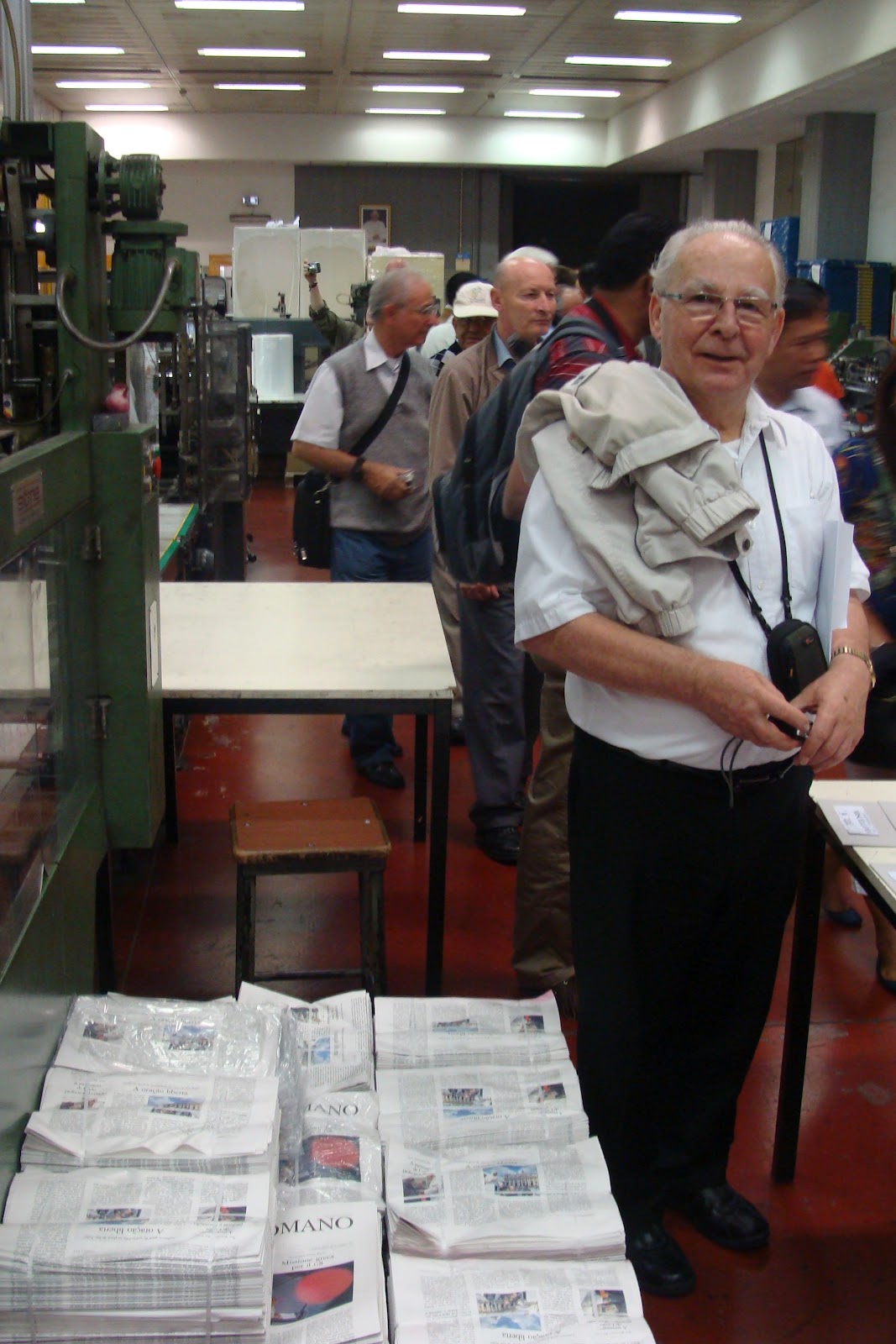
The rhythm of work eased up on Saturday morning for a guided visit to L’Osservatore Romano (OR), the Vatican Press, and the Vatican gardens. Fr. Sergio Pellini, superior of the SDB community in the Vatican and director general of the Vatican Press – which publishes OR as well as all the official books of the Vatican – met the visiting editors. Dr. Carlo DiCicco, the deputy editor of the Holy See’s daily newspaper, gave them a talk on its history, organizational structure, and updating process.

Fr. Romeo Trottier next to
stacks of OR fresh off the
press
The Salesian editors' visit to the Vatican Press was noted by a short article in the May 20 edition of OR (p. 7), with a group photo.

Meeting again in the afternoon, the editors drew some practical conclusions. The next few years will see the SBs committed to several common leading editorial fronts, such as the 27th General Chapter (2014), preparing for the bicentennial of Don Bosco’s birth, Project Europe, and the pilgrimage of our Founder’s relic in Europe.

Regarding digital communication, in the light of some experiences already in action, a further step toward digital communication was recommended, looking to a “Salesian Webulletin,” paying attention to its identity, positioning, relation to the printed edition, and target readership, moving decisively toward the semantic Web in synergy with institutional Web sites.

In their last session the editors do some summing up
The editors of the SB were keen to share the riches of the various editions across the world, looking for increased dialog between them, setting up a net of communication, and, finally, to promote a more intense animation of the Salesians toward greater awareness and spread of the SB.

Sunday, May 13, 2012

Homily for 6th Sunday of Easter

Homily for the
6th Sunday of Easter
May 13, 2012
Acts 10: 25-26, 34-35, 44-48
Ursulines, Willow Dr., New Rochelle

“Peter ordered them to be baptized in the name of Jesus Christ” (Acts 10: 48).
Sacrament of Baptism.
Stained glass in St. Mary's Church, Fredericksburg, Va.
No doubt you’re familiar with the story of the conversion of the Roman Cornelius and his household, an event whose significance in Luke’s narrative and in the history of the Church it’s impossible to exaggerate.

You’re also familiar with the details leading up to it: Peter’s vision of the clean and unclean members of the animal kingdom and God’s command that he should accept all of them (10:9-16), and Cornelius’s vision that he should send to Joppa for Peter (10:1-8).

You’re also familiar with later details in Acts: of Paul and Barnabas’s preaching to the Gentiles and the so-called council of Jerusalem that agreed to admit Gentiles to full communion in the body of Christ’s believers (Acts 15), much of which made up our 1st readings last Wednesday, Thursday, and Friday.

How are people saved? By observing the Law of Moses and being good Jews? If so, how does the passion, death, and resurrection of Jesus effect our redemption? Can God claim the whole world for himself in Christ? Does he wish to?

Such were the issues that Peter, the Church in Jerusalem, and the wider community of the followers of Jesus struggled with in these 1st two decades after the Ascension of Jesus, after the gift of the Holy Spirit to the assembled Church.

The way in which the Church resolved this issue has ever since been our guide in dealing with difficult questions, with new challenges to our theology and pastoral practice. The Church took 2 approaches in answering the question of the relationship between the Gentiles and the Lord Jesus Christ, of the place of the Mosaic Law in Christian identity. The 1st approach is the one in today’s reading, and the 2d the one in Acts 15, the council at Jerusalem—the meeting between Paul and Barnabas, coming up from Antioch, and “the apostles and elders” (15:2,6).

St. Peter holding keys.
Fresco in Church of Quo Vadis, Rome
The 1st approach relies on the charism of Petrine leadership. Peter’s aided here by a direct revelation, but his decision’s consistent with the mandate given him by Jesus in the gospels—explicitly in Matthew (16:17-19) and John (21:15-17), and implicitly in Luke (22:31-32). God has evidently called upon Peter to act in a radically new way for the salvation of souls, and the Church listens to Peter in this matter of binding and loosing, of using the keys to the kingdom of heaven.

The 2d approach is the Church in grand assembly, together voicing different opinions and seeking guidance from the Lord. When they reach a decision, they voice it in the name of the Church and the Holy Spirit (Acts 15:28), that Spirit given to the Church by Jesus to guide her to all truth (John 16:13), that Spirit thru whom Jesus remains with his Church until the close of the present age (Matt 28:20).

You know your church history, sisters, and so you know that Jesus’ Church has used both of these approaches thruout her history: the magisterium or charism of teaching exercised by Peter’s successors, and the magisterium exercised by ecumenical councils. Sometimes councils have been prodded or guided by Peter’s successor, e.g. St. Leo the Great’s teaching on the one Person and two natures of Christ at Chalcedon and the leadership of Blessed John XXIII and Paul VI at Vatican II. Sometimes Peter’s successor has refused to sanction what a council of bishops has done, leaving some decree and even entire councils as theological footnotes, e.g. “robber council” of Ephesus in 449 and the decrees on conciliarism of the councils of Constance and Basel in the 15th century. Other councils have had little papal involvement but been accepted as authoritative by the Pope and the Church, e.g. Nicaea I, which wrote most of our profession of faith, and Trent, which defined the differences between Catholicism and Protestantism and left to the Popes the tasks of reforming the liturgy and composing a catechism.

These 2 approaches to challenging doctrinal and pastoral matters remain the ways in which the Spirit of Jesus leads the Church. No individual bishop, priest, sister, or lay person has the charism of leadership that Jesus gave to Peter and his successors, no matter how charismatic the individual, no matter how convinced the individual is of his or her own righteousness, no matter that some following gather around him or her, e.g. Fr. George Stallings in Washington, Fr. Jim Callan in Rochester, Fr. Roy Bourgeois, Abp. Marcel Lefebvre—you see them at both ends of the theological spectrum. You all remember the ad slogan, “When E.F. Hutton talks, people listen.” Such individuals do a lot of talking and gain some listeners. But you may also remember that E.F. Hutton’s not around any more.

If the individual’s right, that will be borne out in due time under the Spirit’s guidance, e.g. Fr. John Courtney Murray, Fr. Henri du Lubac (later cardinal), to some extent Fr. Pierre Teilhard de Chardin. These remind me of Gamaliel’s advice about the apostles to the Sanhedrin in Acts 5 (vv. 34-39), to the effect that God will sustain what he has himself inspired.

The Holy Spirit poured out upon the Church.
National Shrine of the Immaculate Conception, Washington
These 2 inspired approaches, Petrine and conciliar, have bearing on how we live as religious, too. The Church in solemn assembly at Vatican II called upon us to be radicals: literally, to return to our roots, to look to the Gospel and the charism of our founders, and to reform our Rules, our practices, and our apostolic activity in the light of what the Gospel and the founders show us.

In the subsequent decades, the Church—thru Peter’s successor or thru his deputies—continues to offer us guidance, sometimes controversially so. The recent visitation of active women religious in the U.S. and the still more recent action regarding the LCWR might seem as shocking to you as what Peter did in Cornelius’s house shocked some leaders of the Church in Jerusalem, to whom Peter had to explain himself (see Acts 11:1-18). Even those traveling with Peter—to whom he must already have reported his vision in Joppa—“were astounded that the gift of the Holy Spirit should have been poured out on the Gentiles also” (10:45). That wasn’t supposed to happen!

So we need to ask, where’s the Holy Spirit in what’s going on now between religious families and the Holy See? Is the Spirit trying to tell us something about religious life in our country, its direction, its condition, as the Spirit spoke to Peter and demonstrated his presence in Cornelius’s house?

Our psalm today proclaims, “The Lord has made his salvation known: in the sight of the nations he has revealed his justice” (98:2). It was so in the 1st century, and it remains so in the 21st for those who listen to the Spirit.